
Probing the Interacting Dark Sector: How SKA and Euclid Will Redefine Our Universe
Probing Interacting Dark Sectors with upcoming Post-Reionization and Galaxy Surveys
This paper presents a comprehensive forecast of the constraining power of future post-reionization and galaxy surveys (SKA-mid and Euclid) on Interacting Dark Matter-Dark Energy (iDMDE) models. By analyzing 21-cm intensity mapping, galaxy clustering, and cosmic shear, the authors demonstrate that upcoming observations can significantly tighten constraints on the dark sector interaction strength () and the dynamical dark energy equation of state ().
Executive Summary
TL;DR: This study benchmarks the potential of the Square Kilometre Array (SKA) and the Euclid mission to detect signatures of interactions between Dark Matter (DM) and Dark Energy (DE). By simulating future 21-cm signals and galaxy distributions, the research finds that we are on the verge of a 10-to-70-fold increase in precision, potentially resolving long-standing cosmological tensions.
Positioning: This work is a critical forward-looking forecast that maps out the "discovery space" for the next decade of observational cosmology, specifically targeting extensions of the CDM model.
Problem & Motivation: The Breaking Point of CDM
The "Vanilla" CDM model is struggling. We currently face a ~7 "Hubble Tension" between early-universe CMB data and late-universe local measurements. Furthermore, the tension suggests that the universe is less "clumpy" than the standard model predicts.
The authors argue that these aren't just measurement errors but signs of a coupled dark sector. If DM and DE interact, they change the expansion history and the growth of structures. However, current data is too "blunt" an instrument to isolate these subtle effects.
Methodology: Mapping the Dark Interplay
The core of this work lies in the iDMDE framework. Unlike standard models where DM and DE evolve independently, here they exchange energy:
abla_\mu T^\mu_{ u(dm)} = Q_ u, \quad abla_\mu T^\mu_{ u(de)} = -Q_ u $$ The authors focus on a coupling $Q$ proportional to the dark energy density $\rho_{de}$, which is particularly effective at late times when DE dominates. ### The Probes 1. **21-cm Intensity Mapping (SKA)**: Uses the neutral hydrogen signal as a tracer of the underlying matter density. 2. **Galaxy Clustering**: Traces how galaxies group together across cosmic time. 3. **Cosmic Shear (Weak Lensing)**: Measures the distortion of background galaxy shapes by the gravitational pull of dark matter. 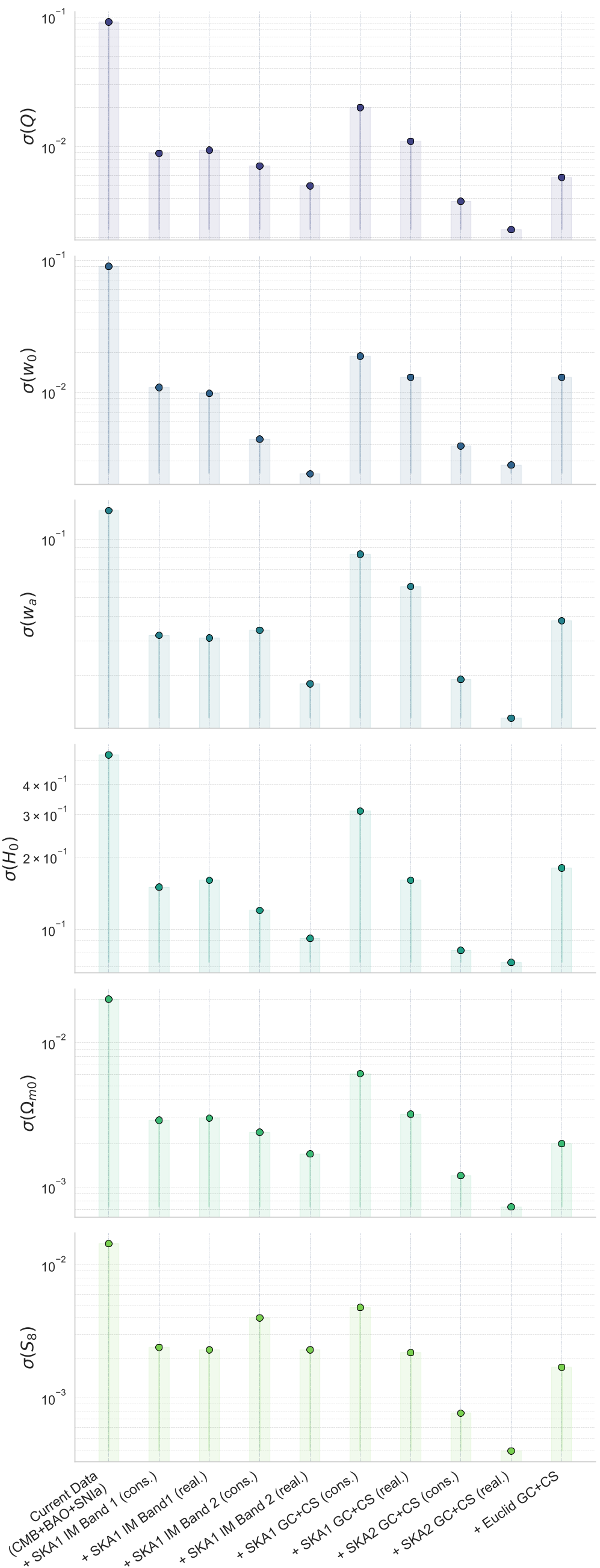 *Figure 1: Comparison of error bars for interaction strength (Q) and DE parameters across different probe combinations.* ## Experiments & Results: A Precision Revolution The results are striking. The combination of current data with **SKA2 Galaxy Clustering and Cosmic Shear** (the "realistic" scenario) yields a massive reduction in uncertainty. - **Interaction Strength ($Q$)**: Constraints improve from current broad bounds to high-precision measurements (Improvement Factor ~40). - **Matter Clustering ($S_8$)**: The projected precision reaches the sub-percent level, which will definitively confirm whether the $S_8$ tension is a physical reality. - **Redshift Sensitivity**: Interestingly, SKA Band 2 (lower redshift) often outperforms Band 1 because the DM-DE interaction is a late-time phenomenon—it grows as dark energy takes over the universe. 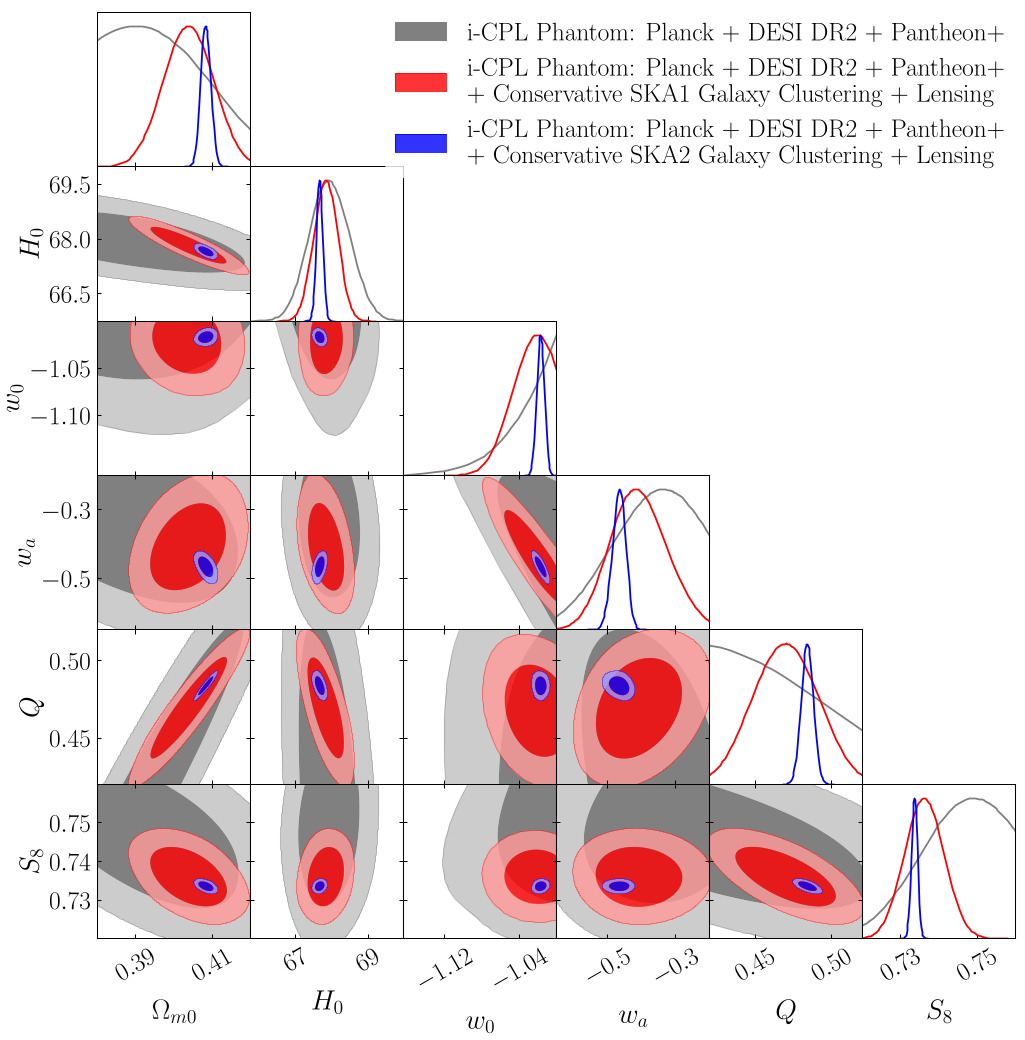 *Figure 2: 2D Posterior distributions showing how SKA and Euclid (colored regions) shrink the allowed parameter space compared to current CMB+BAO data (grey).* ## Critical Analysis & Conclusion ### Takeaway The synergy between radio (SKA) and optical (Euclid) surveys is the key. While Euclid provides a massive volume of galaxy data, SKA's ability to use 21-cm mapping provides a unique "cross-check" that is less sensitive to certain optical biases. ### Limitations The "realistic" gains rely heavily on our ability to model **non-linear scales** ($k > 0.15 \, h \, ext{Mpc}^{-1}$). As the authors note, at these scales, baryonic feedback and complex galaxy bias become "nuisance parameters" that could degrade the signal if not handled with sophisticated simulations. ### Future Outlook If the fiducial values used in this paper (derived from current best fits) are correct, **SKA and Euclid will likely detect a non-zero interaction in the dark sector within the next decade.** This would represent the first evidence of physics beyond gravity in the dark sector, fundamentally changing our understanding of the fate of the universe.