
[Research Insight] ProcureGym: Mapping the Strategic Frontier of National Drug Procurement via Multi-Agent AI
ProcureGym: A Multi-Agent Markov Game Framework for Modeling National Volume-based Drug Procurement
ProcureGym is a data-driven multi-agent Markov Game framework designed to simulate China’s National Volume-Based drug Procurement (NVBP). Leveraging real-world data from 7 rounds of procurement covering 325 drugs and 2,267 firms, it evaluates Reinforcement Learning (RL), Large Language Model (LLM), and Rule-based agents, with RL agents (MAPPO/IPPO) achieving a SOTA winner prediction accuracy of 74.81%.
TL;DR
Researchers from Fudan and Tongji University have unveiled ProcureGym, the first comprehensive data-driven simulation platform for China’s National Volume-Based drug Procurement (NVBP). By treating the multi-billion dollar bidding process as a Markov Game, the study proves that AI agents—specifically Reinforcement Learning (RL) models—can predict winning outcomes with nearly 75% accuracy. This work bridges the gap between theoretical game theory and real-world policy impact, offering a high-fidelity "sandbox" for economic strategy.
The "Billion-Dollar" Bidding Problem
Since 2018, China’s NVBP has saved over 500 billion CNY. However, for pharmaceutical firms, it is a high-stakes game of "prisoner's dilemma" under incomplete information. Firms must cut prices to win a guaranteed government-procured volume (the "volume"), but cutting too deep erodes profit margins.
Existing models typically fall into two traps:
- Analytical Models: Too simplified to handle thousands of diverse firms.
- Traditional ABMs: Rely on static rules that can't "learn" or adapt to new policies.
ProcureGym addresses this by building a simulator grounded in real-world data from 325 drugs and 2,267 firms, allowing AI agents to navigate the non-linear dynamics of competitive bidding.
Methodology: High-Fidelity Markov Games
The core of ProcureGym is the formalization of bidding as a Markov Game. The state space includes 10 critical dimensions, such as the maximum valid bidding price (), procurement ratio (), and internal production costs ().
The Agent Spectrum
The platform supports a unified interface for three distinct "agent brains":
- RL-based (MAPPO/IPPO): These agents treat profit as a reward signal, iteratively refining their bids to find the sweet spot between winning and margin.
- LLM-based (Qwen/GPT): Utilizing a Perception-Memory-Decision-Reflection loop, these agents use natural language to "think" through the competition.
- Rule-based: Heuristic strategies representing "old-school" business logic.
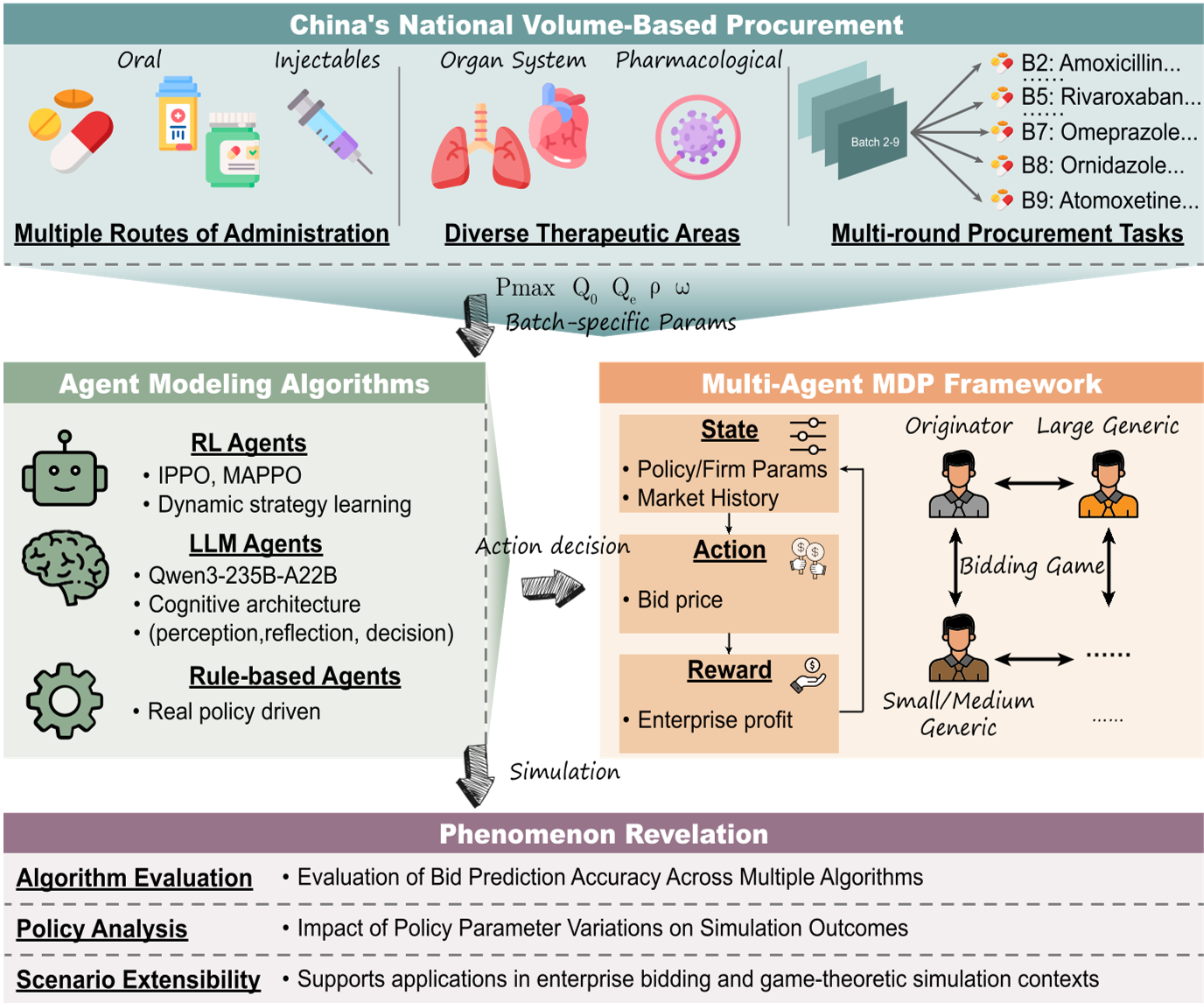 Figure 1: Overview of the ProcureGym Framework, showcasing the data integration and multi-agent interaction layers.
Experiments: RL vs. LLM vs. Reality
The results provide a fascinating look at machine "rationality."
- Prediction Accuracy: MAPPO achieved the highest explanatory power () and specialized in Winner Alignment (75% accuracy), significantly outperforming human-crafted rules (64%).
- Profit Optimization: RL agents didn't just copy history; they improved upon it, learning strategies that secured higher profits than historical benchmarks.
- LLM "Homo Silicus": While slightly less accurate in pricing than RL, LLMs provided interpretability. High-cost firms were observed to protect margins, while low-cost firms aggressively chased market share—logic confirmed by LLM reasoning logs.
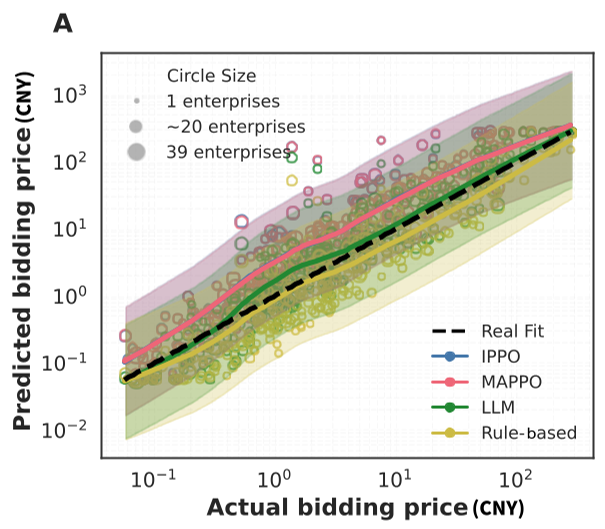 Figure 2: Evaluation of NVBP Simulation. Note the strong spearman correlation () between predicted and actual prices.
Counterfactual Analysis: Stress-Testing the Policy
One of ProcureGym's most powerful features is its ability to perform sensitivity analysis.
- Price link strategy: Increasing the maximum bidding price () naturally leads to higher bids but also higher profits across the board.
- Demand Dominance: The simulations identified market demand () as the single most influential driver of firm profitability, even more so than cost reductions or procurement ratios.
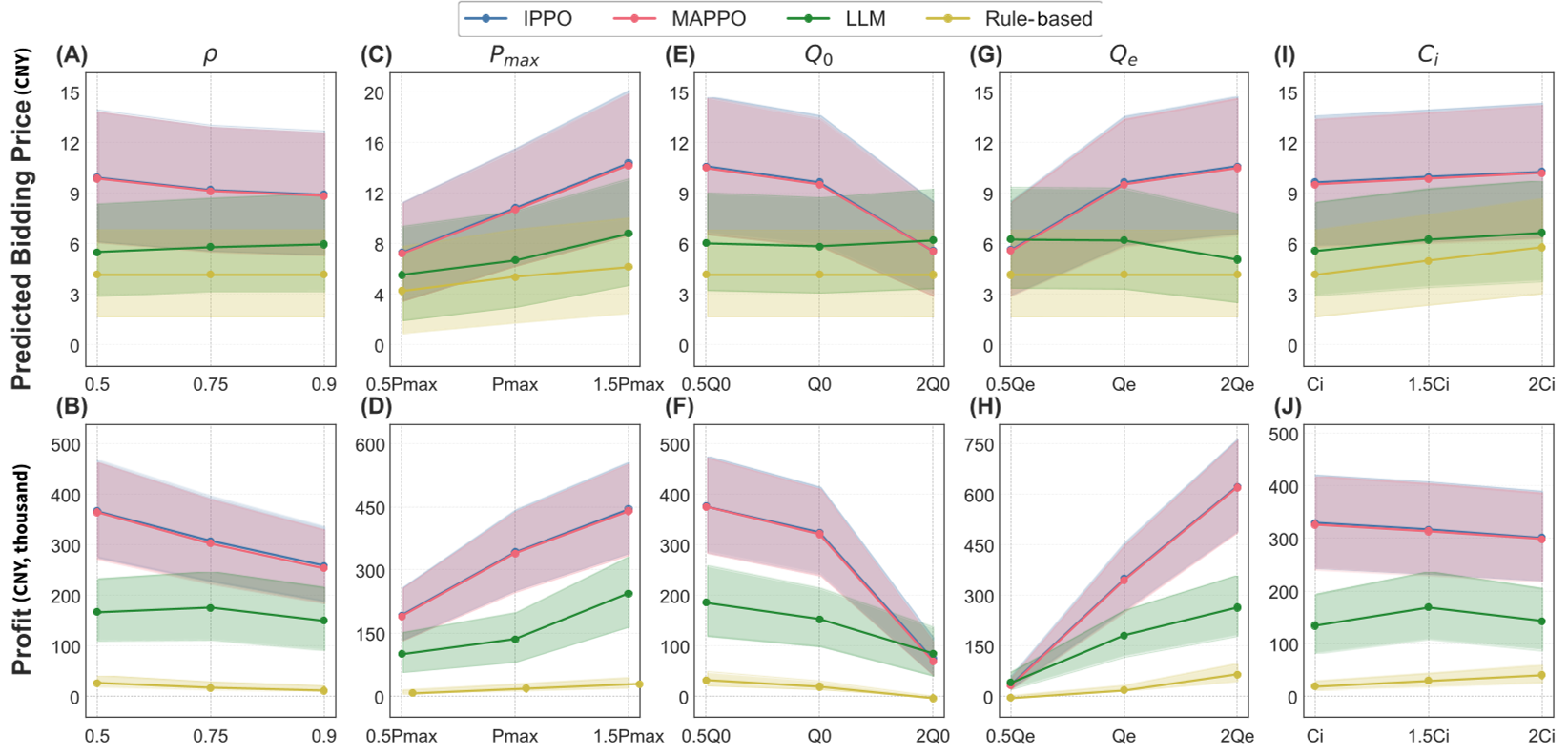 Figure 3: Sensitivity Analysis of Policy and Market parameters. RL methods (blue/orange) show the most stability across varying procurement volumes.
Conclusion and Future Horizons
ProcureGym represents a significant step forward in Computational Economics. It demonstrates that AI can do more than generate text or images; it can model the pulse of a national economy.
Takeaways for the Industry:
- For Firms: RL-based strategy optimization can provide a competitive edge in "volume-for-price" environments.
- For Regulators: The platform allows for the "pre-testing" of bidding rules, revealing potential unintended consequences before they affect millions of patients.
Limitations: Currently, the model focuses on firm behavior. Future iterations incorporating the decision-making logic of hospitals and government oversight would create a truly holistic "Digital Twin" of the healthcare ecosystem.