
ProMMSearchAgent: Mastering the Art of Knowing When to Search
ProMMSearchAgent: A Generalizable Multimodal Search Agent Trained with Process-Oriented Rewards
ProMMSearchAgent is a multimodal search agent framework that utilizes a "Sim-to-Real" training paradigm to enhance knowledge-intensive visual reasoning. By training a Qwen2.5-VL-7B model in a local static sandbox with process-oriented rewards, the agent achieves new SOTA performance on benchmarks like FVQA-test (+5.1%) and MMSearch (+11.3%), generalizing zero-shot to live web search.
TL;DR
ProMMSearchAgent introduces a breakthroughs in multimodal search by solving the "reward-action mismatch." By leveraging a stable local sandbox and process-oriented rewards, the agent learns to identify its own knowledge boundaries. It achieves SOTA results on benchmarks like InfoSeek and MMSearch, proving that a model trained in a static environment can seamlessly handle the messy, live web in a zero-shot fashion.
The "Tool-Shy" Paradox: Why Current Agents Fail
Building a multimodal agent that searches the web sounds simple, but training it with Reinforcement Learning (RL) is a nightmare. Most current systems use Outcome-Based Rewards: if the answer is right, the agent is rewarded. To prevent the model from becoming "lazy" and searching for everything, developers often add a tool penalty.
However, the authors identify a critical flaw: for complex, knowledge-intensive questions, search is mandatory. Penalizing a tool call in these cases creates a logical contradiction. The agent is forced to choose between a penalty for the "right" action (searching) or a failure for the "wrong" action (guessing). This prevents the agent from learning its true internal knowledge boundaries.
Methodology: The Sim-to-Real Shift
ProMMSearchAgent breaks this bottleneck using two key innovations:
1. The Behavioral Metadata Engine
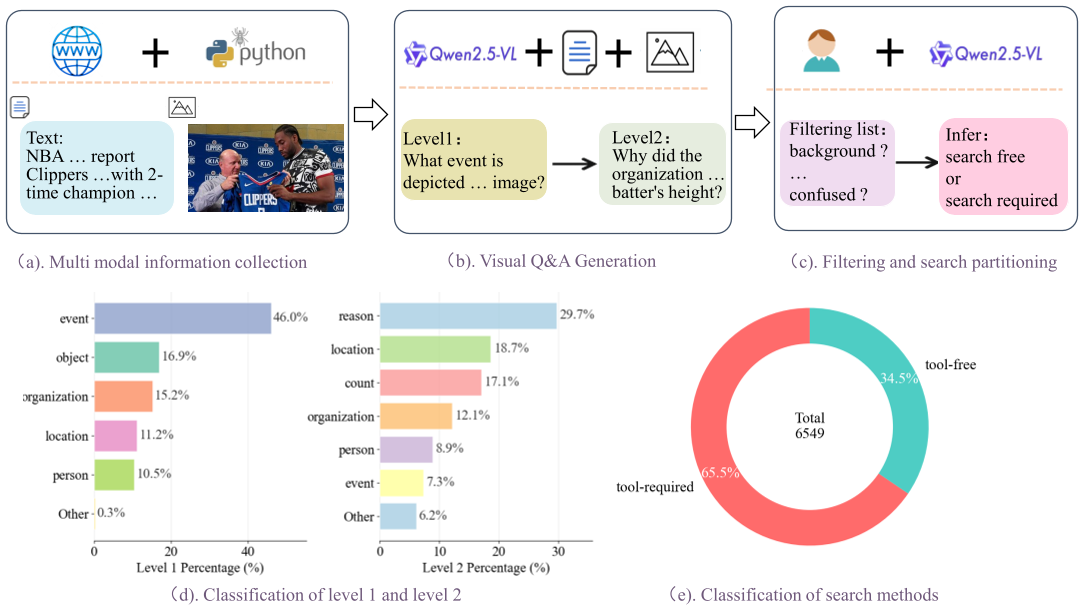
To teach the model when it needs help, the authors use an introspection step. They probe the model with eight tool-free rollouts. If it fails all eight, they label the sample as "search-required." This metadata becomes the ground truth for an Introspective Process-Oriented Reward, ensuring the agent is rewarded for its decision logic, not just the final result.
2. The Decoupled Tool Sandbox
Instead of training against the slow and volatile live web, ProMMSearchAgent trains in a Tool Sandbox. This uses a 2025 Wikipedia dump and a pre-computed image cache. This "Sim-to-Real" approach provides a deterministic environment for the RL algorithm (GRPO) to converge quickly and cheaply.
Performance and Efficiency
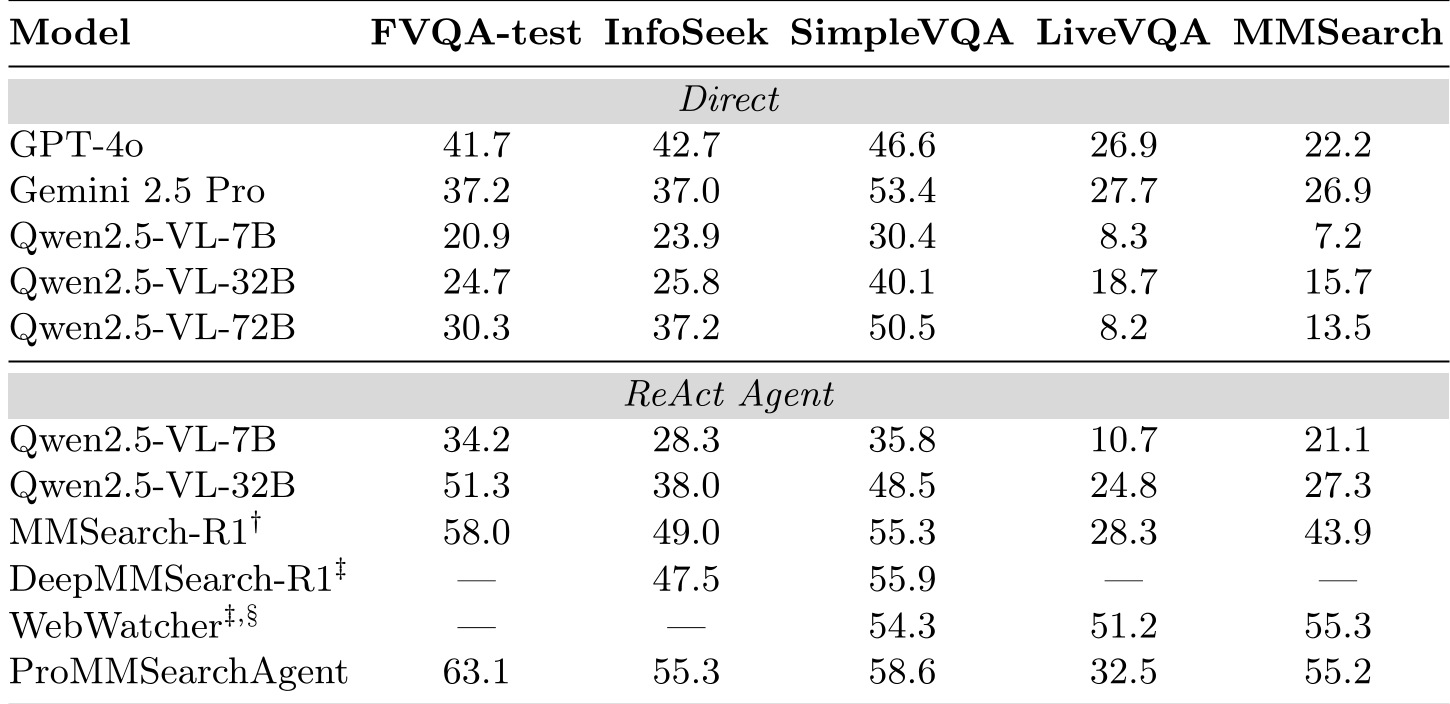
The results are striking. ProMMSearchAgent doesn't just beat previous agents; it achieves this with far lower training costs.
- Accuracy Boost: Surpasses MMSearch-R1 by 11.3% on the MMSearch benchmark.
- Speed & Cost: Local training is 13.1x faster (457s vs. 6017s per epoch) and costs virtually zero API fees.
- Zero-Shot Transfer: The logic learned in the local Wiki sandbox generalizes perfectly to the live Google Search API during testing.
Adaptive Intelligence in Action
A fascinating finding in the ablation studies is the Adaptive Behavior. Unlike models with simple penalties, ProMMSearchAgent strategically reduced its tool use on simple benchmarks (SimpleVQA) while increasing it on difficult ones (LiveVQA).
| Configuration | FVQA-test Acc | Tool Ratio (TR) |
|---|---|---|
| Base Qwen2.5-VL-7B | 34.2 | 84.4% |
| ProMMSearchAgent | 62.4 | 88.1% |
| Penalty-based Reward | 56.9 | 83.4% |
This suggests the model isn't just "hacking" a reward—it is actually developing a meta-cognitive sense of what it knows and what it doesn't.
Conclusion: A New Blueprint for RL Agents
ProMMSearchAgent proves that training against the live web is often unnecessary and even counterproductive. By focusing on process-oriented rewards and stable simulated environments, we can create agents that are both more accurate and more cognitively calibrated. This "Sim-to-Real" paradigm is likely the future for developing affordable, high-performance agents for specific industrial or research domains.
Limitations
While powerful, the system relies on the quality of the initial "self-probing" phase. If a model is overconfident or hallucinating during the rollout phase, the metadata might be noisy. Future work could integrate more robust uncertainty estimation techniques.