
[Theoretical Combinatorics] Unifying the Orbits of Rational Dyck Paths: Promotion meets Rowmotion
Promotion and rowmotion in rational Catalan combinatorics
This paper explores the unified combinatorial structure of four fundamental bijections—promotion, evacuation, rowmotion, and rowvacuation—within the framework of rational Catalan combinatorics. By generalizing Dyck paths and non-crossing partitions to the (a, b)-rational case, the author establishes a formal equivalence between promotion and rowmotion through a generalized RSK-type correspondence and an innovative "matching map."
TL;DR
In a tour de force of algebraic combinatorics, Keiichi Shigechi’s latest paper provides a unified map for the four horsemen of poset bijections—Promotion, Evacuation, Rowmotion, and Rowvacuation—within the realm of rational Catalan combinatorics. By redefining the RSK correspondence through the lens of Dyck tilings, the paper proves that these seemingly distinct operations are actually conjugate versions of each other.
Context: This is a major theoretical consolidation that extends classical results (where ) to the more complex "rational" case where paths move in an grid.
The Problem: The Symmetry Gap in Rational Catalan Combinatorics
In the classical world of Dyck paths ( grids), we have beautiful symmetries. The Lalanne–Kreweras involution and Kreweras complement relate non-crossing partitions to path rotations. However, when we move to Rational Dyck paths—where the path stays above the diagonal of an rectangle—the classical bijections break down.
The "Why" behind this paper is the search for a Universal Commutative Diagram. If you perform a "Rowmotion" (shifting antichains in a poset), is there a way to describe that same movement as a "Promotion" (sliding labels in a linear extension)? Previosly, this was only clear for very specific cases.
Methodology: Tiling the Way to RSK
The core innovation lies in the Matching Map (Mat) and its relationship to the Robinson-Schensted-Knuth (RSK) correspondence.
1. The Matching Map
Shigechi defines an integer sequence based on the "valleys" of a rational Dyck path. This sequence is then transformed into a Perfect Matching—a set of non-crossing chords in a circle. This visualization is crucial because it allows us to see "rotations" of the path as simple geometric shifts.
2. Dyck Tilings as RSK
Traditionally, RSK is seen as an algorithmic insertion into Young Tableaux. Shigechi replaces this with Maximal Cover-Inclusive Dyck Tilings. By filling the space between a path and the top boundary with specific "Dyck tiles," the author generates transpositions that define a 321-avoiding permutation.
 Figure 2.3: Examples of k-Dyck paths and their corresponding Young diagrams.
The Core Result: The Grand Equivalence
The most striking result is the proof of the Commutative Symmetry. For a rational Dyck path , the author demonstrates: where is rowmotion and is promotion.
This tells us that Rowmotion is simply Promotion in a different coordinate system (the system defined by the Matching Map).
For the specific case of k-Dyck paths (where ), the paper provides explicit congruences. One of the most beautiful is: This shows that the "Evacuation" of a path is exactly equal to its "Rowvacuation" shifted by ranks of the poset.
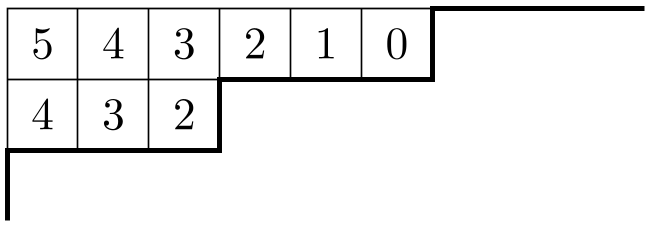 Figure 7.14: The rank of cells for 3-Dyck paths, illustrating the poset structure required for the rowmotion calculation.
Deep Insight: Why Tilings Matter
The switch from "Permutation-based RSK" to "Tiling-based RSK" is more than a change of notation. Tilings depend only on the Young Diagram formed by the path. This allows the theory to work for any coprime , bypassing the need for 321-avoiding permutation logic which is strictly a "square grid" phenomenon.
Conclusions & Future Work
Shigechi has built a bridge between algebraic poset theory and geometric path combinatorics.
- Takeaway: The "Matching Map" is the natural language for rational Catalan objects.
- Limitations: The current framework relies on being coprime. The "non-coprime" case remains a wild frontier where paths can touch the diagonal at multiple rational points.
- Prospects: This tiling approach could potentially solve similar "orbit-counting" problems in other type-A posets and even extend to other Coxeter groups.
Editor's Note: This paper is a must-read for researchers in Algebraic Combinatorics interested in the "Cyclic Sieving Phenomenon" and the internal symmetries of the Catalan family.