
[JCAP 2025] The Axion's Identity Crisis: Why Solving the Cosmological Constant Might Kill the QCD Axion
Can QCD Axions Survive the Cosmological Constant Problem?
The paper investigates the viability of the QCD axion within "yoga" relaxation frameworks designed to solve the cosmological constant problem. It reveals that mechanisms which dynamically suppress vacuum energy also drastically reduce the axion's scalar potential, leading to a significant shift in its mass-coupling relation and a susceptibility to matter-induced displacements.
TL;DR
The "Cosmological Constant Problem" is the ultimate elephant in the room of physics. While "yoga" relaxation models offer a path to dynamically shrinking the vacuum energy, this paper delivers a sobering realization: this relaxation doesn't just target the vacuum—it suppresses the entire scalar potential. For the QCD axion, this means its mass and couplings are pushed into ruled-out territories, and its ability to solve the Strong-CP problem is neutralized by the very matter it resides in.
Problem & Motivation: The Collateral Damage of Relaxation
To make the Dark Energy density as small as what we observe, theories of "Natural Relaxation" (or Yoga models) propose that the universe's background fields (relaxons) adiabatically adjust to cancel out large vacuum energy contributions.
However, the authors point out a critical "Slow vs. Fast" tension. While high-energy collider physics (Fast) is too quick for the relaxon to notice, cosmological evolution (Slow) is perfectly suited for the relaxon to interfere. Since the QCD axion's existence depends on a very specific, tiny potential generated by QCD instantons, it becomes collateral damage in the relaxon's quest for a zero cosmological constant.
Methodology: The Trough and the Trap
The authors embed the axion into the yoga framework, where the scalar potential looks like a "trough." As the dilaton grows to to explain the Planck-to-EW scale hierarchy, the axion's vacuum potential is suppressed by factors of .
The Two Benchmarks:
- Brane Axions: Localized on our 3D world. Their mass is suppressed so heavily ( eV) that they move horizontally on the vs. plot, landing squarely in the "Excluded" zone.
- Bulk Axions: These live in higher dimensions. While they evade some direct detection bounds, they suffer a different fate: the "Matter Trap."
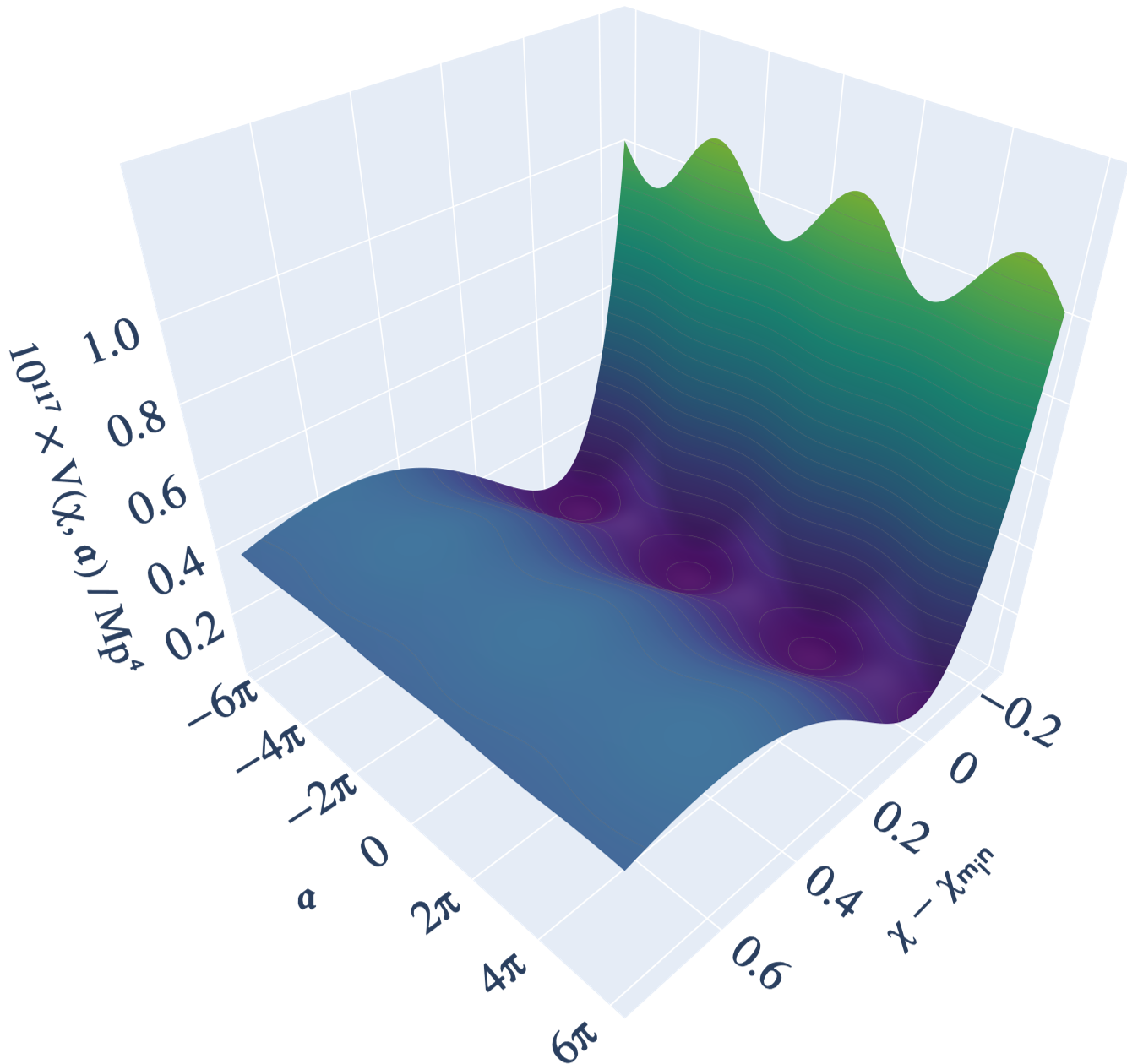 Above: The axion-dilaton potential. While a stable trough exists, the "floor" of the axion direction is so shallow that external influences (like matter) can easily push the field around.
The "Matter-Induced" No-Go
The paper's most lethal argument is the Matter-Induced Potential. Normally, the axion ignores the presence of regular matter because the "vacuum potential" from QCD is much stronger. But in a relaxed universe, the vacuum potential is weakened.
The authors show that for density thresholds as low as one atom per thousand cubic meters, the matter-induced potential (which pushes the axion away from the CP-conserving minimum) becomes stronger than the vacuum potential.
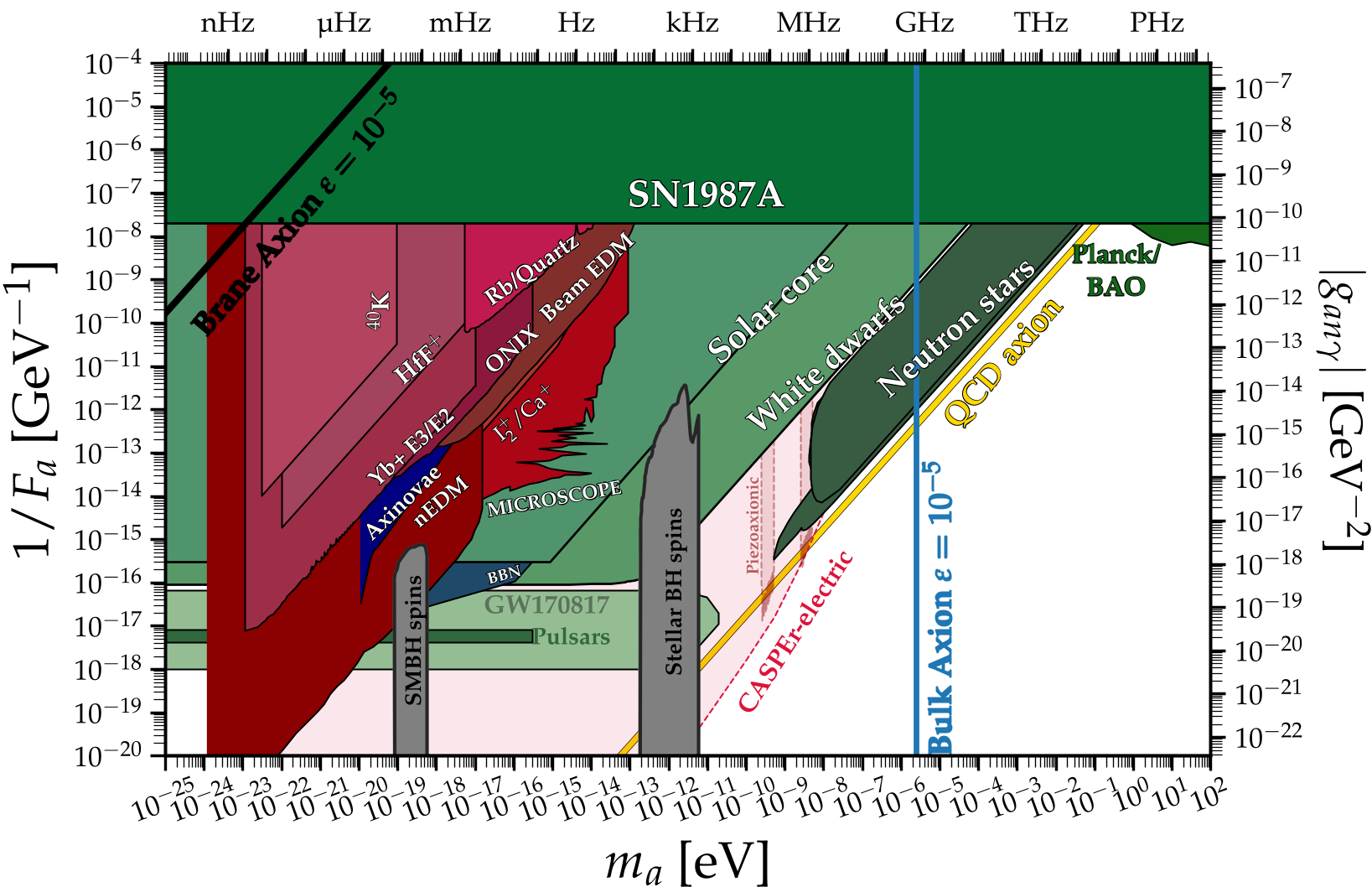 Above: The black (brane) and blue (bulk) lines show how relaxed axions diverge from the yellow "Standard QCD Band." Most of these trajectories are already intersected by grey "forbidden" regions.
Results & Critical Analysis
- Mass-Coupling Shift: The fundamental axion relation is broken. Brane axions become too light; bulk axions become too "coupled" to matter.
- Cosmological Disaster: In the early universe (BBN and Recombination), the axion would have tracked the CP-violating minimum of the matter potential, leading to nuclear properties that contradict our observations.
- The "Survival" Condition: For a QCD axion to survive in a yoga universe, it must be hidden in a sector that only couples via derivatives, or we must find a way to "screen" its mass shifts within matter.
Conclusion: A Tough Trade-off
This research highlights a fundamental trade-off: We can have a naturally small Cosmological Constant, or we can have the standard QCD Axion, but having both requires extreme theoretical gymnastics.
For the broader community, this is a warning: solving the "Big" problem of Dark Energy might inadvertently break the "Small" solutions we've built for CP-symmetry and Dark Matter. The quest for a unified Dark Sector continues, but the standard axion might not be invited to the party.