
Quantum Advantage: A Moving Target in the Shadow of Tensor Networks
Quantum Advantage: a Tensor Network Perspective
This paper reviews recent quantum advantage experiments from IBM, D-Wave, and Google through the lens of Tensor Network (TN) methods. It evaluates how advanced classical simulation techniques, such as Matrix Product States (MPS) and Projected Entangled Pair States (PEPS) combined with Belief Propagation, have successfully challenged and in some cases refuted claims of "quantum supremacy."
TL;DR
The boundary between "classically tractable" and "quantum supreme" is being redrawn by the rapid progress of Tensor Network (TN) algorithms. This paper provides a high-level post-mortem on the major quantum advantage claims by IBM, D-Wave, and Google, demonstrating that what was once considered "centuries of computation" can often be reduced to seconds on a modern laptop through structural insights into entanglement and correlation geometry.
The Problem: The "Illusion" of Intractability
The core challenge in claiming quantum advantage is the classical baseline. Historically, quantum hardware teams (IBM, Google, D-Wave) estimated classical difficulty based on brute-force state-vector simulation or naive TN mappings (like snaking a 2D grid into a 1D Matrix Product State).
The authors argue that these estimates often ignore the "Inductive Bias" of the physical system. If a system is noisy or possesses a "tree-like" correlation structure, advanced TN methods like Belief Propagation (BP) or Projected Entangled Pair States (PEPS) can bypass the exponential wall by focusing on relevant local information rather than the full global wave function.
Methodology: The Tensor Network Counter-Strike
The paper categorizes the classical "weapons" used to bridge the supremacy gap:
- Exploiting Connectivity: Methods like BP-PEPS directly mirror the hardware's 2D heavy-hex or square lattice, avoiding the costly long-range interactions created by 1D mappings.
- Heisenberg-Picture Evolution: For IBM's "Kicked Ising" experiment, simulating the evolution of operators (MPOs/PEPOs) proved more efficient than simulating the state, as unitary cancellations limit the growth of operator entanglement.
- Hyper-Optimized Contraction: For Google’s Random Circuit Sampling (RCS), the "Big-Head" algorithm and dynamic slicing allowed classical GPUs to find "paths" through the computation that avoided the most dense tensor bottlenecks.
 Figure: Various TN architectures (a) MPS, (b) MPO, and (d,e) PEPS/PEPO used to simulate quantum processors.
Battlegrounds: IBM, D-Wave, and Google
1. IBM (Kicked Ising)
IBM initially claimed their 127-qubit "Eagle" processor could simulate complex dynamics beyond classical reach. However, within months, TN researchers used Belief Propagation to produce results on a laptop that were more accurate than the hardware (which suffered from noise). The reason? The heavy-hex lattice is "locally tree-like," a regime where BP thrives.
2. D-Wave (Quantum Annealing)
D-Wave's 5000+ qubit advantage in simulating 3D spin glasses was challenged by 2D and 3D TNs. By using message-passing BP, researchers extracted critical exponents (Kibble-Zurek) with linear scaling, matching QPU accuracy at a fraction of the predicted energy cost.
3. Google (RCS & Quantum Echoes)
While Google's 2019 Sycamore claim stood for years, a 2024 GPU implementation (1432 GPUs) performed the sampling 7x faster than the quantum chip. Google's response—the Willow processor and "Quantum Echoes"—seeks to move the goalposts toward Out-of-Time-Order Correlators (OTOCs), which measure the scrambling of info—a task specifically designed to frustrate current TN approximation schemes.
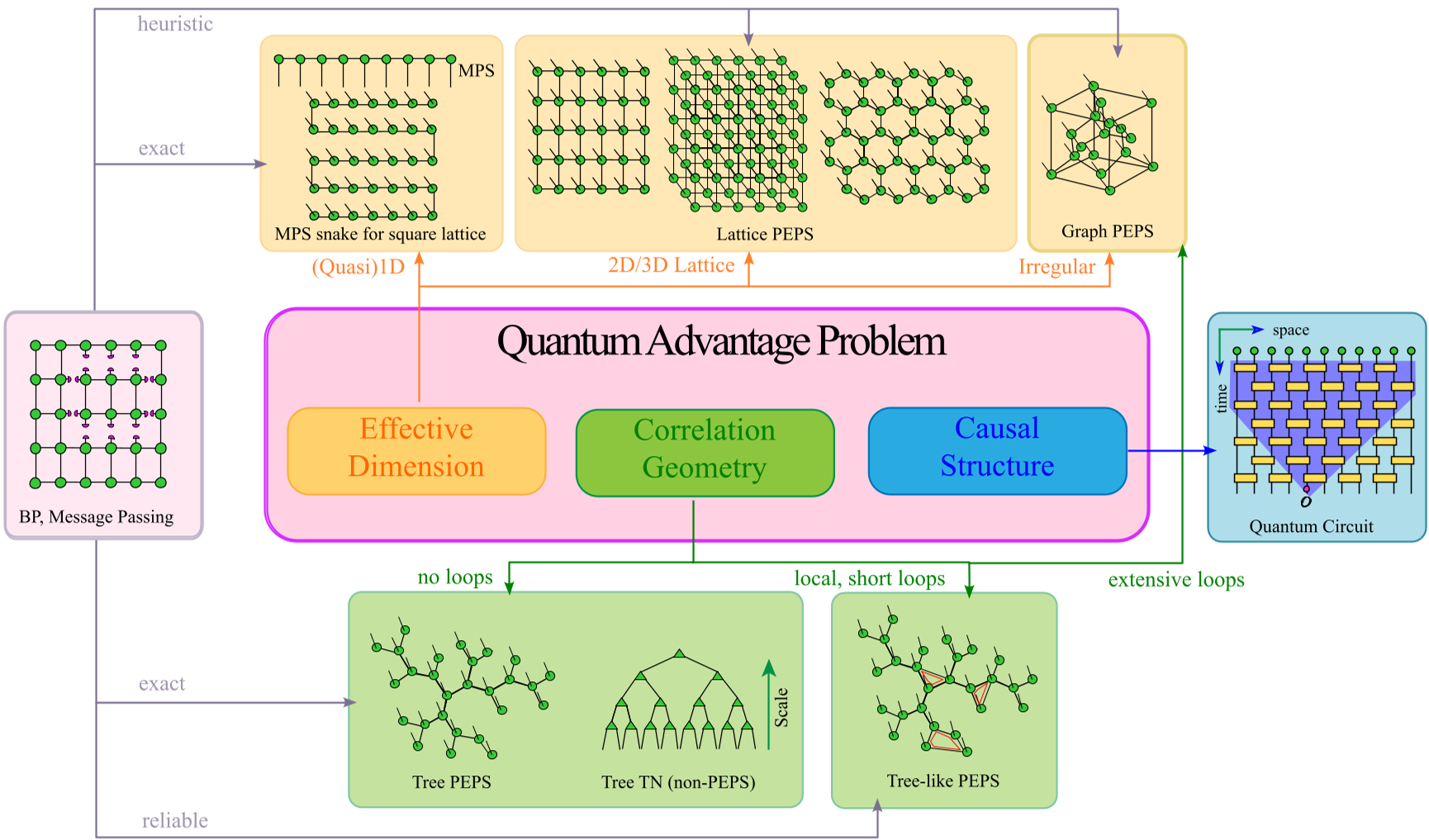 Figure: A decision tree for selecting classical simulation methods based on system dimensionality and entanglement.
Deep Insight: Where is the Real Frontier?
The authors conclude that for a quantum computer to "win," it must operate in regimes where the entanglement is both high and "loopy."
- The TN Weakness: Geometric frustration (Triangular lattices) and high-connectivity graphs (complete graphs) break the product-environment assumptions of BP and PEPS.
- The Quantum Path: Future experiments should move away from pure sampling and toward "Scientific Utility"—simulating frustrated magnetism or fermionic systems near criticality.
Conclusion
This paper serves as a reminder that "Exponential Complexity" is a theoretical limit, but "Practical Tractability" is an engineering problem. The competition between TNs and Quantum Computers is a "Red Queen's Race"—one must run as fast as possible just to stay in the same place. As Google’s Willow and IBM’s Condor scale up, the next battle will be won not just by qubit counts, but by identifying the specific mathematical "traps" that even the most hyper-optimized tensor networks cannot escape.