
Quantum Gravitational Contrast: Bridging the Gap Between Schrödinger’s Cat and Spacetime Geometry
Quantum gravitational contrast in creating Schrödinger cat state
The paper investigates a Schrödinger cat state in a matter-wave interferometer as a perturbative quantum-gravity system, utilizing Effective Field Theory to quantize massless spin-2 gravitons. The authors demonstrate that matter-graviton coupling transforms the graviton vacuum into a coherent state, achieving a "quantum bridge" between superposed geometries.
TL;DR
This paper presents a rigorous theoretical framework to treat both matter and gravity on an equal quantum footing. By modeling a matter-wave interferometer, the authors show that a massive object in spatial superposition creates a "superposition of geometries." This interaction displaces the graviton vacuum into a coherent state, where the degree of overlap (contrast) between these states determines the level of entanglement between matter and the quantum gravitational field.
Background: Gravity Meet the Cat
In the quest for Quantum Gravity, we often look toward the stars or high-energy colliders. However, this paper looks at the "mesoscopic" scale—masses that are large enough to exert gravity but small enough to remain in a quantum Schrödinger cat state. The central question is: If matter is in a quantum superposition, what happens to the gravitational field it creates?
The Problem: Classical Backgrounds vs. Quantum Reality
Most prior work treats gravity as a classical bridge or a fixed background metric. This creates a conceptual wall between the quantum behavior of the mass (described by wavefunctions) and the relativistic behavior of gravity (described by geometry). The authors argue that at a perturbative level, we must quantize the massless spin-2 graviton and account for its coupling with the energy-momentum tensor of quantum matter to truly understand gravitational decoherence and entanglement.
Methodology: The Displaced Graviton Vacuum
The authors use an Effective Field Theory (EFT) approach to General Relativity. In this view, gravity is a field quantized around a flat Minkowski background.
1. The Interaction Mechanism
When a mass exists, it couples to the gravitational field via the interaction Hamiltonian . Because the mass is quantum (a Gaussian wavepacket), the graviton field doesn't just "sit" there; it undergoes a transformation.
2. Coherent States of Geometry
The authors find that the vacuum state of the graviton becomes a displaced vacuum—mathematically identical to the coherent states found in quantum optics.
Note: The system describes the joint state as , where and are the different "versions" of spacetime geometry produced by the two arms of the interferometer.
Key Results: Defining the "Quantum Bridge"
The most striking contribution is the calculation of the Contrast (C), or the overlap between the two gravitational states:
- The Mass Effect: As the mass increases, . This means the gravitational states become orthogonal, leading to maximal entanglement between the mass and its own gravitational field.
- Geometric Resolution: The overlap depends on the ratio of the superposition distance to the width of the mass distribution .
Quantitative Evidence
The authors show that for a standard mesoscopic object ( kg), the individual arms of the superposition behave locally like a Schwarzschild geometry.
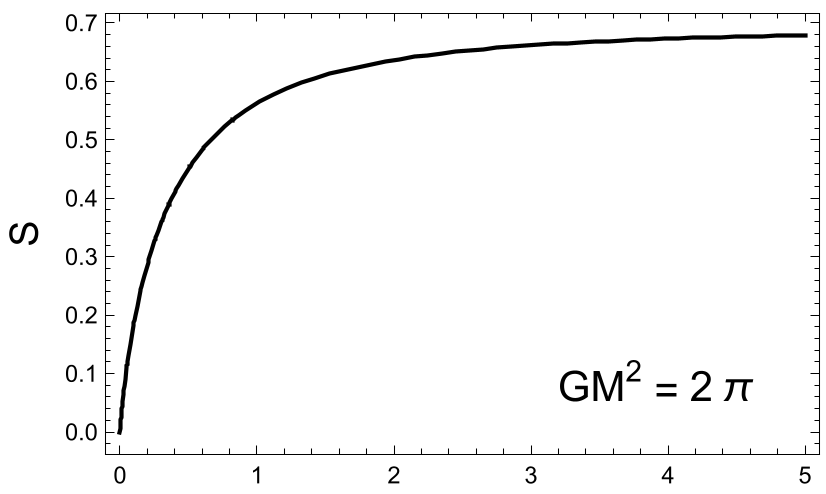 Figure 1: Entanglement entropy as a function of superposition size and mass . Notice how the entropy reaches its maximum () as the mass increases.
Deep Insight: Beyond Static Systems
In the appendix, the authors move from static mass to a Quantum Harmonic Oscillator. This is a dynamic system that emits gravitational waves. They calculate that after every oscillation, the "contrast" of the gravitational waves determines the decoherence rate of the oscillator. This provides a direct link between gravitational radiation and the loss of quantum coherence.
Critical Analysis & Conclusion
Takeaway
This paper provides the mathematical "scaffold" for the QGEM (Quantum Gravity-induced Entanglement of Masses) experiments. It demonstrates that gravity isn't just a force; it is a quantum entity that can carry information and entangle with matter.
Limitations
- Perturbative Limit: The study is restricted to "tree-level" physics. It does not account for non-perturbative effects or higher-order vertex corrections, which would be necessary near the Planck scale.
- Decoherence: While they touch on gravitational waves, the paper treats the matter-graviton system as a closed system, ignoring external environmental noise.
Future Outlook
This work hints that the "quantumness" of gravity can be tested in a laboratory. By measuring the contrast/overlap of matter-wave signals, we aren't just looking at atoms—we are effectively measuring the overlap of two different shapes of the universe.