
A Quantum Singularity Theorem: Why Evaporating Black Holes Must Still Be Singular
A Quantum Singularity Theorem for the Evaporating Black Hole
This paper presents the "Causally Robust Quantum Singularity Theorem," proving that evaporating black holes are null geodesically incomplete (singular) within semiclassical gravity. By relaxing the traditional requirement for global hyperbolicity and replacing the Null Curvature Condition (NCC) with the Generalized Second Law (GSL), the authors bridge the gap between quantum thermodynamics and gravitational collapse.
TL;DR
For decades, a gap has existed in our understanding of black holes: while we know they evaporate via Hawking radiation, the classic theorems proving they contain "singularities" (points where physics breaks down) didn't actually apply to evaporating ones. In this groundbreaking paper, Netta Engelhardt and Ivri Nagar from MIT prove a new Quantum Singularity Theorem. They demonstrate that even when we account for quantum radiation and complex causality, the "death" of a black hole still results in a mathematical singularity—specifically, null geodesic incompleteness.
Background: The Conflict Between Quantum Effects and Classic Relativity
In 1965, Roger Penrose proved that if enough matter collapses, a singularity is inevitable. However, his proof relied on two strict assumptions:
- Global Hyperbolicity: The universe is "predictable" from a single time slice.
- Null Curvature Condition (NCC): Gravity is always attractive (energy is non-negative).
Evaporating black holes break both. Quantum effects (Hawking radiation) create negative energy density, violating the NCC. Furthermore, as a black hole disappears, the "predictability" (global hyperbolicity) of the spacetime likely breaks down. This left physicists in a precarious position: we suspected black holes were singular, but our best theorems couldn't prove it for the real, quantum world.
The "Quantum" Insight: Replacing Energy with Entropy
The authors' core insight is to replace the local energy conditions (which quantum mechanics violates) with a semi-local thermodynamic condition: the Generalized Second Law (GSL).
Instead of saying "energy can't be negative," they say "the total entropy (Area + Quantum Entropy) of the universe cannot decrease." By using the GSL and a new definition of a robustly quantum trapped surface, they show that even if the light-rays are "pushed outward" by negative energy, the sheer gradient of entropy eventually forces a crossover that terminates the spacetime.
Key Methodology: Hybridizing Causality and Thermodynamics
The proof bridges two disparate fields:
- Lorentzian Geometry: Utilizing "past reflectivity" (a weaker version of causality than global hyperbolicity).
- Quantum Information: Using the strong subadditivity of entropy to bound the behavior of quantum fields near the horizon.
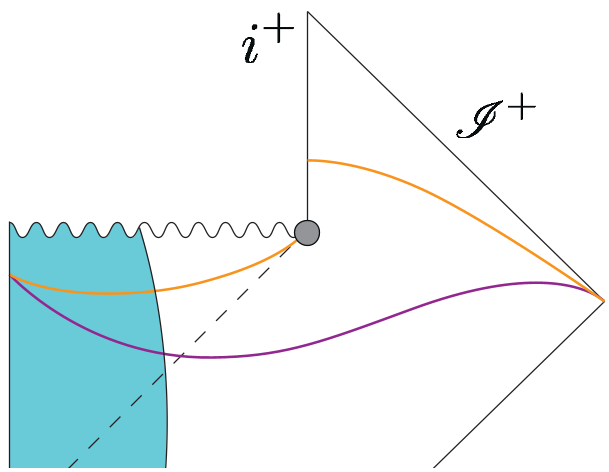 Figure 1: Comparison of Penrose's classical trapped surface and the quantum version where evolution is tracked through Hawking radiation.
The Proof Outline: A Contradiction in Terms
The authors proceed by contradiction. They assume a spacetime that is geodesically complete (no singularities) and then show this violates the GSL.
- Construct a Horizon: They fire light rays from a "quantum trapped surface."
- Apply Causality: They use technical results from Minguzzi to find a specific light ray that must behave in a certain way if the universe were "smooth."
- The Tension: The "quantum trapped" nature of the surface says the entropy should behave "anomalously," but the GSL (assuming completeness) says it must behave "normally."
- The Result: The only way out is if the light ray ends—meaning the spacetime is incomplete (singular).
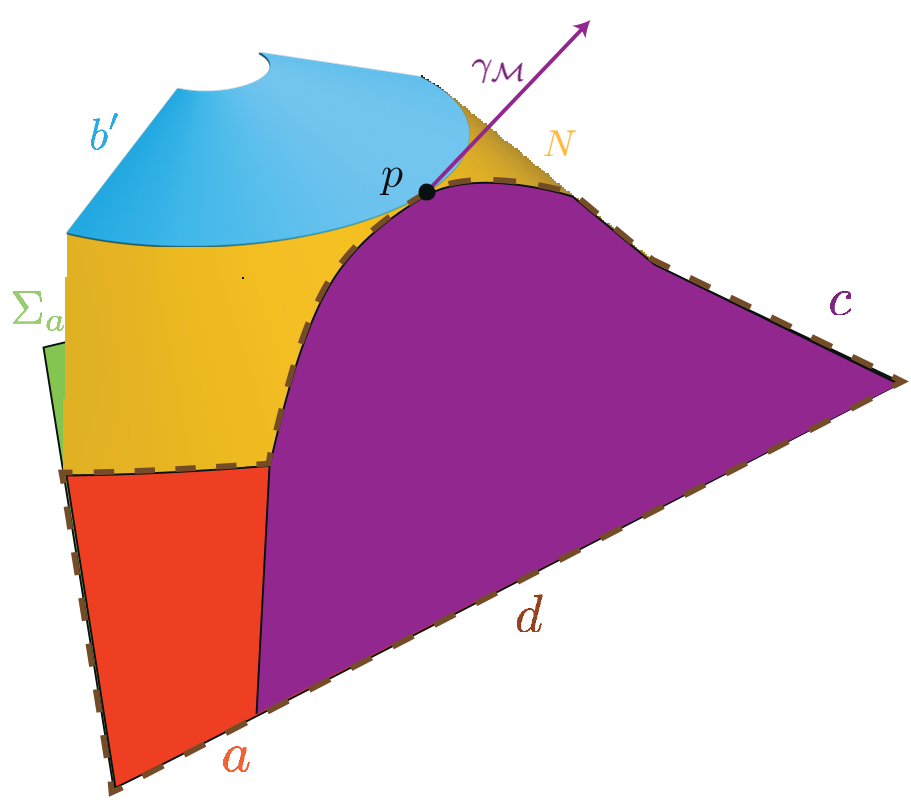 Figure 2: The construction of surfaces b' and c used in the proof to demonstrate the contradiction between entropy gradients and causality.
Critical Analysis & Conclusion
This paper is a major milestone in Mathematical Physics. It doesn't just "fix" Penrose’s theorem; it redefines it for the 21st century.
Takeaway: We now have rigorous proof that evaporating black holes are singular. This means we cannot "math our way out" of the singularity by appealing to Hawking radiation. The breakdown of General Relativity is real and unavoidable.
Limitations: The proof relies on two conjectures: the Generalized Second Law (GSL) in non-globally hyperbolic spacetimes and the Strong Subadditivity of Generalized Entropy. While widely accepted, these remain unproven in the most extreme regimes.
Future Outlook: Now that we know the singularity must exist, the next step is to understand what replaces it in a full theory of Quantum Gravity. This theorem narrows the search space for the final theory of everything.