
Ray-Aware Pointer Memory: Solving Viewpoint Ambiguity in Streaming 3D Reconstruction
Ray-Aware Pointer Memory with Adaptive Updates for Streaming 3D Reconstruction
The paper introduces a Ray-Aware Pointer Memory framework for streaming 3D reconstruction. By explicitly storing 3D positions, visual features, and viewing directions (rays), it achieves SOTA consistency on datasets like 7-Scenes and NRGBD, outperforming baselines such as Point3R in long-horizon stability.
TL;DR
Researchers from CUHK Shenzhen and Tsinghua University have developed a new framework for streaming 3D reconstruction that fixes a critical flaw in current "pointer-based" memories: the inability to distinguish between the same point seen from different angles and different points that just look similar. By adding Ray Direction to the memory and using a stochastic retain-or-replace policy, they achieve unprecedented geometric consistency and memory efficiency.
Problem & Motivation: The Appearance Trap
Recent "feed-forward" models like DUSt3R and Point3R have revolutionized 3D reconstruction by moving away from complex Bundle Adjustment (BA) toward direct pointmap prediction. However, when these models scale to long "streaming" video sequences, they face a consistency crisis.
Standard spatial memories store points based on coordinates and features. But if you see a landmark from a 180-degree opposite angle, the "feature similarity" often fails. Conversely, repetitive textures (like tiles on a floor) might trick the system into merging points that are actually meters apart. This leads to feature dilution—where averaging observations from different viewpoints creates a "blurry" geometric representation that causes camera tracking to drift.
Methodology: Thinking in Rays
The core innovation is the Ray-Aware Pointer Memory. Every "pointer" in the memory is now a tuple: where is the unit ray direction from the camera to the point.
1. The Unified Observation Reasoner
The system doesn't just look at how close points are; it looks at the angular difference of the rays. This allows for a three-way logic:
- Local Redundancy: Close space + Small angle Same point, same view.
- Loop Revisit: Close space + Large angle Same point, different view (A "Loop" detected!).
- Novel Geometry: Large spatial distance New territory discovered.
2. Retain-or-Replace Update
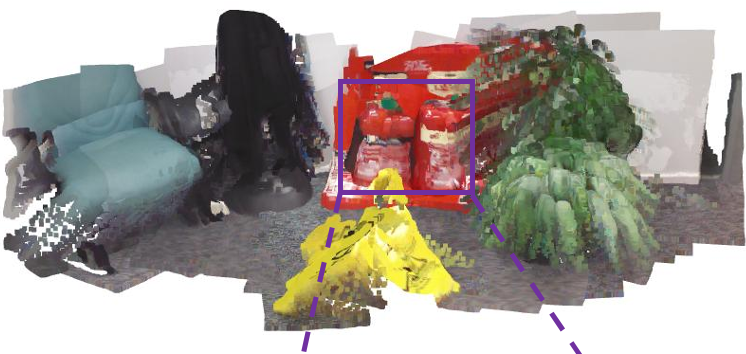
Traditional methods merge nearby points by averaging their features. The authors argue this is harmful because it destroys the unique "view-dependent" information. Their solution? A stochastic choice: when a new observation matches an old one, the system randomly chooses to either keep the old one or replace it entirely with the new one. This preserves "sharp" features and prevents the memory from growing indefinitely.
Experiments & Results: Sharper Geometry, Lower Footprint
The results on 7-Scenes and NRGBD are striking. In terms of Mean Accuracy (Acc), the method achieves a 58% improvement over the previous SOTA (Point3R).
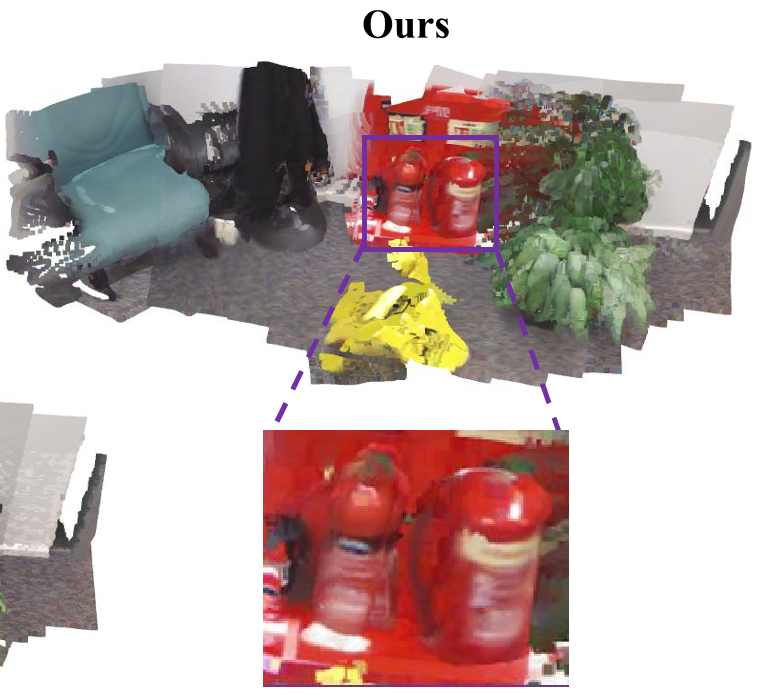
Key findings from the ablation study:
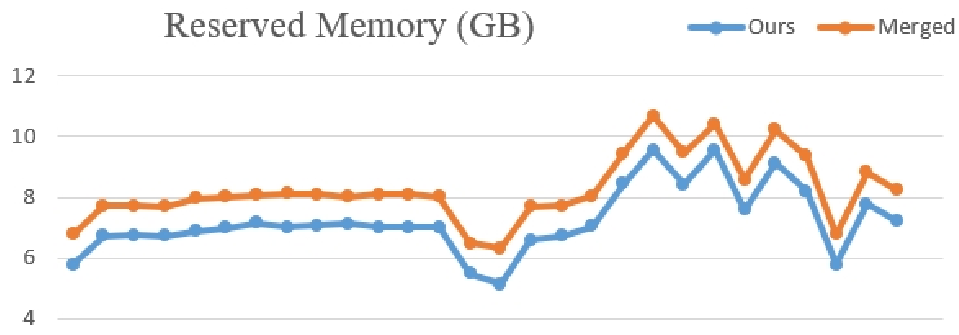
- Memory Efficiency: By being more selective about what to store, the system uses significantly less GPU memory (typically 6-9 GB vs. up to 10.5 GB for Point3R) while maintaining a more uniform distribution of points across the scene.
- Loop Closure: The ray-aware logic naturally triggers pose refinement when loop candidates are detected, drastically reducing Absolute Trajectory Error (ATE).
Critical Insight & Conclusion
The "Retain-or-Replace" strategy is a bold move. While it might seem counter-intuitive to "throw away" data rather than fuse it, the paper proves that in the latent space of neural networks, averaging is often the enemy of discriminability.
Takeaway: Future 3D vision systems should move away from treating 3D points as static "dots" and start treating them as "oriented observations." Integrating the observer's perspective directly into the scene representation is the key to scalable, drift-free SLAM.
Limitations: The system still relies on a relatively good initial pose estimate. If the camera tracking fails catastrophically in a single frame, the memory updates might still propagate the error. Integrating a more robust uncertainty-aware pose logic could be the next frontier.