
RCoT-Seg: Turning Video Segmentation into an Actionable Chain-of-Thought
RCoT-Seg: Reinforced Chain-of-Thought for Video Reasoning and Segmentation
RCoT-Seg is a novel Video Reasoning Segmentation (VRS) framework that factorizes the task into Temporal Video Reasoning (TVR) and Keyframe Target Perception (KTP). By leveraging an agentic keyframe selection module and GRPO-based reinforcement learning, it achieves state-of-the-art performance on benchmarks like ReVOS (+1.2% J&F) and ReasonVOS (+3.0% J&F) using a Qwen2.5-VL backbone.
TL;DR
RCoT-Seg redefines Video Reasoning Segmentation (VRS) by decomposing it into a verifiable two-stage process: Temporal Video Reasoning and Keyframe Target Perception. Unlike prior "one-shot" sampling methods, it uses an agentic self-evaluation loop (AKS) and GRPO reinforcement learning to ensure the model segments the right object based on the best temporal evidence. It sets new SOTA records on ReVOS and ReasonVOS while remaining computationally efficient.
The Problem: The "Brittle Evidence" Trap
Existing Video Reasoning Segmentation models typically follow a "sample-then-segment" pipeline. They use simple heuristics (like uniform sampling) or a separate MLLM to pick a few frames and then attempt to segment the target.
The flaw is simple: spatial perception is only as good as temporal evidence. If the selected frame is occluded, or if the "reasoning" fails to identify the correct temporal window (e.g., "the car that was red but is now under the bridge"), the segmentation model is doomed. Most current SOTA models treat frame selection as a "black box" pre-processing step with zero error tolerance.
Methodology: Reasoning as a Semantic Scaffold
RCoT-Seg introduces a paradigm shift where Chain-of-Thought (CoT) isn't just an explanation—it's a functional bridge.
1. Agentic Keyframe Selection (AKS)
Instead of a single-pass choice, RCoT-Seg acts as an agent. It selects a candidate keyframe and then asks itself: "Is this frame sufficient to answer the user's query?"
- If Yes, it proceeds to segmentation.
- If No, it triggers a re-selection loop, updating its internal context to search for better evidence.
2. Spatiotemporal Factorization
The model splits the workload into two specialized stages:
- TVR (Temporal Video Reasoning): Scans low-resolution video to understand "what happened when" (Global Context).
- KTP (Keyframe Target Perception): Takes the verified keyframe at high resolution to pinpoint bounding boxes and points (Local Precision).
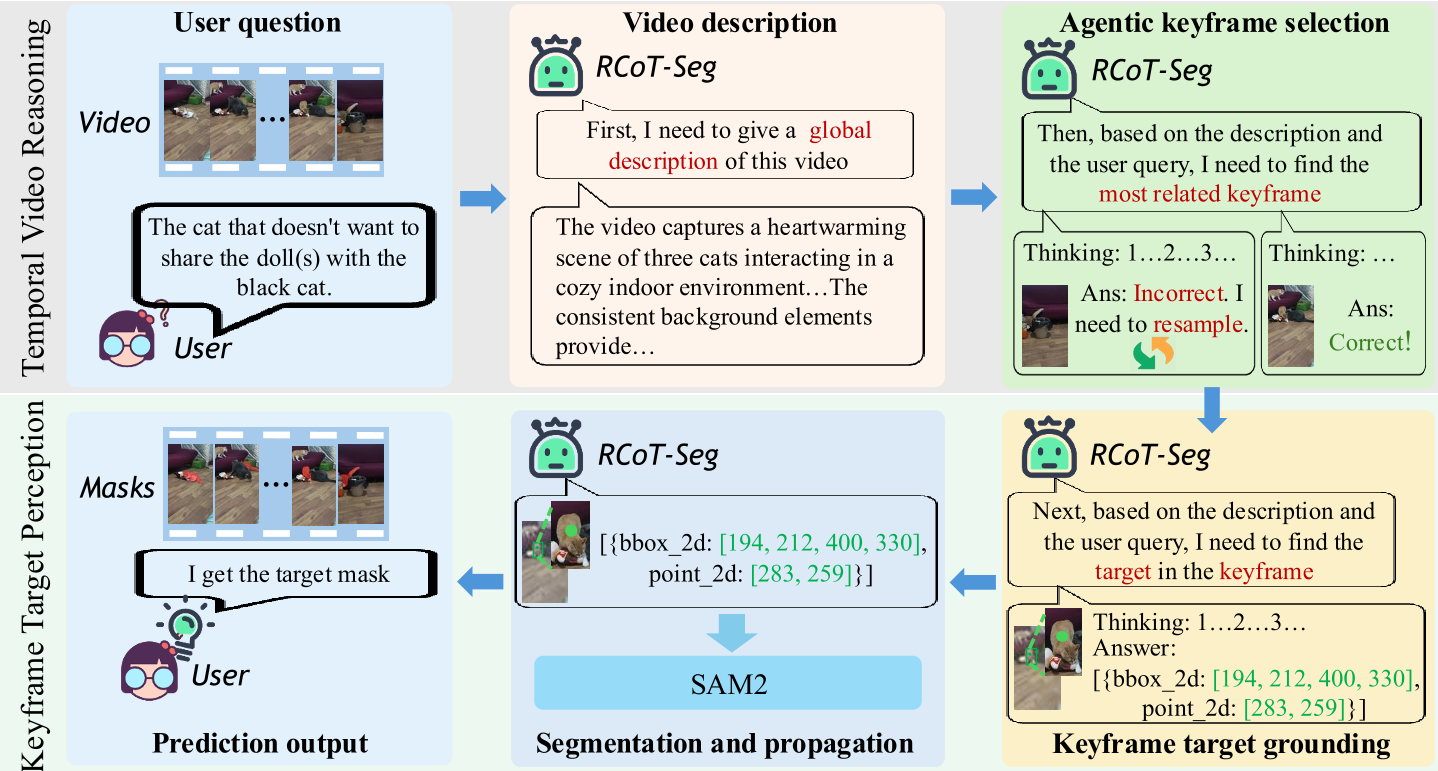 Figure 1: The unified RCoT-Seg pipeline, showing the feedback loop between reasoning and perception.
3. RL via GRPO with Hungarian Rewards
To fine-tune this behavior, the authors used Group Relative Policy Optimization (GRPO). To solve the "credit assignment" problem in multi-object scenes (where the model might mix up different objects), they implemented a Hungarian-algorithm-based reward. This ensures that the reinforcement signal correctly matches predicted masks to ground truth targets, providing stable gradients for complex reasoning.
Experimental Results: Efficiency Meets Accuracy
RCoT-Seg consistently punches above its weight class. Comparing the 3B parameter version against 13B models reveals a clear advantage in reasoning-heavy tasks.
| Dataset | Metric (J&F) | Gain over Prior SOTA |
|---|---|---|
| ReVOS (Reasoning) | 58.2 | +1.4% |
| ReasonVOS | 58.2 | +3.0% |
| DAVIS17 | 76.1 | +1.7% |
 Figure 2: RCoT-Seg performance on ReVOS compared to high-token and other RL-based methods.
Why does it work? (Ablation Insights)
- Visibility Boost: The AKS mechanism increases the "Target Area Ratio" (visibility) by 22.9% on the DAVIS dataset. By simply picking a better frame, the segmentation task becomes exponentially easier.
- The Power of "Think": Using explicit
<think>tokens (CoT) improved results by ~3% J&F compared to an "Answer-Only" baseline, proving that forced internal reasoning helps resolve temporal ambiguities.
Critical Analysis & Conclusion
The standout innovation of RCoT-Seg is the Self-Critical Agentic Selection. It moves away from the "static pipeline" philosophy of current MLLMs and moves toward "active perception."
Limitations: The current model struggles with "Zero-Target" scenarios (when the object in the query isn't actually in the video), as it wasn't trained on negative samples.
The Takeaway: For future video-language tasks, we should stop treating the MLLM as a single-pass function. By building internal verification loops and using RL to align reasoning with verifiable rewards, we can achieve superhuman-level precision even with smaller, more efficient backbones.
Senior Editor's Note: RCoT-Seg is a classic example of how "System 2" thinking (deliberative reasoning) can be successfully injected into "System 1" (reactive perception) tasks like segmentation.