
RealCam: Democratizing Cinematic Camera Control through Real-Time Autoregressive Synthesis
RealCam: Real-Time Novel-View Video Generation with Interactive Camera Control
RealCam is a novel autoregressive framework for real-time, interactive camera-controlled video-to-video (V2V) generation. It utilizes a Cross-frame In-context Learning paradigm and causal distillation to achieve state-of-the-art visual fidelity with sub-second inference latency, significantly outperforming existing bidirectional "render-and-wait" paradigms.
TL;DR
RealCam is the first framework to enable real-time, interactive camera-controlled video generation. By ditching the traditional "prefix-style" conditioning for an interleaved frame-pair approach and distilling a heavy teacher into a 3-step causal student, it achieves sub-second latency (0.72s) while maintaining SOTA geometric consistency.
Problem & Motivation: The "Render-and-Wait" Bottleneck
In filmmaking, camera movement is a language. While AI has made novel-view synthesis from monocular footage possible, existing SOTA models like ReCamMaster are fundamentally non-causal. They require the entire source video and the intended camera path to be provided upfront, followed by minutes of processing.
The root causes are two-fold:
- Bidirectional Attention: Standard Transformers look "forward and backward" in time, prohibiting frame-by-frame streaming.
- Prefix-style Concatenation: Thinking of the source video as a long "prefix" before the target video creates a rigid structure that breaks if the video length changes or if you want to control the camera on-the-fly.
Methodology: The Architecture of Interactivity
1. Breaking the Prefix: Cross-frame In-context Learning
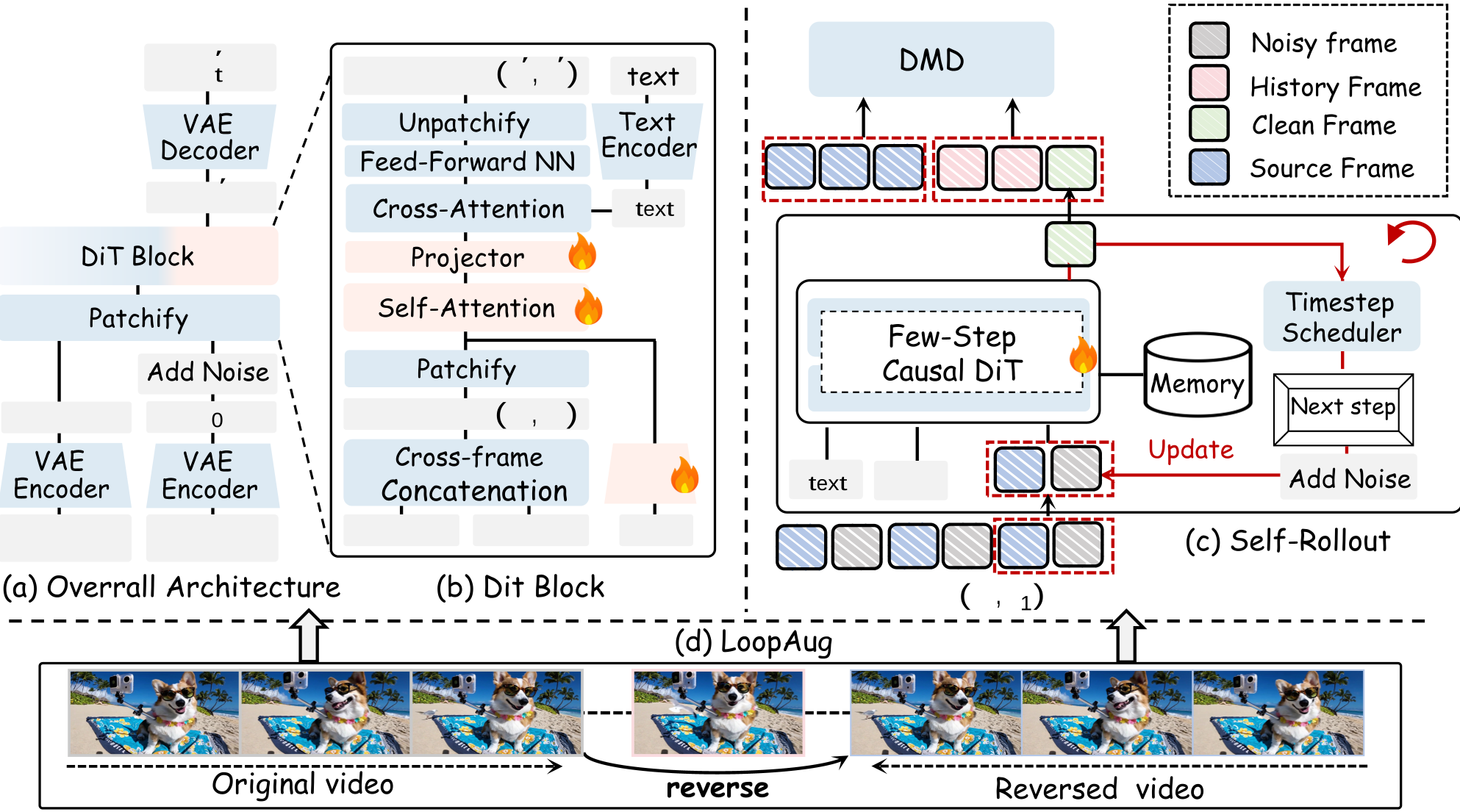
Instead of the [Source Video] + [Target Video] sequence, RealCam interleaves them: [S1, T1, S2, T2, ... Sn, Tn].
- Physical Intuition: This shifts the model's focus from "absolute time" to "relative correspondence." The model learns the geometric delta between a source frame and its target counterpart at the same timestamp.
- Causal Readiness: Because only depends on and previous pairs, the architecture can easily switch to causal masks without losing context.
2. Causal Distillation & Self-Forcing
To reach real-time speeds, the authors use Distribution Matching Distillation (DMD) to turn the many-step teacher into a 3-step student. To prevent "drift" (where errors accumulate over time in autoregressive generation), they use Self-Forcing. During training, the model is fed its own previously generated (and slightly noised) frames, bridging the gap between training and real-world inference.
3. LoopAug: Solving the "Closed-Loop" Glitch
A common failure in AR models is when the camera returns to its starting point, but the scene has shifted. RealCam introduces Loop-Closed Data Augmentation (LoopAug): creating training data where a video is concatenated with its reverse. This forces the model to respect global consistency when the loop closes.
Experiments: Orders of Magnitude Faster
The quantitative results are striking. While previous methods took over 400 seconds to generate a scene, RealCam does it in 0.72 seconds.
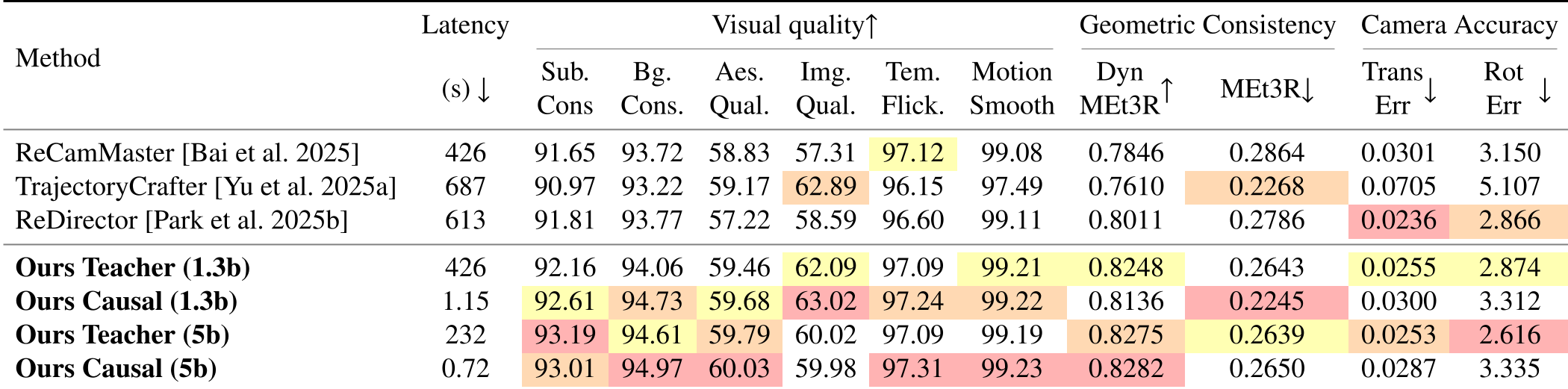
- Visual Fidelity: Despite being faster, the visual quality (Aesthetic/Imaging) remains equal to or better than offline SOTA.
- Geometric Precision: The MEt3R scores (measuring 3D alignment) show that the implicit learning of 3D structure is preserved through the distillation process.
Critical Insight & Conclusion
RealCam’s biggest contribution isn't just speed—it’s the causal refactoring of the conditioning mechanism. By interleaving frames, they successfully transformed a global optimization problem into a local, streaming-friendly one.
Limitations: While the sub-second latency is impressive, temporal drift in extremely long sequences (beyond several minutes) remains a general challenge for autoregressive models. However, for interactive filmmaking and live streaming, RealCam sets a new benchmark for what's possible in the generative post-production era.