
RealMaster: Bridging the Sim-to-Real Gap via Diffusion-Based Second-Stage Rendering
RealMaster: Lifting Rendered Scenes into Photorealistic Video
RealMaster is a novel sim-to-real video translation framework that lifts synthetic 3D engine renders into photorealistic videos. By combining a sparse-to-dense anchor propagation strategy with an IC-LoRA distilled diffusion model, it achieves state-of-the-art photorealism while maintaining strict geometric and motion consistency.
TL;DR
RealMaster is a new framework designed to turn synthetic "game-like" renders into cinematic, photorealistic videos. Unlike standard video editors that often lose track of the original scene's geometry, RealMaster preserves every detail—from facial identities to complex physics—by distilling a sparse-to-dense propagation pipeline into a powerful video diffusion model.
The "Uncanny Valley" of 3D Engines
For decades, 3D engines like GTA-V or Unreal Engine have provided unmatched control over scene dynamics. However, they often fall into the uncanny valley: textures are too sterile, lighting is too perfect, and high-frequency details (like skin pores or ambient reflections) are missing.
While modern Video Diffusion Models (VDMs) can generate photorealistic content, they are notoriously hard to steer. If you ask a VDM to "make this GTA video real," it often hallucinates new faces or shifts object positions. The core challenge is Structural Precision vs. Global Semantic Transformation.
Methodology: The Two-Stage Mastery
RealMaster solves this via a clever "distillation" strategy.
1. Data Generation: Sparse-to-Dense Propagation
Since no large-scale dataset of "GTA-to-Real" video pairs exists, the authors built their own.
- Anchoring: They take the first and last frames of a rendered clip and use a high-quality image-to-image model (Qwen-Image-Edit) to make them look real.
- Propagation: They use VACE (a conditional video model) to fill in the middle frames. Crucially, they condition this process on edge maps from the original render to ensure the "real" version follows the exact movement of the "sim" version.
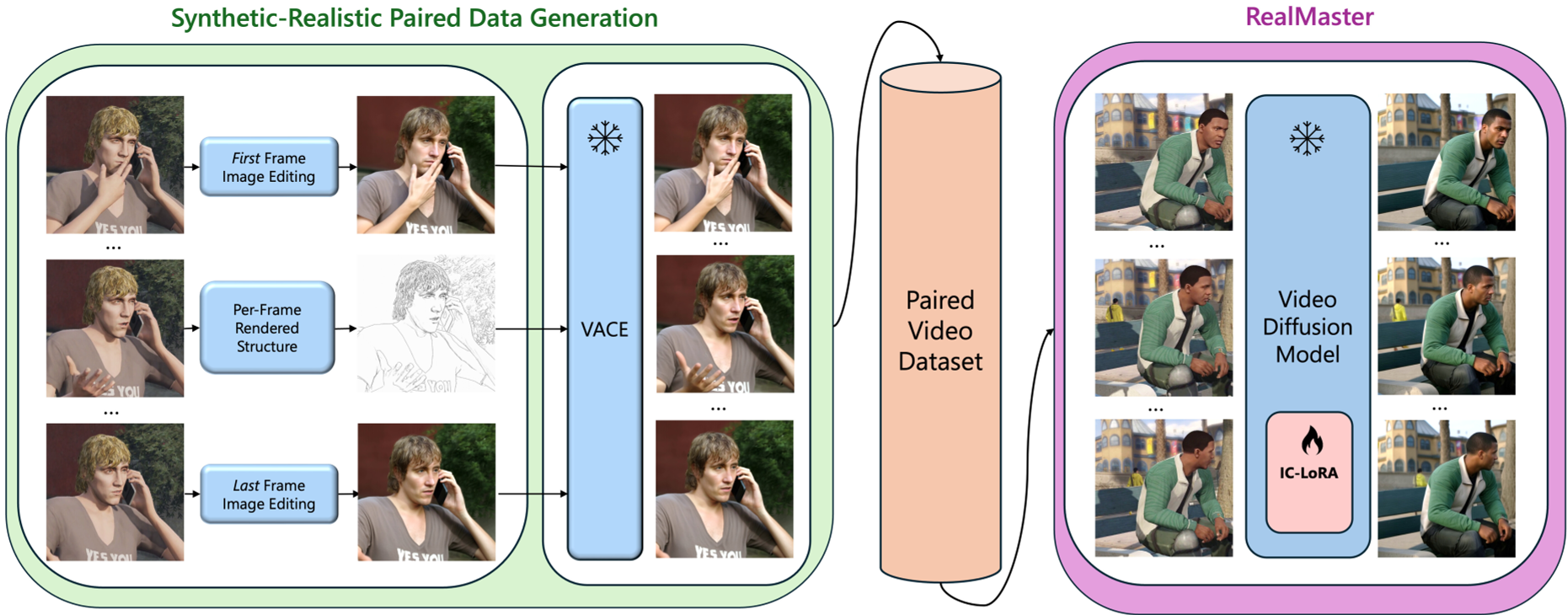 Above: The RealMaster workflow, showing the transition from rendered anchors to a fully distilled LoRA model.
2. Model Distillation: IC-LoRA
Running the full pipeline is slow and struggles when new objects appear in the middle of a shot. To fix this, they trained an IC-LoRA (In-Context LoRA) on the Wan2.2 14B video backbone. This "distills" the knowledge of the propagation pipeline into a single, efficient adapter that can process videos in one pass during inference.
Experimental Showdown
The results on the SAIL-VOS (GTA-V) dataset show a clear leap over industry leaders.
- Photorealism: Measured by GPT-4o as a "blind judge," RealMaster scored significantly higher than Runway and LucyEdit.
- Identity Preservation: Using ArcFace (face recognition) scores, RealMaster proved it can keep a character's face consistent, whereas other models often "swapped" the person for someone else.
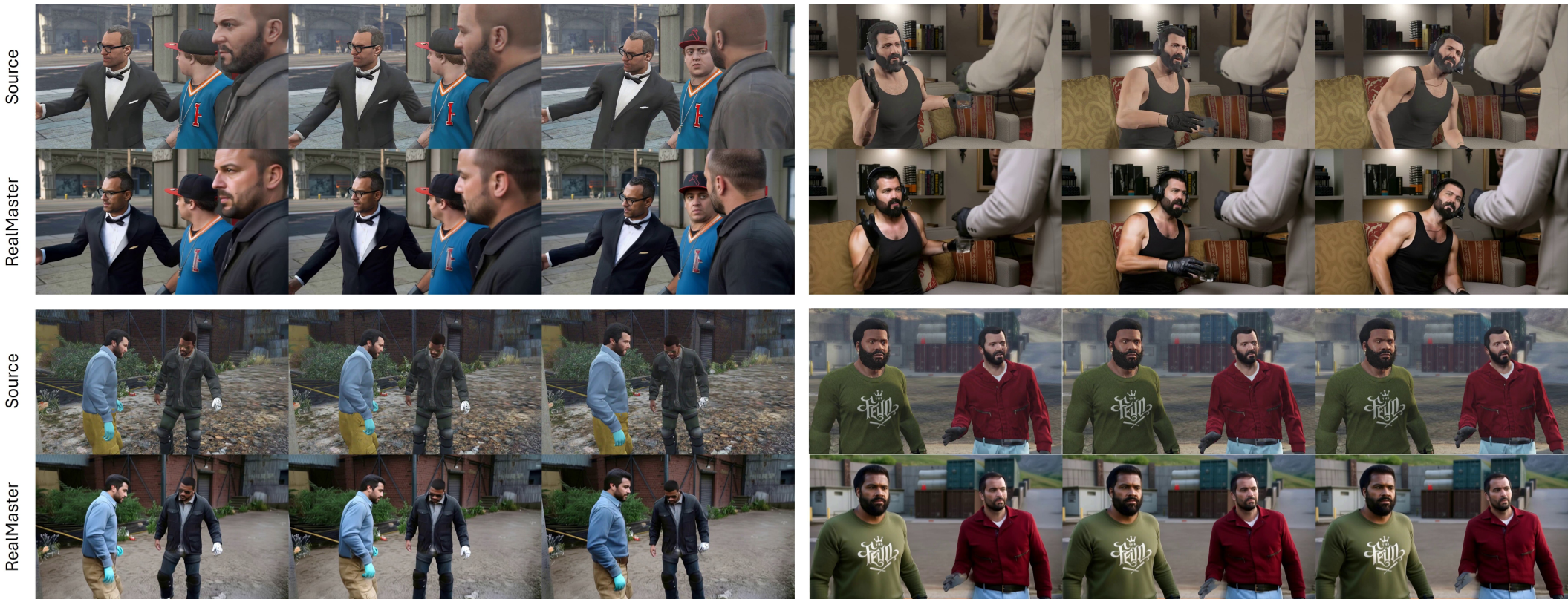 Comparison of RealMaster against baselines. Note how RealMaster preserves the original lighting and character identity while adding realistic skin textures and environmental depth.
Deep Insight: Beyond Style Transfer
The most impressive part of RealMaster is its Cross-Simulator Generalization. Even though it was trained on GTA-V, it works on CARLA (a driving simulator) with zero extra training.
This suggests that the model isn't just learning "how to make GTA look real," but is learning a unified mapping from synthetic G-buffer-like textures to real-world optics. It can even handle dynamic weather effects—like adding rain and realistic wet-road reflections—simply by changing the text prompt at inference time, effectively acting as a "Neural Shader."
Conclusion & Future Work
RealMaster marks a shift in how we think about AI video. Instead of treating AI as a replacement for 3D engines, it treats AI as a post-processing renderer.
Limitations:
- The model's realism is capped by the first-stage image editor.
- Fast camera motion can still cause "motion blur" artifacts from the base diffusion model.
Future Outlook: As these models become faster, we might see "RealMaster-style" neural rendering happening in real-time, allowing gamers to play in worlds that are indistinguishable from live-action cinema.