[ArXiv 2025] PJB: Beyond Average Scores—A Diagnostic Map for AI Recruitment Retrieval
PJB: A Reasoning-Aware Benchmark for Person-Job Retrieval
The paper introduces PJB (Person-Job Benchmark) v1.0, a reasoning-aware retrieval evaluation dataset designed to diagnose where person-job matching systems fail. It comprises nearly 300 JDs, 200,000 resumes, and over 2,000 competency-driven relevance judgments, establishing a new SOTA evaluation protocol for recruitment AI.
TL;DR
When evaluating AI for hiring, the question "who scores higher" is becoming obsolete. The real challenge is "where does the system fail?" This paper introduces PJB (Person-Job Benchmark), a reasoning-aware evaluation framework that moves beyond average metrics to provide a diagnostic capability map. Using 200,000 real-world resumes, it reveals that domain-specific training is far more critical than simply stacking LLM-based query expansion modules.
The Motivation: Why Generic Benchmarks Fail Recruitment
In general Information Retrieval (IR), like searching Wikipedia, the goal is often finding a "topic." In recruitment, the goal is finding "competency." Success requires two distinct cognitive processes:
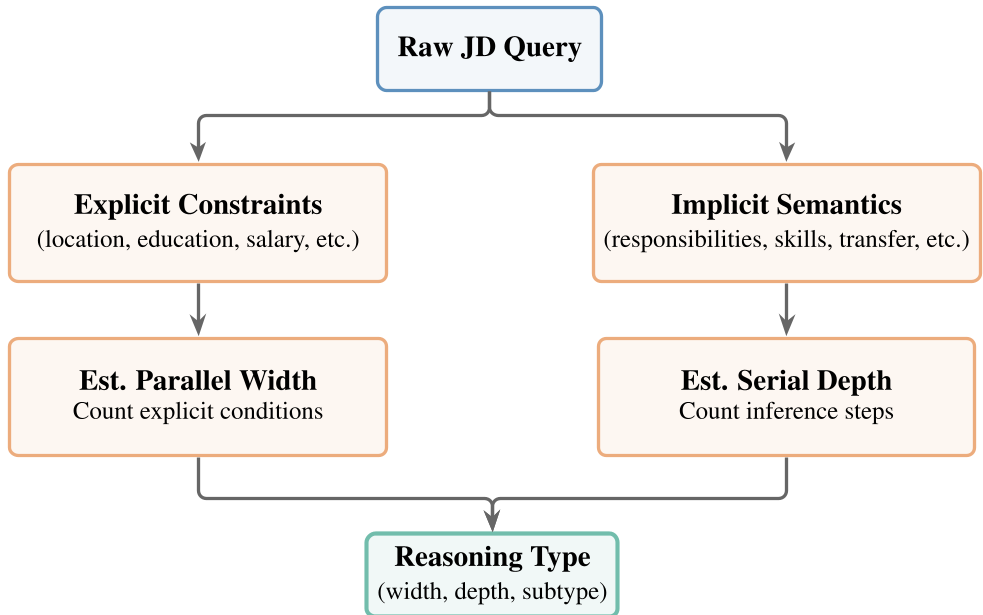
- Parallel Reasoning: Verifying explicit constraints (e.g., Is the candidate in London? Do they have 5+ years of Java?).
- Serial Reasoning: Inferring implicit capabilities (e.g., Can a "Strategic Operations Manager" from the automotive industry transfer their skills to "E-commerce Growth"?).
Existing benchmarks like MTEB or BEIR don't test these "Serial" hops. PJB fills this gap by categorizing queries based on their reasoning complexity and industry domain.
Methodology: Formalizing the "Competency Map"
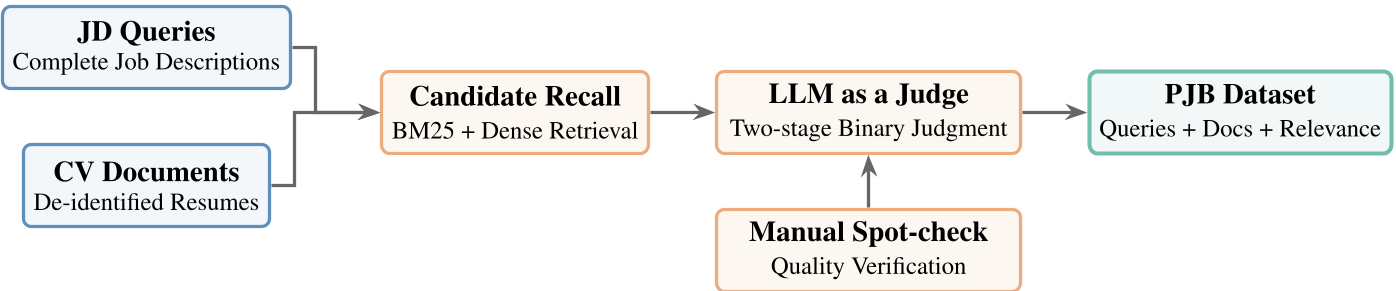
The authors constructed PJB v1.0 using real-world recruitment data from 2025, de-identifying data to ensure privacy. The core innovation lies in the Diagnostic Taxonomy:
1. Domain Families
Job categories are aggregated into 6 clusters (e.g., Technical R&D, Sales & Market Support) based on shared competency dimensions. This prevents statistical noise from small sample sizes while maintaining business relevance.
2. Reasoning Taxonomy
Queries are analyzed through two lenses:
- Parallel Width: Number of explicit constraints to be verified.
- Serial Depth: Number of semantic normalization or multi-step inference steps required.
Based on these, queries are typed as Parallel-only, Hybrid-balanced, or Serial-dominant. This allows researchers to see if a model is "smart" (good at serial inference) or just "organized" (good at filtering constraints).
Key Experimental Insights
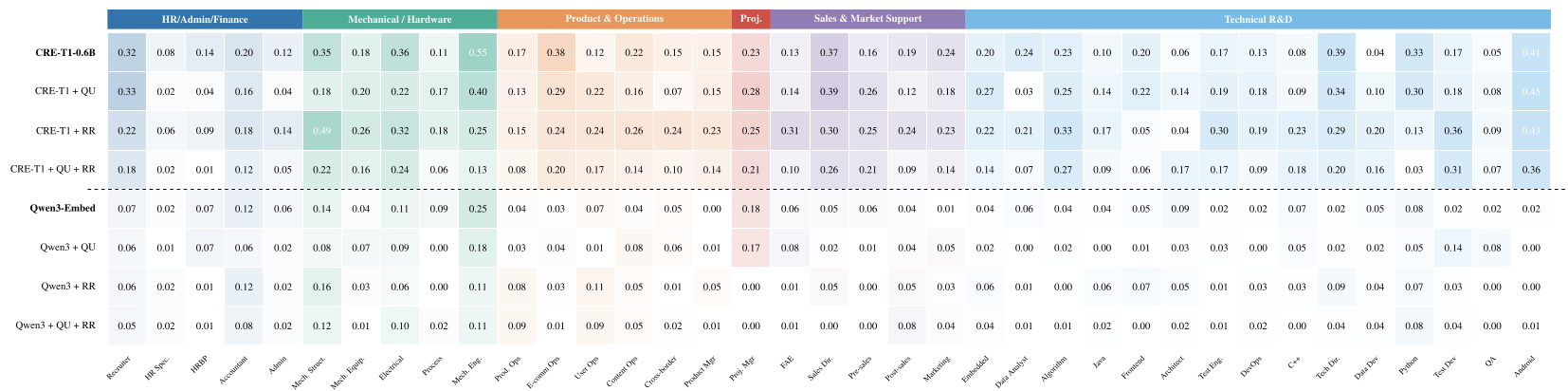
The researchers conducted a 2x4 ablation study comparing an in-house model (CRE-T1) against the general Qwen3-Embedding.
1. The Domain Adaptation Gap
Generic models fail miserably in specialized recruitment. CRE-T1 achieved an nDCG@10 of 0.2070, nearly 3.5x higher than Qwen3's 0.0592. Specialized vocabulary and industry-specific context are not optional; they are the foundation.
2. The Module Trap: Reranking vs. Query Understanding (QU)
A surprising finding was that "Query Understanding" (using LLMs to rewrite the JD) actually degraded performance in many scenarios.
- Reranking: Provided a stable +8.9% gain on the domain-adapted model.
- QU + Reranking: The combination was worse than Reranking alone, suggesting that LLM-driven query expansion might lose the structural matching info essential for precise recruitment.
3. Reasoning Heterogeneity
Reranking modules were found to be most effective for Serial-dominant queries (where deep inference is needed), improving nDCG@10 from 0.1879 to 0.3809. However, for Parallel-only queries, reranking actually caused a slight decline.
Critical Analysis & Takeaways
The "Capability Map" Philosophy
The most significant contribution of PJB is the shift from a leaderboard to a diagnostic plane. By looking at the "Error Profile," we can see that when a base retriever is weak, adding sophisticated "post-processing" (like Rerankers) doesn't fix the problem—it often adds more noise and increases the "Bad Query Rate."
Limitations
While PJB v1.0 is a massive step forward, it currently focuses on Dense Retrieval. Future iterations will need to explore how BM25-based hybrid pipelines or "Late Interaction" models (like ColBERT) perform on these reasoning tasks.
Conclusion
For practitioners, the message of PJB is clear: Invest in the base retriever first. Don't expect general-purpose LLM modules to solve the "reasoning" problem if the underlying embedding space isn't domain-aware. PJB provides the first standardized "map" to tell you exactly where your recruitment system is getting lost.