
RAO: Teaching Agents the Art of Recursive Delegation and Test-Time Scaling
Recursive Agent Optimization
The paper introduces Recursive Agent Optimization (RAO), a reinforcement learning framework that trains a single LLM policy to dynamically spawn and delegate sub-tasks to itself. Evaluated on complex benchmarks like TextCraft-Synth and Oolong-Real, RAO achieves SOTA performance by enabling agents to scale inference-time compute through divide-and-conquer strategies.
TL;DR
Recursive Agent Optimization (RAO) is a breakthrough RL approach that matures LLM agents from "flat executors" to "recursive managers." By training a single model to act as both parent and child in a dynamic execution tree, RAO enables agents to break through context limits, solve tasks 9x harder than seen in training, and utilize parallel processing to slash execution time.
Background: The Limits of the "Flat" Agent
Current LLM agents typically operate in a linear fashion. Even when wrapped in "scaffolds" (like AutoGPT), the underlying model isn't trained to manage its own sub-processes. This leads to two critical failures:
- Context Collapse: As a task gets longer, the prompt fills up, and the model loses its "train of thought."
- Generalization Ceiling: A model trained on 5-step tasks often fails on 50-step tasks because it lacks a fundamental strategy for decomposition.
RAO changes the paradigm: Inference-time scaffolds should not merely be designed around models; models should be trained to use them.
Methodology: Reward Design for Recursive Trees
The core innovation of RAO is its reward function. Instead of just looking at the final outcome (Root Reward), RAO introduces Local Node Rewards.
Each node (agent instance) in the execution tree is evaluated on:
- Self-Success: Did this specific sub-task get solved?
- Delegation Bonus: Did the children this node spawned actually succeed?
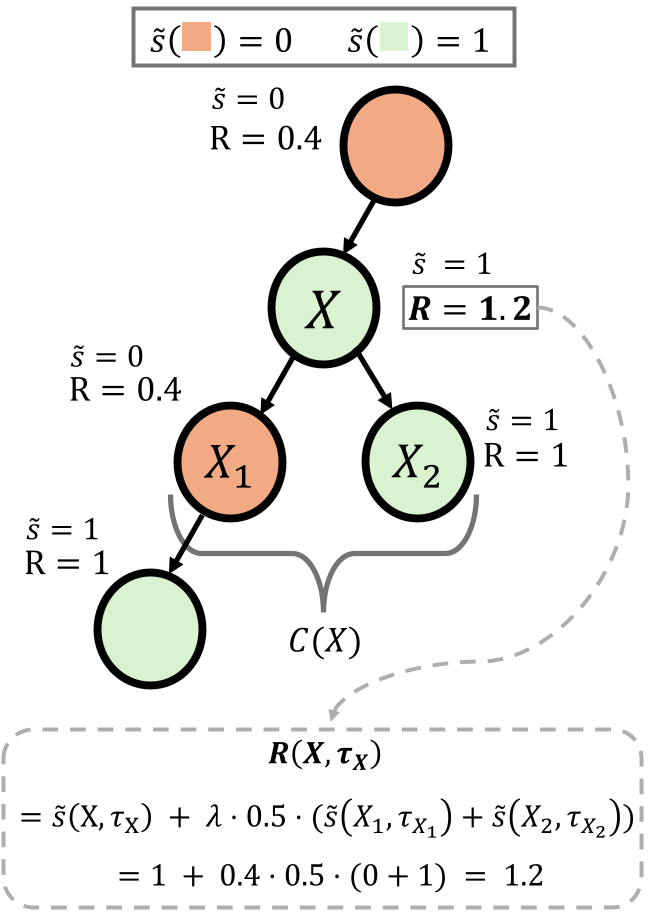 Figure: The RAO Reward Design, balancing local achievement with effective delegation (λ weight).
To prevent the model from being overwhelmed by the sheer number of sub-tasks, the authors use Depth-level Inverse-Frequency Weighting. This ensures that the model learns equally from high-level strategy (root) and low-level execution (leaves).
Experimental Breakthroughs
The authors tested RAO on TextCraft-Synth (crafting trees), Oolong-Real (long-document DnD logs), and DeepDive (multi-hop web research).
1. Scaling Beyond the Context Window
In the Oolong-Real benchmark, models were restricted to a 32K token training window but had to process 220K tokens. Single-agent systems failed because they couldn't "see" the whole document. RAO agents learned to chunk the input and delegate pieces to sub-agents, effectively creating an "infinite" working memory.
2. Emerging Parallelism
One of the most impressive results is the reduction in wall-clock time. Because RAO agents use an async launch_subagent action, they naturally learn when sub-tasks (like searching for two different items) can be done at the same time.
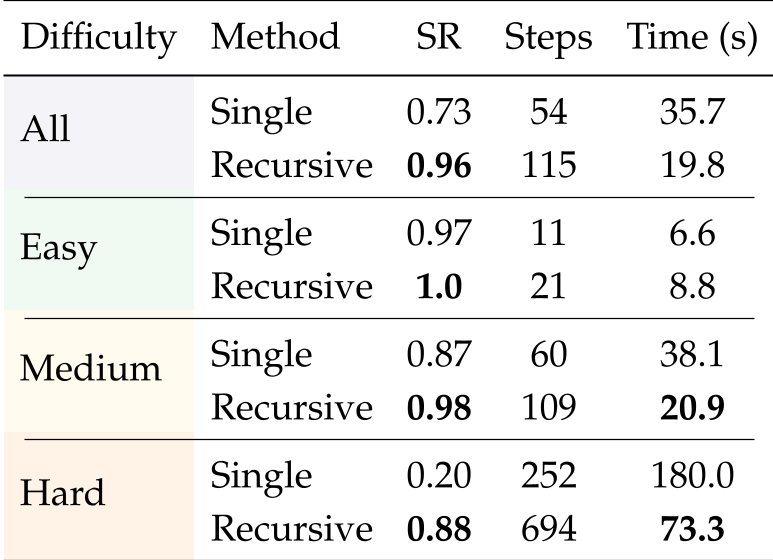 Table: On Medium/Hard tasks, RAO is significantly faster than single-agent baselines due to concurrent execution.
3. "Zero-Shot" Task Scaling
RAO agents trained only on "Medium" difficulty tasks (depth 4-6) were able to generalize to "Hard" tasks (depth 7-9) with an 88% success rate, whereas single agents dropped to 0%. This proves that recursion is a robust primitive for test-time scaling.
Critical Analysis & Conclusion
RAO is a major step toward "Self-Organizing Agents." The policy learns a self-induced curriculum: by solving sub-tasks, it naturally practices easier versions of the main problem.
Limitations:
- Compute Cost: While parallel execution saves time, it uses significantly more total tokens (VRAM/API costs).
- Dependency Bottlenecks: In tasks like DeepDive (web research), where step B depends on step A, the benefits of parallelism vanish, and the system becomes slower due to the overhead of spawning agents.
The takeaway? We are moving away from monolithic "Black Box" reasoning toward "Agentic Organizations." Future SOTA models won't just be bigger; they will be better at managing "copies" of themselves to conquer complexity.