
RELO: Aligning Training with Evaluation via Reinforcement Learning for Visual Tracking
RELO: Reinforcement Learning to Localize for Visual Object Tracking
RELO is a novel reinforcement learning-based paradigm for visual object tracking that replaces traditional handcrafted spatial priors with a localization policy learned via a Markov Decision Process (MDP). Using an actor-critic framework with rewards based on frame-level IoU and sequence-level AUC, it achieves state-of-the-art results including 57.5% AUC on the LaSOText benchmark.
TL;DR
Visual object tracking has long been "supervised" by handcrafted spatial priors like heatmaps. While effective, these priors are mere proxies for the actual metrics we care about: IoU and AUC. RELO (Reinforcement Learning to Localize) breaks this tradition by reformulating localization as a Markov Decision Process (MDP). By directly optimizing for tracking performance via Reinforcement Learning, RELO sets new SOTA benchmarks (57.5% AUC on LaSOText) while maintaining real-time speeds.
Problem & Motivation: The Gap Between Priors and Performance
Most modern trackers (Siamese or One-stream Transformers) localize targets by predicting a "likelihood map." This map is usually supervised by a Gaussian-shaped target or a binary mask.
However, this approach has a fundamental flaw: Handcrafted priors are not tracking metrics.
- Misalignment: A model might perfectly fit a center heatmap but fail to maximize IoU due to target deformation.
- Heuristic Bias: Designers decide if a heatmap should be a Gaussian or a box; these choices are often arbitrary and don't account for complex real-world motions.
- Generalization Bottleneck: When the target's appearance changes drastically, center-biased priors become a "straitjacket," preventing the tracker from exploring the search region effectively.
RELO's core insight is simple yet bold: Stop telling the tracker where the center is, and start rewarding it for finding the box that maximizes the success curve.
Methodology: Target Localization as an MDP
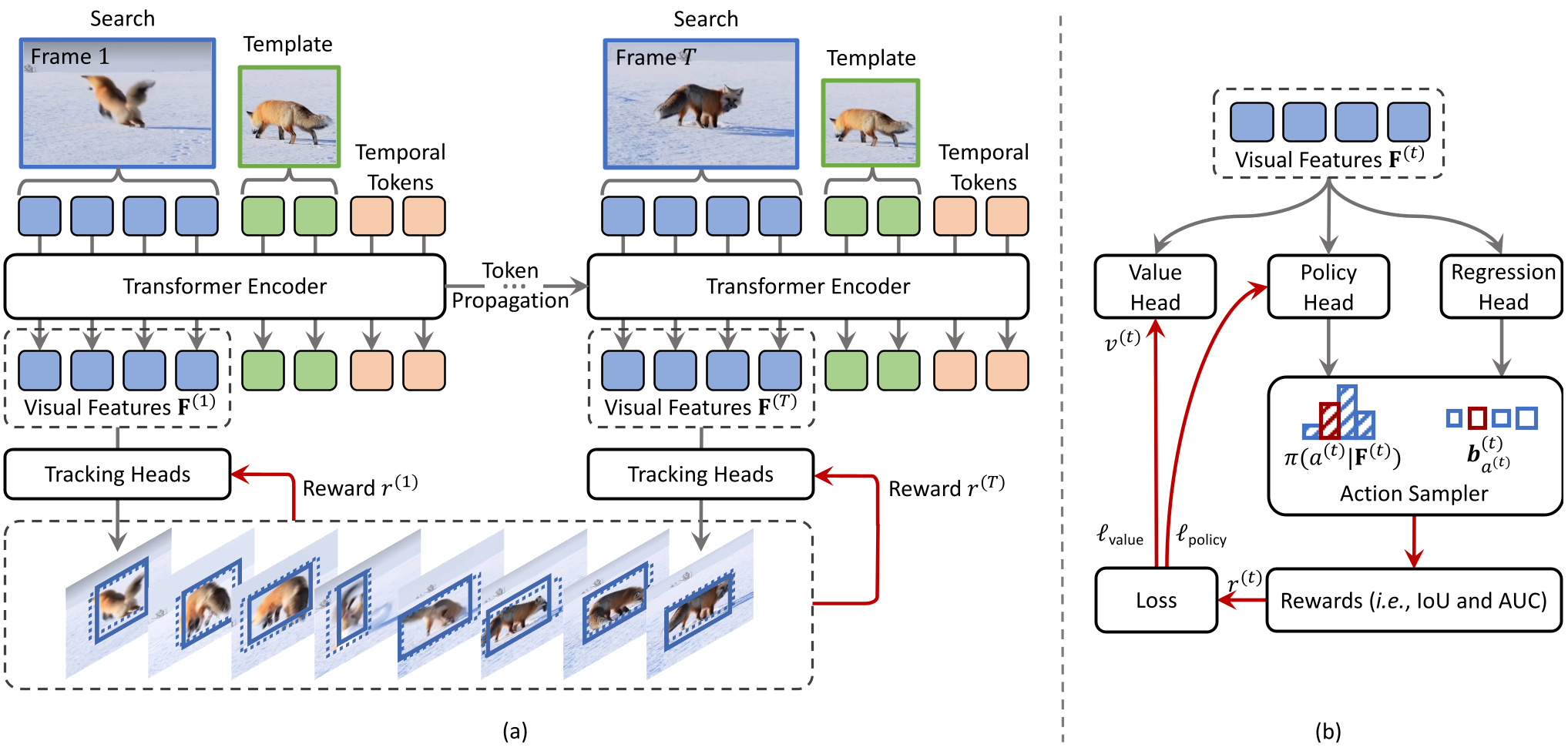
RELO transforms the dense prediction map into an action space. Each pixel in the feature map is a candidate action.
1. The Architecture
The system utilizes a one-stream Transformer encoder. For every search frame, it branches into three heads:
- Regression Head: Predicts a candidate bounding box for every position.
- Policy Head: Outputs logits defining the probability distribution over all positions (actions).
- Value Head: Estimates the expected reward for variance reduction.
2. Reward-Driven Optimization
RELO uses an Actor-Critic framework. The reward function is a hybrid of:
- Frame-level IoU: Immediate feedback on the current frame's box accuracy.
- Sequence-level AUC: A global reward shared across the clip (length ), encouraging long-term consistency.
3. Layer-Aligned Temporal Token Propagation
To improve temporal context, RELO propagates tokens between frames. Unlike previous methods that mix high-level "deep" tokens with low-level "shallow" ones, RELO ensures that tokens from layer of frame only interact with layer of frame . This preserves semantic hierarchy and boosts consistency with zero extra FLOPs.
Experiments & Results: The Power of Exploration
The results on LaSOText (a benchmark for out-of-distribution generalization) are particularly striking.
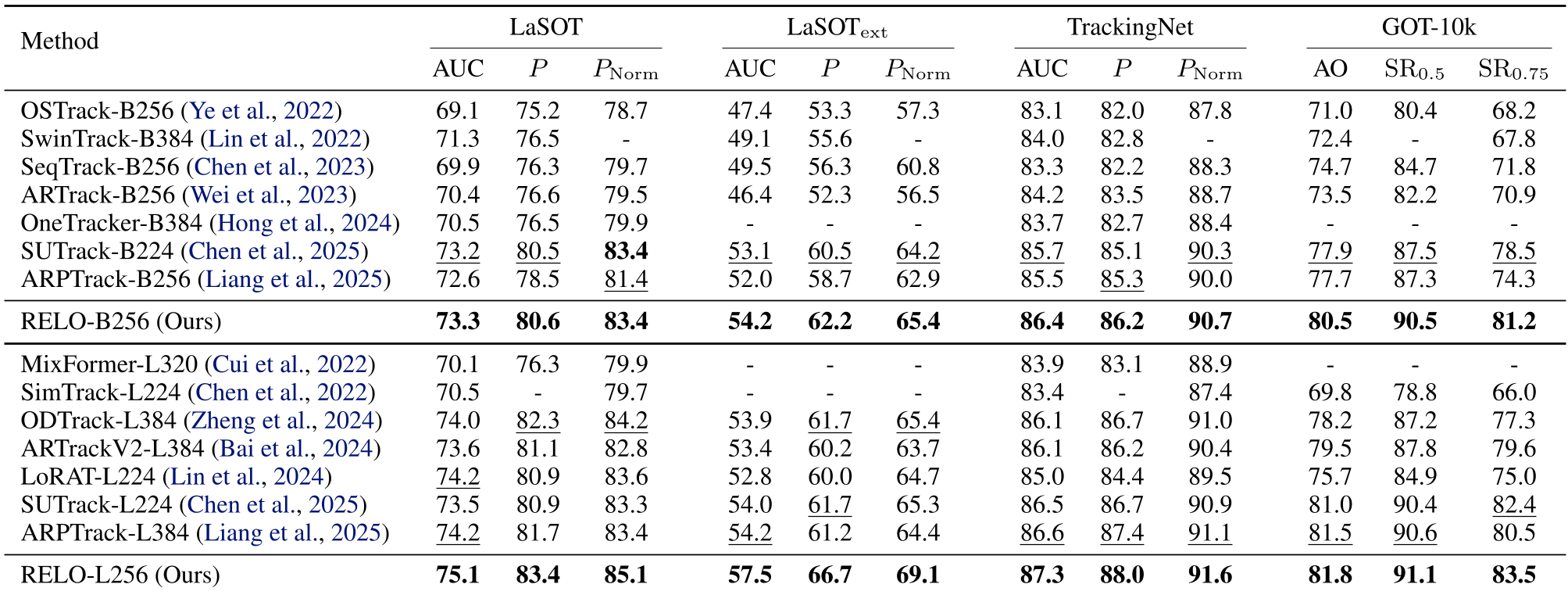
RELO-L256 achieved 57.5% AUC, a significant jump from previous SOTA methods like LoRAT (52.8%) or SUTrack (54.0%). In short-term tracking (GOT-10k), RELO also ranks 1st with an Average Overlap (AO) of 81.8%.
Ablation Study Highlights:
- Warmup matters: Training the policy from scratch is unstable because early box predictions are garbage. A "Regression Warmup" stage is essential to give the policy a meaningful starting point.
- Sequence Level vs Frame Level: The AUC reward (sequence-level) was found to be more critical than the IoU reward (frame-level), proving that tracking is fundamentally a temporal problem, not just a series of static detections.
Takeaway & Future Outlook
RELO demonstrates that Reinforcement Learning is not just for hyperparameter tuning or post-processing; it can be the core mechanism for visual localization. By shifting from "pattern matching" (priors) to "goal seeking" (rewards), trackers become inherently more robust to the unpredictable nature of real-world videos.
Limitations: The current reward (IoU/AUC) is still somewhat simplistic and may not fully represent "robustness" during total occlusion. Future work could integrate uncertainty estimation or re-detection logic directly into the RL reward loop.
Senior Editor's Note: RELO represents a healthy return to RL in tracking, not as a complex add-on, but as a replacement for the brittle inductive biases we've relied on for years.