
ReActor: Bridging the Embodiment Gap with Physics-Aware RL Retargeting
ReActor: Reinforcement Learning for Physics-Aware Motion Retargeting
ReActor is a bilevel optimization framework for physics-aware motion retargeting that adapts human reference motions to diverse robotic morphologies (humanoids and quadrupeds). By jointly optimizing retargeting parameters and a Reinforcement Learning (RL) tracking policy, it achieves SOTA results, effectively eliminating physical artifacts like foot sliding and self-collision.
TL;DR
ReActor transforms the traditionally static process of motion retargeting into a dynamic bilevel optimization problem. By training an RL policy and optimizing retargeting parameters simultaneously, it produces high-fidelity, physically plausible motions for humanoids and quadrupeds that are ready for real-world deployment, virtually eliminating artifacts like foot sliding and self-collision.
The Problem: The "Ghost" in the Machine
When we try to map human motion capture (Mocap) data onto a robot, we hit a wall: the embodiment gap. Robots have different mass distributions, joint limits, and proportions compared to humans.
Kinematic-only methods often result in:
- Foot Sliding: The robot's feet drift across the floor because the physics of contact isn't respected.
- Self-Collision: Limbs "ghost" through the torso because the solver doesn't know the robot is a solid object.
- Dynamic Metadata Mismatch: A motion that looks fine in a viewer might require the robot to exert impossible torques, making it useless for downstream Imitation Learning.
Methodology: The Bilevel Breakthrough
The genius of ReActor lies in its Bilevel Optimization framework. Instead of treating retargeting and tracking as two separate steps, it treats them as a nested loop:
- Upper Level (Retargeting Optimization): Adjusts the "parameters" (offsets, rotations, and vertical shifts) of the reference motion to better suit the robot's frame.
- Lower Level (Reinforcement Learning): Trains a policy to track that motion in a physics engine (Isaac Sim).
Simplified Gradient Estimation
A major technical contribution is how the authors solve this. Normally, differentiating through an RL policy's reward (the lower level) is mathematically "expensive" (requiring Hessian inversions). ReActor uses a simplified gradient estimate based on the intuition that if the reference moves, the optimal robot state should follow it roughly linearly. This allows the system to update retargeting parameters at every RL iteration, making the massive AMASS dataset (thousands of motions) trainable in just ~6 hours.
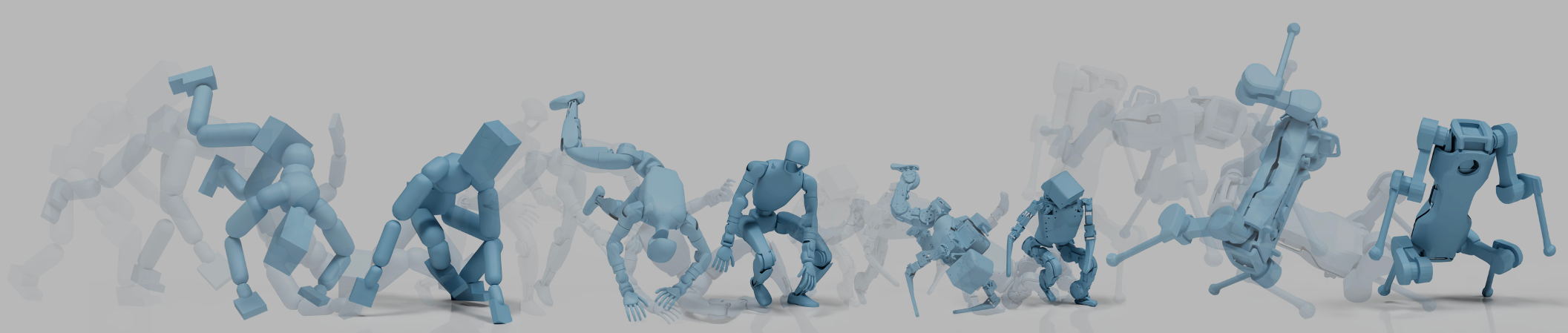 Fig 1: ReActor maps human motion onto radically different structures, from narrow humanoids to four-legged quadrupeds.
The Secret Sauce: Residual Force Control (RFC)
To handle "impossible" human motions (like handstands for a robot without hands), the system allows the RL controller to use a small amount of "magical" external force (Residual Force). However, the system heavily penalizes this force, forcing the policy to rely on the robot’s actual actuators whenever physically possible.
Experiments & Results: Setting New SOTAs
The authors tested ReActor against current leaders like GMR and OmniRetarget. The results were stark:
- Artifact Reduction: ReActor achieved 0.00 cm of average self-penetration depth on both G1 and Lima platforms, whereas competitors often struggled with limb-torso collisions.
- Foot Fidelity: Foot sliding was reduced by over 80% compared to GMR.
- Downstream Success: When the "retargeted" motions were used to train a standard tracking controller, ReActor's data led to a success rate of 97.45%, nearly 10% higher than the baselines on some hardware.
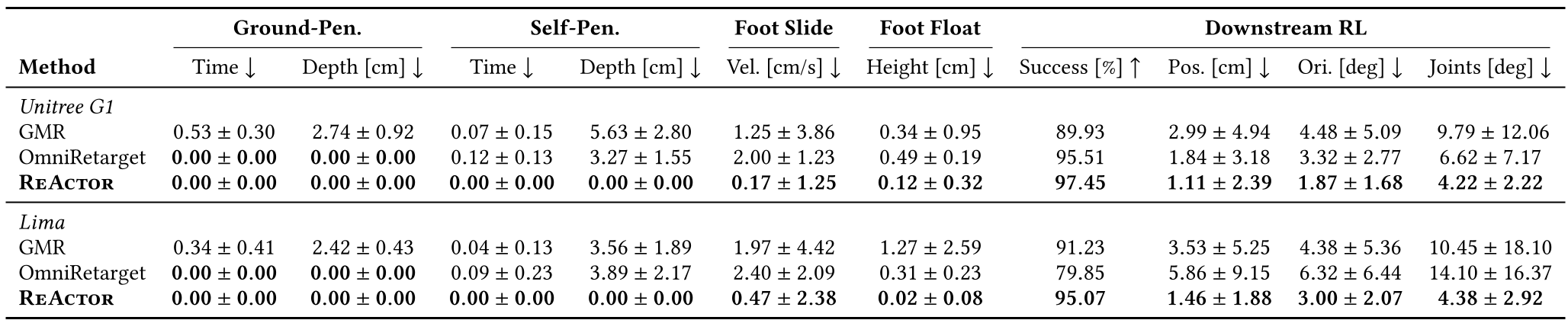 Table 1: Quantitative metrics showing ReActor's dominance in ground penetration, sliding, and downstream RL success.
Real-World Impact: Sim-to-Real
The ultimate test was deploying the results on the Lima robot hardware. Because ReActor optimizes within a physics simulator, the resulting joint setpoints and trajectories accounted for gravity and inertia from day one. This allowed for seamless sim-to-real transfer of complex, stylistically diverse motions.
Deep Insight & Conclusion
ReActor proves that "retargeting matters." By viewing the embodiment gap as a control problem rather than a geometry problem, the authors have unlocked a way to transform massive libraries of human motion data into "fuel" for the next generation of humanoid robots.
Limitations: The current framework assumes retargeting parameters are constant across a motion clip. Future iterations might explore time-varying parameters to allow for even more fluid adaptations during complex tasks like parkour or multi-contact manipulation.
Takeaway for Researchers
If you are building imitation learning pipelines, stop treating your reference trajectory as a "given." Instead, make the trajectory responsive to the physics of your target robot. The bilevel approach is not just a trick; it's the bridge we've been missing.