
[MIT 2026] Residual-as-Teacher: Breaking the Cycle of Teacher Bias in Model Distillation
Residual-as-Teacher: Mitigating Bias Propagation in Student--Teacher Estimation
This paper introduces Residual-as-Teacher (RaT), a novel student-teacher estimation framework that mitigates bias propagation. Unlike standard Student Matching (SM), RaT uses the teacher to estimate residuals in the student's predictions, achieving minimax-optimal rates in the presence of teacher bias and covariate shift.
TL;DR
Knowledge distillation usually involves a "Student" mimicking a "Teacher." But what if the teacher is wrong? Standard Student Matching (SM) propagates the teacher's inherent biases directly to the student. This paper proposes Residual-as-Teacher (RaT): instead of copying the teacher, the student uses the teacher to estimate its own errors (residuals). This subtle shift transforms distillation into an iterative proximal gradient descent, allow the student to surpass a biased teacher and reach minimax-optimal performance.
The "Imitation Game" Trap
In the standard student-teacher paradigm, we minimize the distance between the student's output and the teacher's prediction. This is fine if the teacher is an Oracle. However, real-world teachers—whether they are pruned neural networks, tree ensembles, or LLMs—have Inductive Biases.
When a student matches a biased teacher, it hits a "performance ceiling." Even with millions of target samples, the student remains trapped by the teacher’s systematic mis-specifications. This is particularly catastrophic under covariate shift, where the teacher’s source-domain biases are magnified in the target domain.
Methodology: From Mimicry to Correction
The core insight of RaT is to treat the teacher not as a "Model to Follow," but as a "Guide for Improvement."
1. The RaT Iterative Loop
Instead of a single training pass, RaT operates via Picard Iteration:
- Residual Estimation: The student makes a prediction. The teacher is trained to predict the residual (the error) between the student and the true labels on source data.
- Proximal Update: The student updates its parameters using the teacher's residual estimate as a surrogate for the true functional gradient.
2. Physical Intuition: Proximal Gradient Descent
Mathematically, the authors show that this process emulates a proximal gradient scheme for solving an oracle optimization problem. While the student might have restricted capacity, RaT ensures it settles at the best possible point within its own class, rather than a point biased toward the teacher's specific errors.
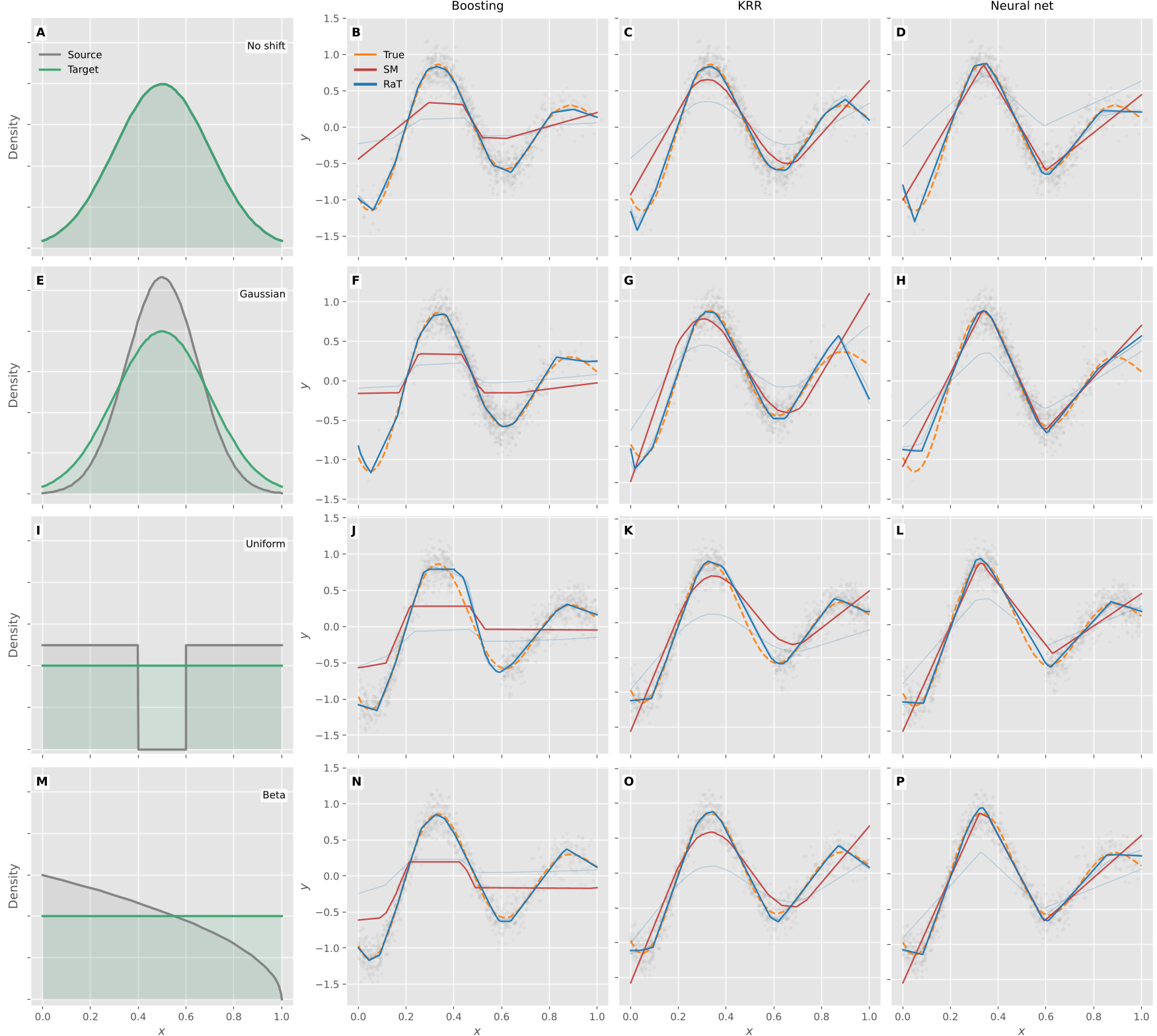 Figure 1: Comparison of RaT (Blue) vs SM (Red). Notice how the Blue line (RaT) progressively corrects toward the dotted orange (Ground Truth) while the Red line (SM) is stuck inheriting the Teacher's "staircase" or "oversmoothed" bias.
Theoretical Breakthrough: The Polynomial Gap
The paper provides a sharp separation result using Kernel Ridge Regression (KRR).
- Student Matching (SM): Incurs a constant error floor. It never converges to the ground truth if the teacher is biased.
- RaT: Achieves the minimax-optimal rate. It effectively "ignores" the teacher's bias as .
Notably, the authors identify "Benign Covariate Shift": situations where learning from the source distribution is actually better than learning from the target, provided the student-teacher interaction is handled via residuals.
Experimental Evidence
The authors tested RaT on synthetic data and the ImageNette dataset with various corruptions (Pixelate, Elastic Blur).
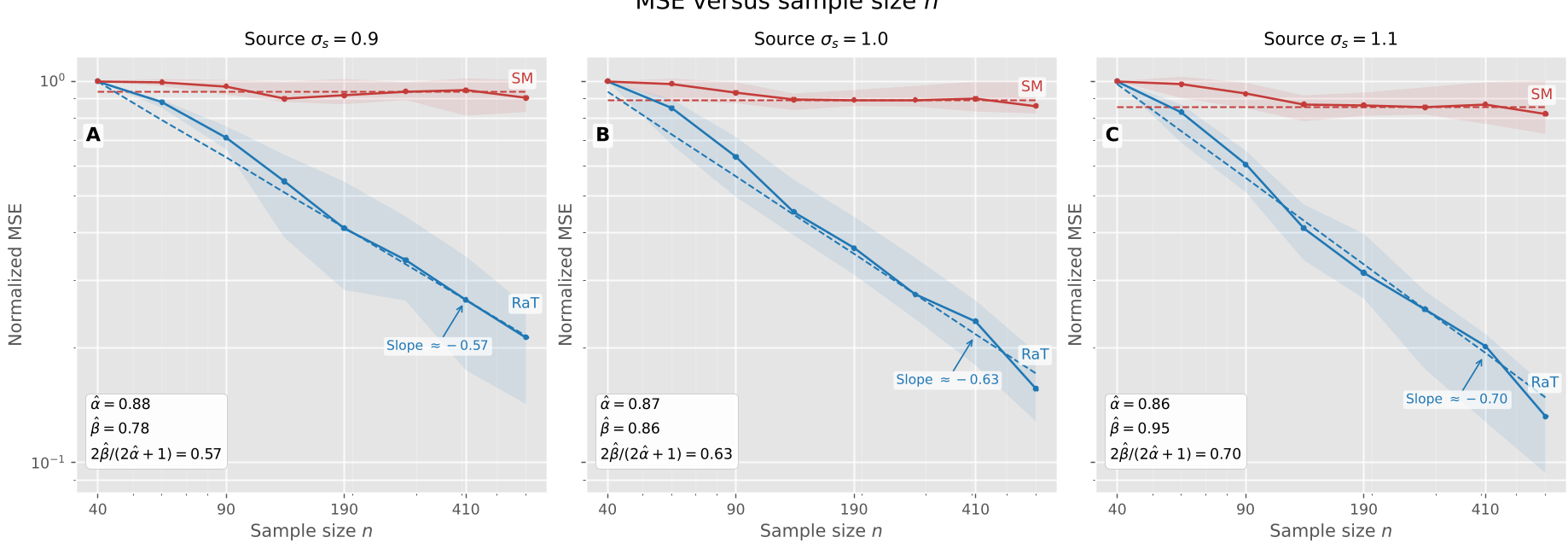 Figure 2: Statistical error scaling. RaT follows the theoretical power-law decay (dashed lines), while SM plateaus early, showing it cannot benefit from more data.
In the ImageNette experiments, as image corruption became more severe, the gap between RaT and SM widened. RaT's ability to "refine" the student became the deciding factor in maintaining accuracy where simple imitation failed.
Critical Analysis & Future Outlook
Takeaway
The "Residual-as-Teacher" approach is a fundamental rethink of distillation. It proves that the teacher's most valuable contribution isn't what it knows, but what it can tell the student about what the student doesn't know.
Limitations
- Computational Cost: RaT is iterative. It requires multiple passes of training the teacher on student residuals, which is more expensive than one-shot distillation.
- Convexity Assumptions: Much of the hard theory relies on convexity. While neural network experiments show promising results, the theoretical guarantee for non-convex landscapes remains an open frontier.
The Road Ahead
This framework is highly relevant for the era of LLM Distillation. As we use models like GPT-4 or DeepSeek to train smaller "edge" models, RaT suggests we should be asking these giants to critique and correct our small models' errors, rather than just providing labels.
Senior Editor's Note: This work by Yamamoto and Wainwright (MIT) provides the missing link between classical boosting and modern distillation. It is a must-read for anyone working on model compression or domain adaptation.