
Rethinking Reasoning-Intensive Retrieval: From Matching to Portfolio Construction
Rethinking Reasoning-Intensive Retrieval: Evaluating and Advancing Retrievers in Agentic Search Systems
The paper introduces BRIGHT-PRO, an expert-annotated benchmark for reasoning-intensive retrieval, and RTriever-4B, a specialized model fine-tuned on the aspect-decomposed RTriever-Synth corpus. These contributions aim to shift the focus from single-passage relevance to the construction of a comprehensive "evidence portfolio" for agentic search systems.
TL;DR
Reasoning-intensive retrieval is the new frontier in AI search. It’s not about finding a relevant document; it's about finding all the right pieces of a puzzle. This paper introduces BRIGHT-PRO, a benchmark that evaluates retrieval through "Reasoning Aspects," and RTriever-4B, a model trained to find complementary evidence. The core takeaway? A retriever's value isn't just its rank—it's how much it contributes to the final reasoning completeness of an AI agent.
The Problem: The "Relevance" Trap
Traditional Information Retrieval (IR) is designed for fact-finding. If you ask "How tall is the Eiffel Tower?", a single passage suffices. But modern "DeepSearch" agents (like OpenAI’s Deep Research or Perplexity) face complex, analytical queries that require a chain of evidence.
Current benchmarks and training sets fail because:
- Single-Passage Bias: They reward models for ranking one "gold" passage highly, even if the user needs three different perspectives to solve the problem.
- Static Evaluation: They ignore the "agent-in-the-loop" dynamic. In reality, an LLM agent uses a retriever multiple times, rephrasing queries based on what it has already found.
The Solution: BRIGHT-PRO & RTriever
The authors propose a shift in perspective: Evidence Portfolios.
1. BRIGHT-PRO Benchmark
Instead of a simple "Query List of Docs," BRIGHT-PRO decomposes each query into Reasoning Aspects.
- Aspect Weighting: Not all sub-problems are equal. Some are "Dominant" (critical for the answer), others are "Supporting."
- Agentic Protocol: They test retrievers inside a real workflow where an LLM (like GPT-5) plans and searches iteratively.
2. RTriever-Synth & RTriever-4B
Most synthetic data used to train retrievers consists of (Query, Positive, Negative) triplets. This paper introduces RTriever-Synth, which generates Complementary Positives.
- How it works: They take a reference answer, break it into 2-3 aspects, and generate a distinct passage for each aspect.
- Hard Negatives: They generate "Positive-Conditioned Hard Negatives"—passages that look like the gold evidence (same topic/keywords) but strategically omit the reasoning needed.
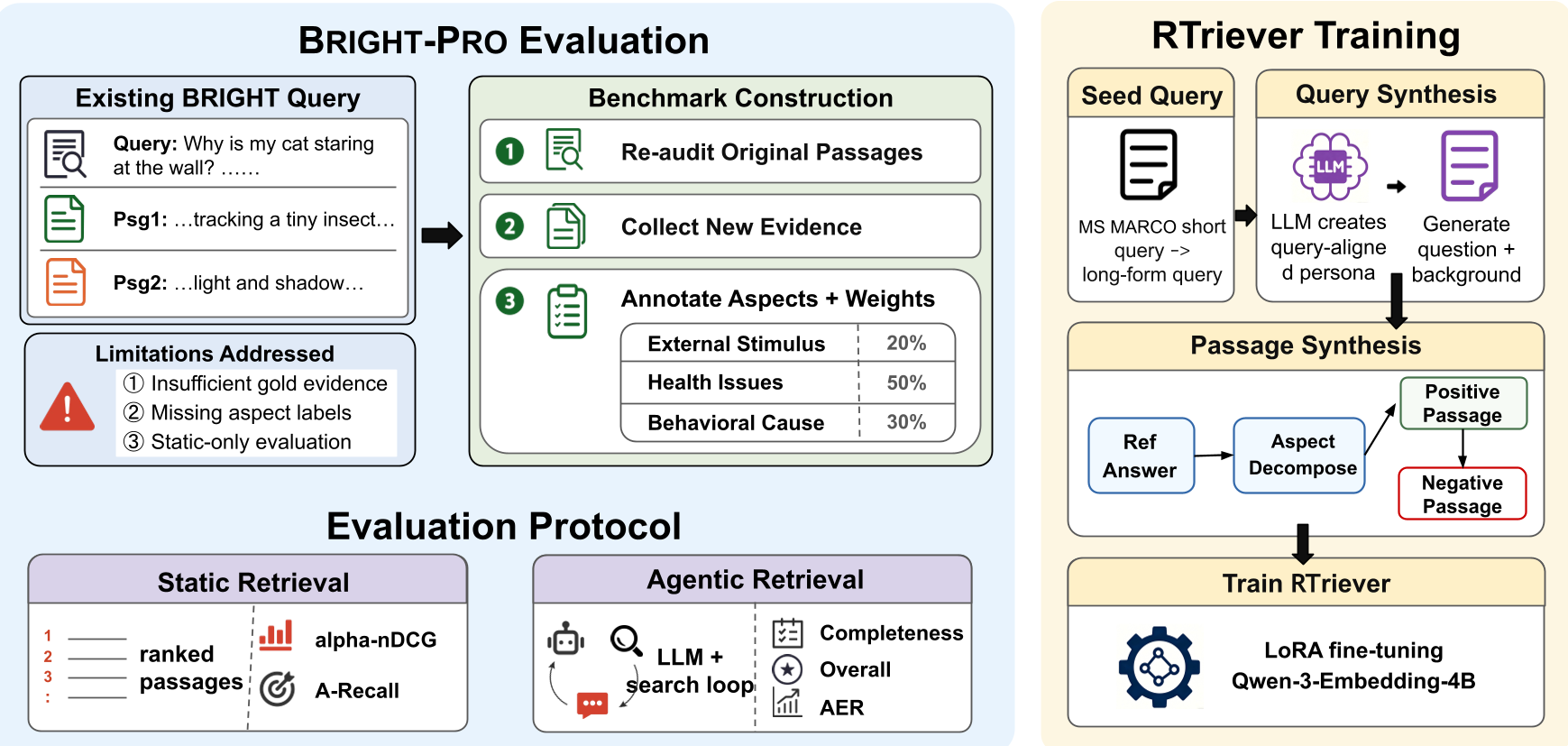 Figure 1: Comparison between the BRIGHT-PRO evaluation setup and the RTriever-Synth training pipeline.
Experimental Insights: Metrics Can Be Deceiving
The results from BRIGHT-PRO reveal fascinating behaviors that standard metrics like NDCG hide.
- The Power of Fine-Tuning: RTriever-4B (a 4B parameter model) consistently beat much larger general-purpose models (7B-8B). This proves that data quality (aspect-decomposed) trumps model size.
- Lexical Redemption: In static tests, BM25 (keyword matching) is terrible. But in the Agentic Protocol, BM25 becomes a top contender! Why? Because LLMs generate better keywords in round 2 and 3, allowing BM25 to find evidence that semantic models might miss due to "embedding drift."
- Efficiency Matters: The authors introduced AER (Efficiency-Quality Reward). It penalizes models that take too many rounds to find the answer. A "strong" retriever is one that lets the agent finish the job in 2 rounds instead of 10.
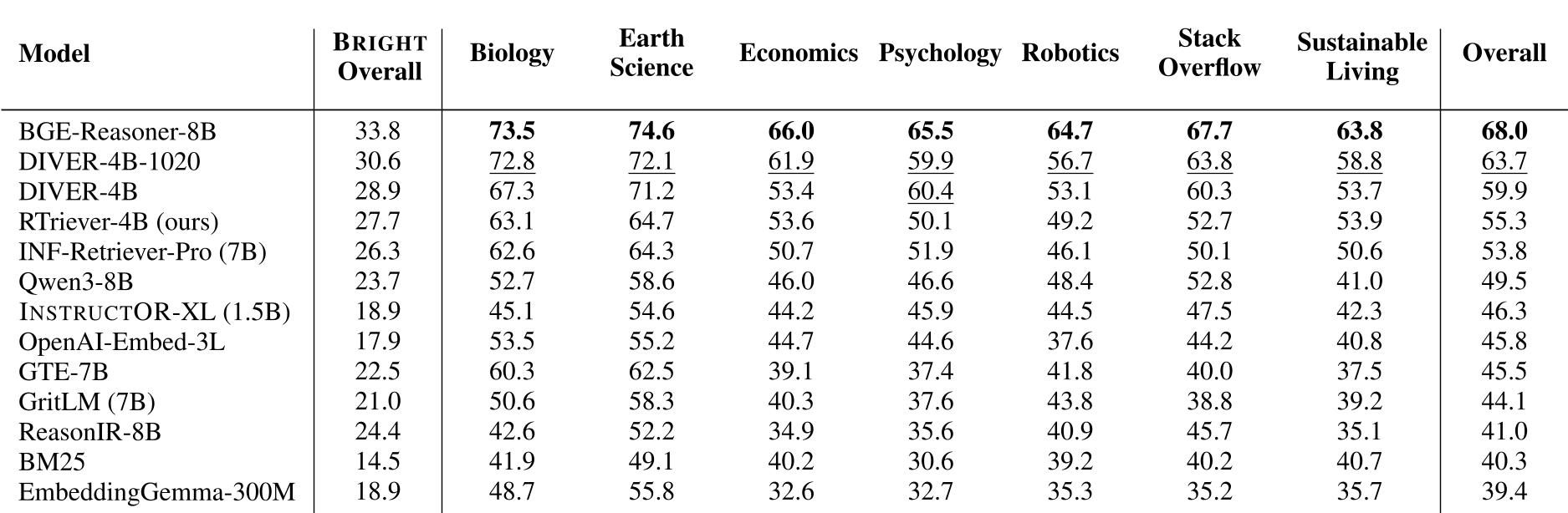 Figure 2: Performance across expert domains. Note the gap between reasoning-specialized models and general-purpose embedders.
Qualitative Analysis: Why Agents Fail
The paper identifies four major failure modes when retrievers and agents interact:
- Aspect Tunnel Vision: The retriever keeps finding deeper info on Aspect A while completely ignoring Aspect B.
- Repetition Bias: The model gets stuck in a "semantic loop," returning the same cluster of documents even when the agent rephrases the query.
- Speculative Reasoning: When the retriever fails entirely, the LLM starts "hallucinating" a plausible answer based on whatever junk was retrieved.
Conclusion and Industry Impact
This work signals a major shift for developers of RAG (Retrieval-Augmented Generation) systems. If you are building a research agent, you can no longer rely on standard "top-k" accuracy. You must optimize for coverage and complementarity.
The Takeaway: Stop training your retrievers to find "relevant" text. Start training them to fill the missing gaps in an LLM's reasoning chain.
Disclaimer: This analysis is based on the paper "Rethinking Reasoning-Intensive Retrieval: Evaluating and Advancing Retrievers in Agentic Search Systems" (Zhao et al., 2026).