
REASONMAXXER: Is the RL Loop Actually Necessary for LLM Reasoning?
Rethinking RL for LLM Reasoning: It's Sparse Policy Selection, Not Capability Learning
This paper introduces REASONMAXXER, an RL-free post-training method for LLM reasoning. By identifying that RL-induced improvements are sparse (affecting only 1-3% of tokens) and localized at high-entropy decision points, the authors achieve SOTA reasoning performance on benchmarks like MATH-500 and GSM8K by replacing heavy RL loops with targeted contrastive fine-tuning.
TL;DR
Contrary to the belief that Large Language Models (LLMs) need massive Reinforcement Learning (RL) pipelines to "learn" how to think, new research reveals that RL's impact is surprisingly surgical. By analyzing token-level changes, researchers found that RL only modifies about 1-3% of tokens, specifically at high-uncertainty "decision points." This insight led to REASONMAXXER, a method that matches RL performance using just 50 problems and minutes of training, slashing costs by three orders of magnitude.
Strategic Context: This work moves the needle from "RL-heavy" to "Data-Surgical" post-training. It positions reasoning improvement as a Sparse Policy Selection problem rather than a capability acquisition problem.
The Motivation: RL's Expensive Secret
The AI community has been obsessed with RLVR (RL with Verifiable Rewards) to replicate the success of models like OpenAI’s o1 or DeepSeek-R1. However, the authors observed a paradox: while RL improves performance, it doesn't actually introduce new tokens that weren't already in the top-5 candidates of the base model.
The researchers asked a fundamental question: If RL is just steering the model toward paths it already knows, can we skip the RL optimization loop entirely?
Methodology: The Mechanistic Reality of RL
By comparing base models with their RL-tuned counterparts (e.g., Qwen2.5-7B vs. its GRPO-tuned version), the authors discovered three key properties:
- Sparsity: Only 1% to 4% of positions were reranked.
- Conservative Edits: The "new" tokens chosen by RL were almost always already favored by the base model (average rank ~2).
- Entropy Localization: Edits concentrated where the base model was most uncertain—measured by high token-level entropy.
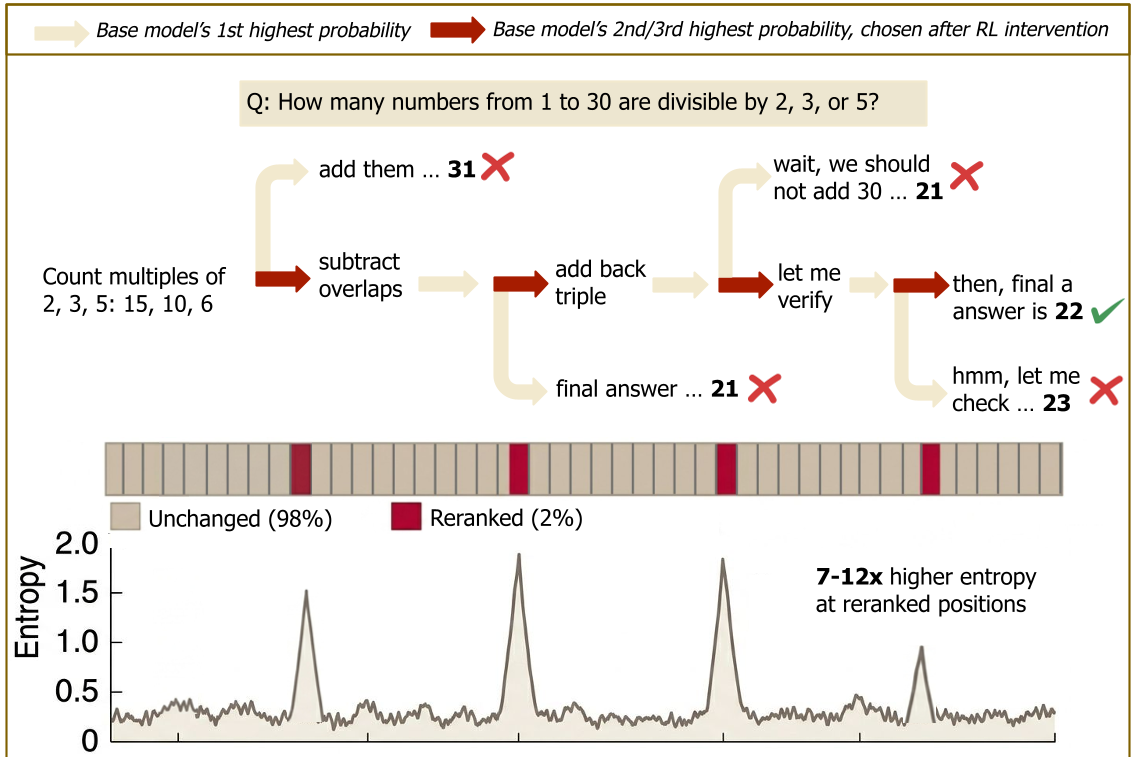 Figure 1: Visualizing that RL doesn't invent new knowledge; it acts as a sparse corrector at high-entropy decision points.
REASONMAXXER: The RL-Free Alternative
Instead of the "shotgun" approach of RL—where gradients are applied to every token in every rollout—REASONMAXXER uses a "sniper" approach:
- Step 1: Edge of Competence Filter: Select problems where the model sometimes succeeds and sometimes fails.
- Step 2: Entropy Gating: Identify positions where entropy .
- Step 3: Contrastive Loss: Apply a loss that boosts tokens leading to correct answers and suppresses those leading to wrong ones, only at those gated positions.
- Step 4: Base Anchoring: Use a KL-divergence loss to ensure the rest of the model's behavior remains identical to the base model.
Experiments & SOTA Performance
The authors tested REASONMAXXER across diverse families (Qwen, DeepSeek, Mistral). The results were staggering.
1. Accuracy Equality
REASONMAXXER consistently matched or beat full-scale RL models. For instance, on MATH-500, REASONMAXXER achieved 50.2% accuracy, outperforming several PPO and GRPO baselines that cost thousands of dollars more to train.
2. Radical Efficiency
The most disruptive finding is the cost-benefit ratio.
- Standard RL (Open-Reasoner-Zero): ~$103,000 to train Qwen2.5-32B.
- REASONMAXXER: ~$25 for the same model.
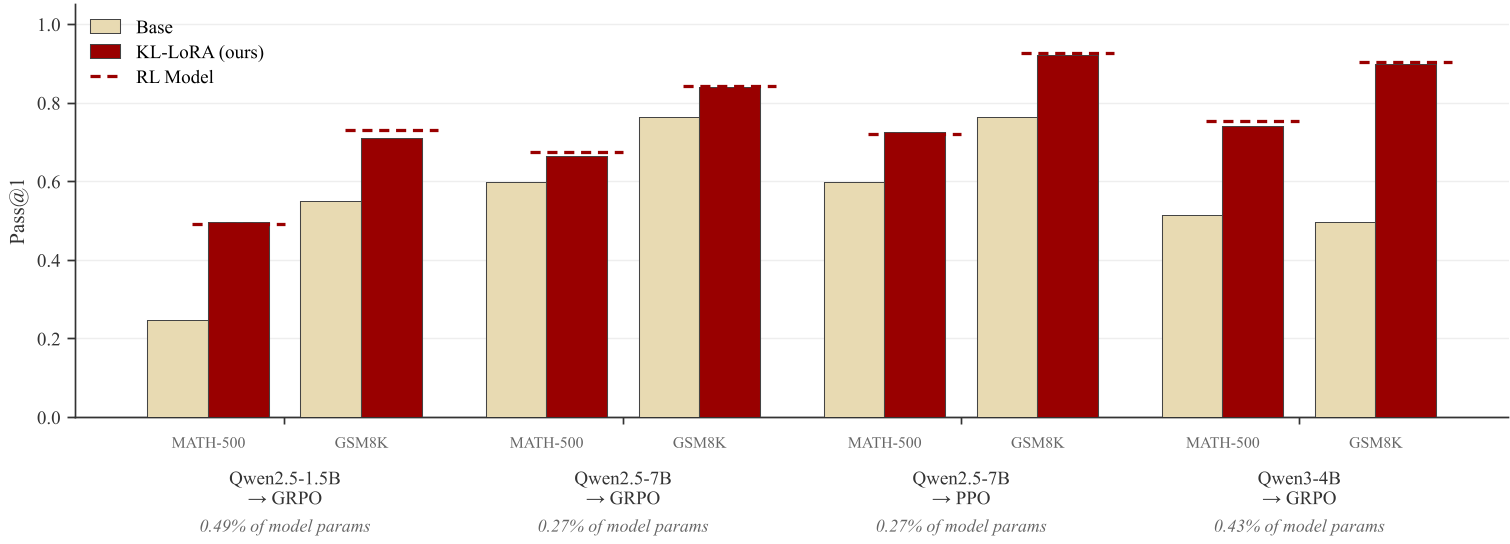 Figure 2: KL-LoRA distillation proves that the entire reasoning delta of RL can be captured in a tiny 0.5% parameter adapter.
Critical Analysis & Deep Insights
Why is this effective?
The core "Insight" is that reasoning is low-dimensional. The model has the "muscles" (the pre-trained knowledge and reasoning chains); it just lacks the "coordination" to choose the right branch at critical junctions. REASONMAXXER provides that coordination using a fraction of the compute.
Limitations
While highly effective for outcome-based reasoning (math, code), REASONMAXXER relies on verifiable rewards. It requires at least one correct rollout within the initial sample pool. If a model is 0% successful on a hard problem, REASONMAXXER (like most RL) has nothing to learn from. Furthermore, it may not account for "Process-based" improvements where intermediate reasoning steps need dense supervision.
Conclusion: The End of Heavy RL for Reasoning?
REASONMAXXER proves that for mathematical and logical reasoning, the "standard" investment in heavy RL infrastructure might be overkill. By refocusing on entropy-gated contrastive tuning, researchers and startups can achieve "reasoning-level" performance on a shoestring budget.
Key Takeaway: Don't train harder; train more selectively. The delta between a base model and a reasoning model is a sparse 3% correction—find those tokens, and you find the solution.