
Rigorous Interpretation Is a Form of Evaluation: Beyond Black-Box Benchmarks
Rigorous Interpretation Is a Form of Evaluation
Summary
Problem
Method
Results
Takeaways
Abstract
This position paper argues that rigorous interpretability—satisfying the scientific criteria of falsifiability, reproducibility, and predictivity—should be treated as a superior form of model evaluation. It moves beyond behavioral "black-box" benchmarks to mechanism-level scrutiny, enabling causal debugging and proactive failure prediction.
## TL;DR
Static benchmarks like accuracy and win rates are no longer enough. This paper argues that for AI evaluation to be truly robust, it must incorporate **rigorous interpretability**. By treating interpretability as a scientific discipline—requiring **falsifiability, reproducibility, and predictivity**—we can debug root causes, detect "correct-for-the-wrong-reason" shortcuts, and predict future failures before they happen.
## The Illusion of Competence
In the current LLM landscape, we are obsessed with "behavioral snapshots." If a model passes a benchmark, we deem it capable. However, the authors argue that this captures only surface competence. Two models might achieve the same score: one through sound logical reasoning, and the other through brittle heuristics (shortcuts).
The core motivation is clear: **Understanding *why* a model behaves a certain way is as critical as measuring *what* it does.** If we don't understand the mechanism, we cannot trust the output in high-stakes or out-of-distribution (OOD) environments.
## Methodology: The Three Pillars of Scientific Interpretability
The paper redefines interpretability as a mechanism-level evaluation through three specific lenses:
### 1. Falsifiability Enables Debugging
For an explanation to be useful, it must be testable. If an interpretability method claims a specific "neuron" or "feature" causes a behavior, we should be able to intervene (e.g., switch it off) and see a predictable change.
* **Success Story:** Concept Bottleneck Models (CBMs) allow experts to edit internal concepts to fix medical imaging misclassifications.
* **The Struggle:** Sparse Autoencoders (SAEs) often show "underdetermination"—the same intervention doesn't always yield the same result across different data distributions.
### 2. Reproducibility Detects Faulty Mechanisms
Reproducibility ensures that our interpretations aren't just "cherry-picked" noise. This is vital for tasks like **Natural Language Inference (NLI)**, where models often learn to associate specific words (shortcuts) with "entailment" rather than understanding logic. A reproducible interpretation would consistently flag these shortcuts across different test sets.
### 3. Predictivity Anticipates Failures
The highest form of evaluation is predicting how a model will fail on data it has never seen.
* **Geometric Insight:** By analyzing the geometry of embeddings (e.g., the "Linear Representation Hypothesis"), researchers can find "entanglements" between concepts like gender and profession, predicting bias even if the current test set is balanced.
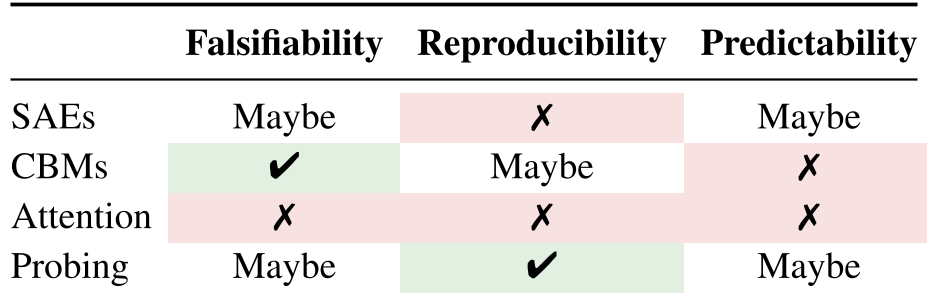
*Table 1: Evaluation of current interpretability methods against scientific standards. Notice that no current method (SAEs, CBMs, Attention, Probing) perfectly satisfies all three criteria.*
## The "SAE" Reality Check
Sparse Autoencoders (SAEs) are the current "darling" of mechanistic interpretability, but this paper offers a sobering critique. SAE features are often **dataset-dependent**. A "refusal" feature found in chat-formatted data might vanish when the model sees raw web text. This inconsistency fails the reproducibility test, making SAEs a "maybe" for rigorous evaluation.
## From Identification to Intervention
The paper concludes that we must move from "descriptive" interpretability (look at this cool heatmap!) to "evaluative" interpretability (I predict this feature will cause a failure on X, and here is the intervention to fix it).
### Key Takeaways for Researchers:
* **Don't rely on Attention maps:** They are often neither falsifiable nor reproducible (the "Attention is not Explanation" debate).
* **Focus on Causal Units:** Look for stable representations that hold up under distribution shifts.
* **Mechanism over Behavior:** A model that is "Right for the Wrong Reasons" is a ticking time bomb for safety.
## Conclusion
Interpretability is not just a post-hoc curiosity; it is the future of model metrology. By holding our explanations to the same scientific rigor as physics or chemistry, we transform interpretability into the most powerful evaluation tool in our arsenal.