
SCALELOGIC: Cracking the Power Law of Long-Horizon Reasoning
Can RL Teach Long-Horizon Reasoning to LLMs? Expressiveness Is Key
The paper introduces SCALELOGIC, a synthetic logical reasoning framework designed to study Reinforcement Learning (RL) scaling in Large Language Models. By independently controlling proof depth (horizon) and logical expressiveness (+Conjunction, +Negation, etc.), the authors demonstrate that RL training compute follows a strict power law relative to task difficulty, achieving SOTA-level reasoning gains on downstream benchmarks like MATH-500.
TL;DR
Researchers have finally quantified the "difficulty" of logic. By creating SCALELOGIC, a synthetic environment with surgical control over proof depth and logical operators, they discovered that RL training effort follows a rigid power law. Crucially, the more complex the logic (e.g., adding "for all" vs. simple "if-then"), the steeper the cost of scaling—but the higher the reward in downstream "real-world" intelligence.
The "Black Box" of Reasoning Difficulty
Why do LLMs fail at multi-step problems? Current benchmarks like GSM8K or MATH are too "noisy" to answer this. We don't know if a model fails because the proof is too long (horizon) or because the logic is too complex (expressiveness).
The authors argue that current RL progress is hampered by the lack of a "Petri dish" for reasoning. SCALELOGIC provides this by generating problems where you can dial up the depth (steps required) or the expressiveness (logical operators like ) independently.
Methodology: The Backward Proof Engine
Unlike human-written problems, SCALELOGIC uses Backward Construction. It starts with a conclusion and recursively generates premises, ensuring a unique path to the "ground truth."
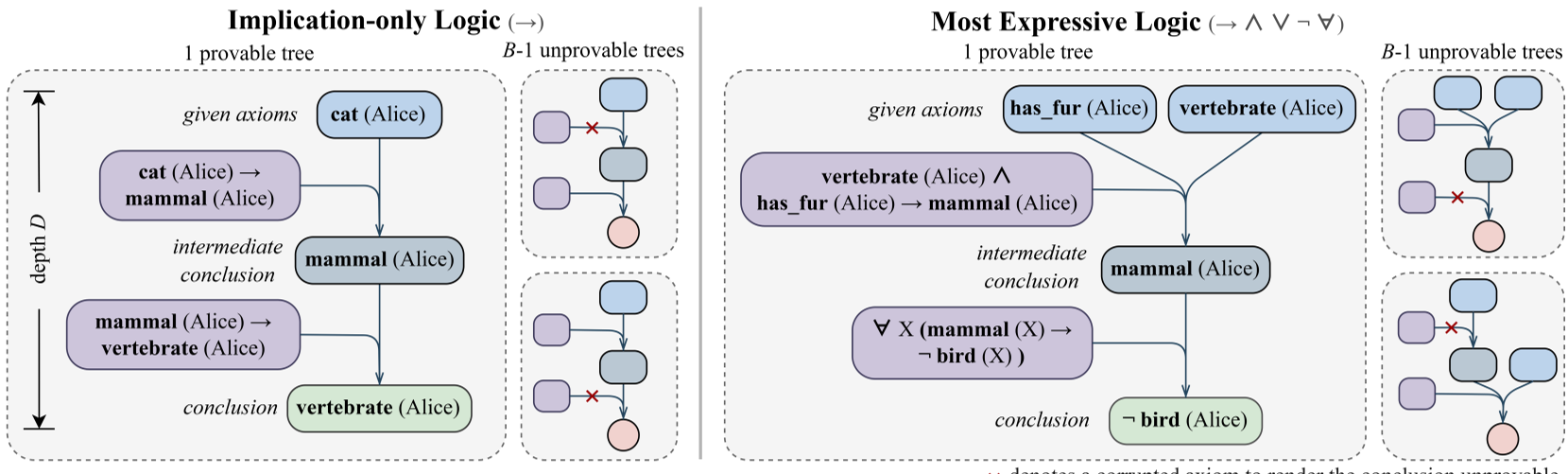
The framework supports a hierarchy:
- Implication-only: Linear "if A then B" chains.
- + Conjunction: Requires merging multiple facts ("A and B then C").
- + Negation/Disjunction: Introduces polarity and branching.
- + Quantification: The "Final Boss"—first-order logic involving "anyone" or "all X."
The Core Discovery: is the Governor of Intelligence
The most striking finding is the Scaling Exponent (). By measuring the training steps () needed to reach 90% accuracy against proof depth (), they found:
- Implication-only: (Cost grows linearly with depth).
- Quantification: (Cost grows nearly cubically).
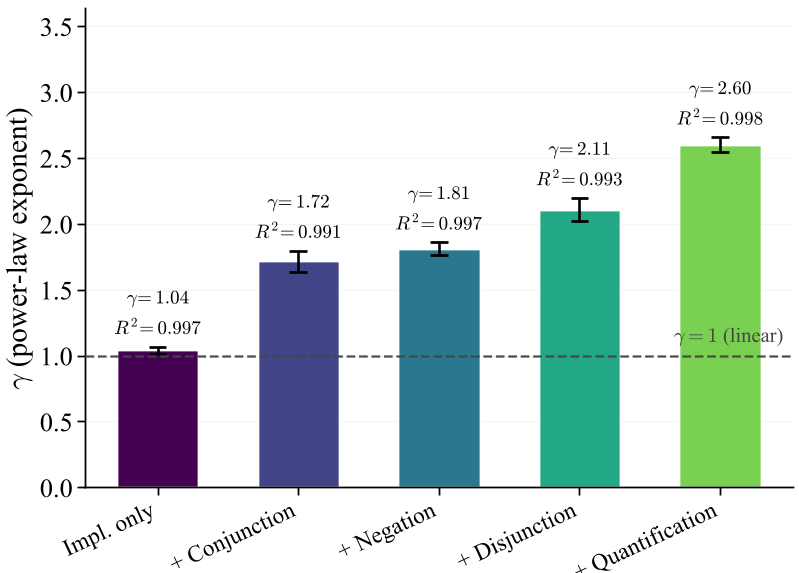
This indicates that as we demand more "expressive" reasoning from AI, the compute required to solve longer chains doesn't just increase—it explodes.
Experiments: Does Synthetic Skill Transfer?
A common criticism of synthetic data is that the model just "memorizes the game." This paper refutes that. Training a 4B model on the most expressive logic led to a 10.66% boost on real benchmarks like AIME and GPQA.
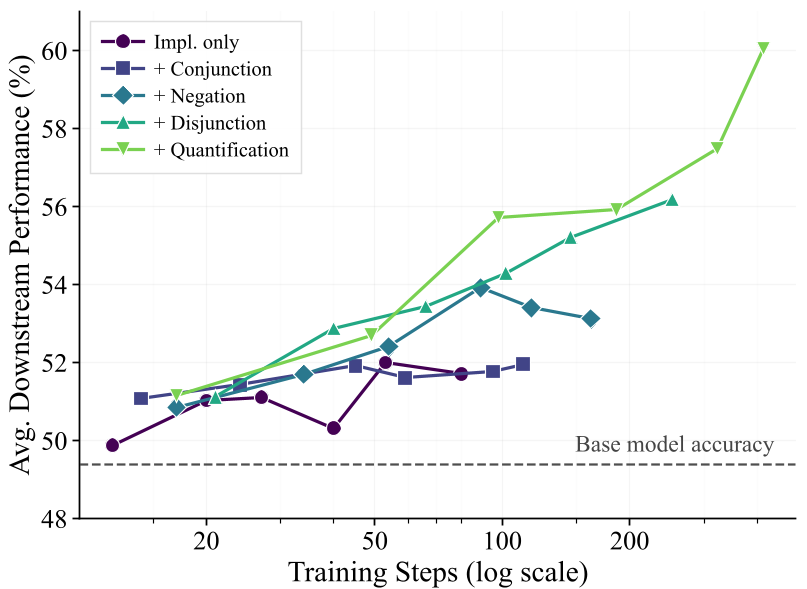
Key Insight: At the same compute budget, models trained on "hard" logic (Quantification) crushed those trained on "easy" logic. This suggests that Expressiveness is a catalyst for generalization.
Deep Insights: The Curriculum Advantage
The authors also show that a Curriculum (starting with shallow proofs and gradually increasing depth) significantly lowers the scaling exponent. It helps the model "bootstrap" long-chain-of-thought (CoT) behaviors earlier, making the training process far more efficient.
Critical Analysis & Conclusion
While the results are robust (R² > 0.99), the study is limited to 4B and 8B models. The "Scaling Exponent" might shift for 70B+ models. However, the takeaway for the industry is clear:
To build the next generation of "Reasoning Models" (like OpenAI's o1 or DeepSeek-R1), simply adding more data isn't enough. We must focus on the structural expressiveness of the training tasks. Synthetic logic isn't just a toy—it's the gym where LLMs learn to think.
Takeaway: If you want a model to solve math, don't just give it math; give it complex, expressive logic.