
RoboAlign-R1: Bridging the Gap Between Visual Fidelity and Physical Reality in Robot World Models
RoboAlign-R1: Distilled Multimodal Reward Alignment for Robot Video World Models
This paper introduces RoboAlign-R1, a novel framework for robot video world models that utilizes reward-aligned post-training and a training-free Sliding Window Re-encoding (SWR) inference strategy. It achieves state-of-the-art results in task consistency and physical realism, improving aggregate scores by 10.1% over strong baselines like iVideoGPT.
TL;DR
RoboAlign-R1 addresses two critical failures in modern robot video world models: the misalignment of training objectives with actual task success, and the dreaded "drift" in long-horizon predictions. By distilling a giant multimodal "Judge" model into a lean reward proxy and introducing a clever "Sliding Window Re-encoding" (SWR) inference trick, it creates a world model that doesn't just look real—it acts logically.
Academic Positioning: This work represents a shift from "Video Generation" to "Interactive World Simulation," prioritizing downstream decision-making utility over simple pixel-level reconstruction.
The Problem: Why "Looking Good" Isn't Good Enough
Traditional world models are trained to minimize reconstruction loss (MSE) or perceptual distance (LPIPS). However, in robotics, a prediction can be visually crisp but physically nonsensical—for instance, a robot hand successfully grasping an object, but the object failing to move. This Reward Misalignment leads to models that hallucinate physics.
Compounding this is Long-Horizon Drift. Because models like iVideoGPT predict tokens autoregressively, a 1% error at step 10 becomes a 100% failure at step 100. The world literally "dissolves" as the sequence progresses.
Methodology: The Two-Pillar Solution
1. Reward-Aligned Post-Training
Instead of relying on dumb metrics, the authors built RobotWorldBench. They fine-tuned an 8B multimodal model (RoboAlign-Judge) to "think" about six dimensions: Instruction Following, Manipulation Success, Action-Outcome Consistency, Temporal Consistency, Contact Realism, and Physics Adherence.
To make this usable for Reinforcement Learning (which requires thousands of iterations), they distilled this 8B "Teacher" into a 98M "Student" reward model. This student is 100x faster but retains the teacher's "intuition."
2. Sliding Window Re-encoding (SWR)
To stop the drift, the authors took inspiration from "Attention Sinks" in LLMs. SWR works by periodically decoding the generated tokens back into an actual image and then re-encoding that image as a fresh "starting frame." This effectively resets the cumulative error timer every steps.
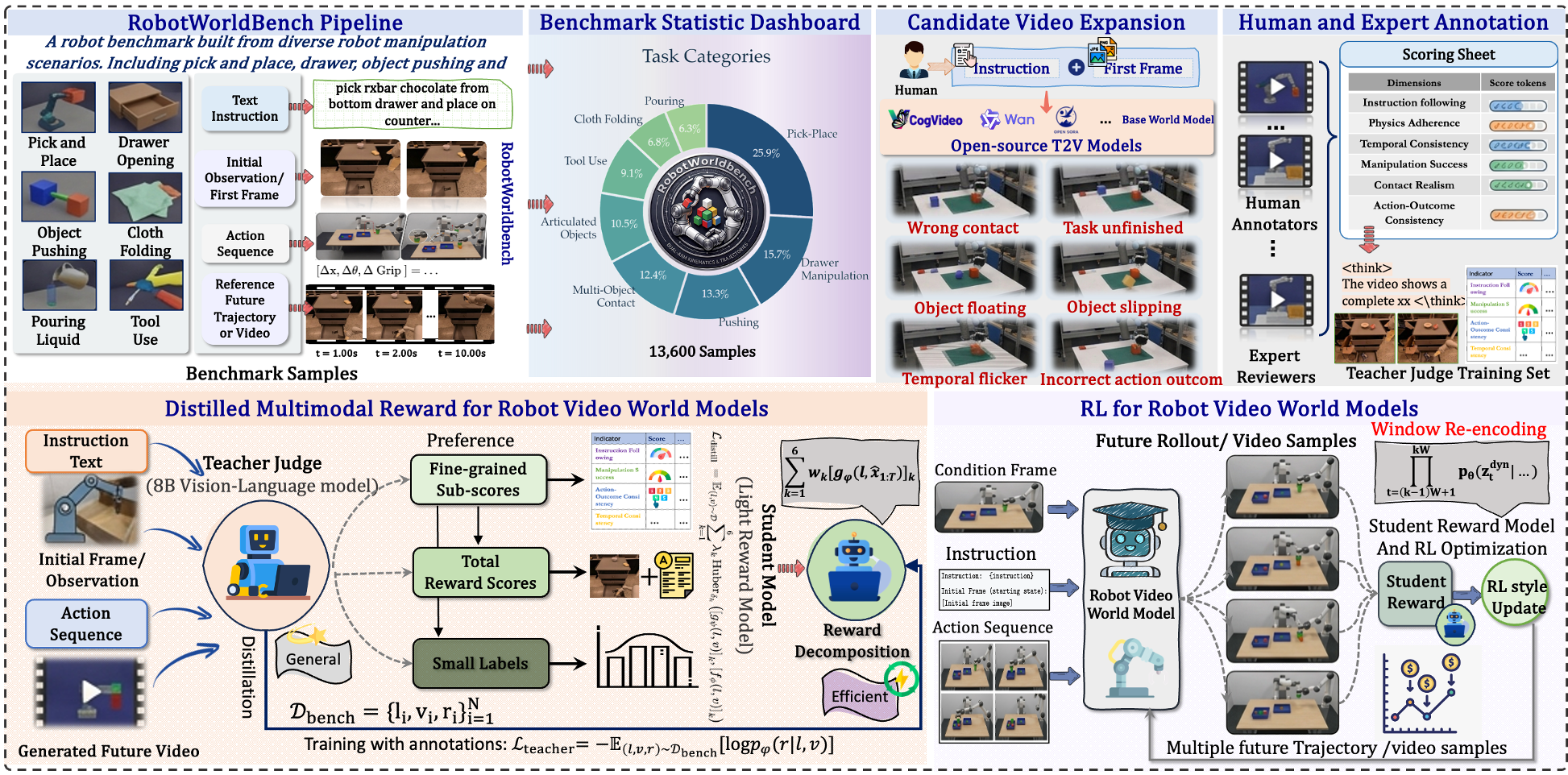 Figure 1: The RoboAlign-R1 pipeline, showing the transition from a heavy Teacher-Judge to a lightweight Student Reward, and the SWR inference logic.
Experimental Battlefront: SOTA Performance
RoboAlign-R1 was tested against traditional video models (SVD, CogVideoX) and interactive world models (iVideoGPT).
- Task Success: On the RT-1 dataset, it surpassed iVideoGPT (the previous SOTA) by 10.1% in aggregate score.
- Stability: SWR proved that you don't need massive compute to fix long-horizon issues. By simply "refreshing" every 6 steps (), the model maintained structural similarity (SSIM) far better than vanilla autoregressive decoding.
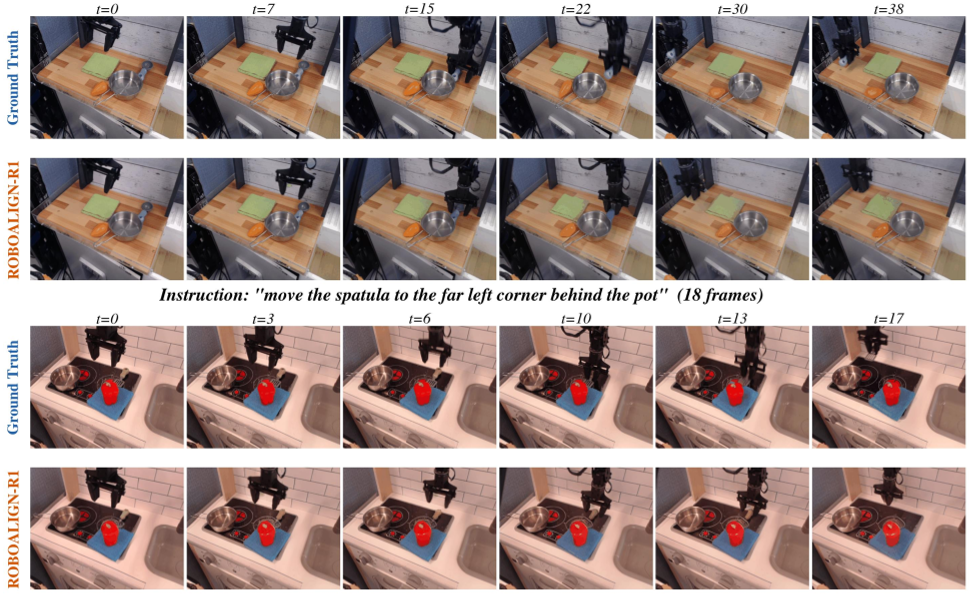 Figure 2: Qualitative results showing RoboAlign-R1 maintaining significantly better shadow consistency and object geometry during a "pick apple" task compared to baselines.
Deep Insight: Efficiency vs. Alignment
One of the paper's most impressive findings is the efficiency of the distilled reward model. As shown in the rewards ablation, using a multimodal reward (aligned with the judge) results in better performance even on low-level metrics compared to training directly on those low-level metrics. This suggests that "teaching" the model about physics and success provides a better inductive bias than just teaching it to copy pixels.
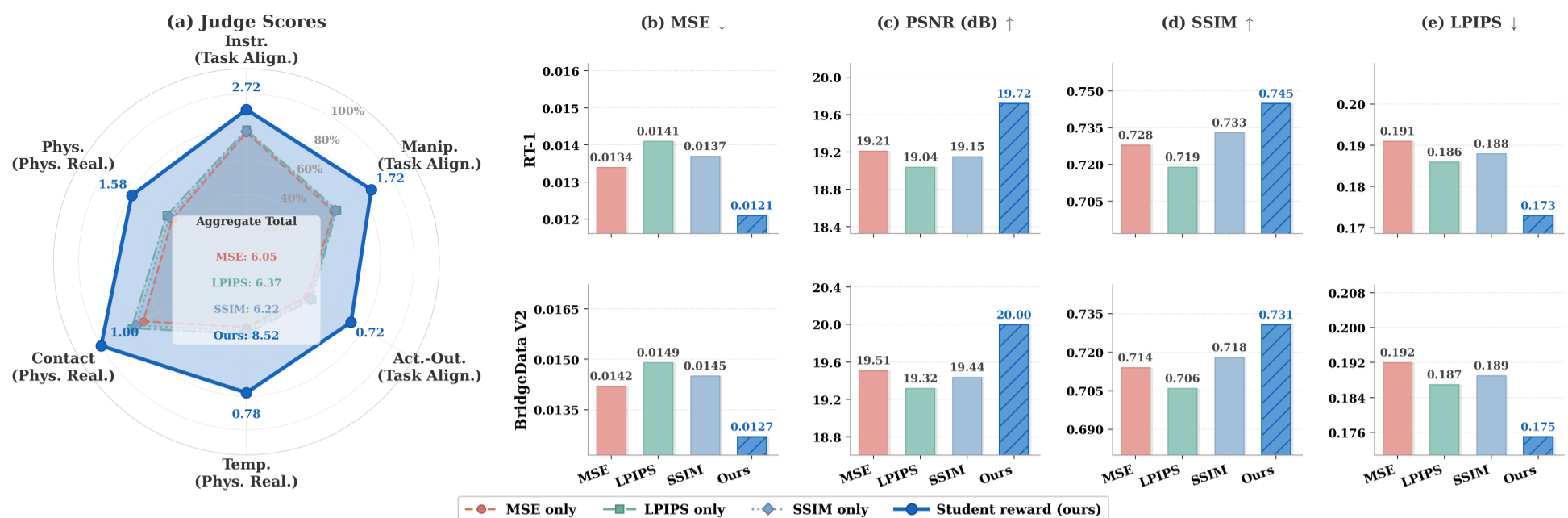 Figure 3: Ablation studies showing the superiority of distilled multimodal rewards over LPIPS or MSE and the effectiveness of SWR in capping LPIPS growth over time.
Critical Analysis & Conclusion
RoboAlign-R1 is a major step forward for Embodied AI. It solves the "fuzzy world" problem that has plagued world models for years.
Takeaways:
- Alignment matters more than scale: A properly aligned 1.3B world model can outperform a 5B general video model on robot tasks.
- Inference-time resets are underrated: SWR is a "free" win (1.1% latency for 10% quality gain).
Limitations: The evaluation is currently restricted to tabletop manipulation. Future work will need to prove if this alignment holds in more complex, dynamic environments (e.g., humanoid locomotion or drone flight).
Senior Editor's Note: If you are building latent world models for control, the SWR strategy and the Judge-to-Student distillation pipeline are now the new baseline protocols to follow.