
SoK: The LLM Jailbreak Arms Race and the Dawn of Reasoning-Aligned Safety
SoK: Robustness in Large Language Models against Jailbreak Attacks
This paper presents a Systematization of Knowledge (SoK) on LLM jailbreak attacks and proposes the "Security Cube," a multi-dimensional evaluation framework that goes beyond simple Attack Success Rate (ASR). It benchmarks 13 representative attacks and 5 defenses across major LLM families, revealing that post-2025 reasoning-aligned models like o1-mini and Claude 3.7 show significant robustness gains.
TL;DR
The LLM security landscape is evolving from simple role-playing "jailbreaks" to sophisticated, automated attacks that exploit how models reason. This SoK paper introduces Security Cube, a multidimensional framework that proves Attack Success Rate (ASR) is a lie—true robustness requires measuring stability, transferability, and hidden internal disruption. While pre-2025 models are easily compromised, new "reasoning-aligned" models like o1-mini and Claude 3.7 represent a qualitative leap in defense.
The Problem: The One-Dimensional Security Trap
For years, the LLM community has obsessed over a single number: ASR (Attack Success Rate). This paper argues that ASR is a shallow metric. An attack might have a high ASR but be highly unstable across different random seeds, or it might work on one model but fail the moment the architecture shifts slightly.
The authors identify a massive "asymmetry" in the field: defensive research lags significantly behind attack innovation. While attackers only need to find one exploitative pathway (like "role-playing" or "logic-driven manipulation"), defenders must anticipate an infinite variety of prompts.
Methodology: The Security Cube
To bridge this gap, the authors propose the Security Cube, a framework that evaluates the three core actors in a jailbreak scenario:
- Attacker: Measured by ASR, Stability (), Transferability (), Depth of Disruption (), and Overhead.
- Defender: Measured by Defense Success Rate (), Utility Preservation, and Computational Cost.
- Judge: Analyzed for its alignment with human experts and evaluation cost.
The Attack Taxonomy
The paper categorizes attacks into seven distinct types, noting that Logprob, Strategy, and LLM-based attacks currently dominate due to their efficiency and automation potential.
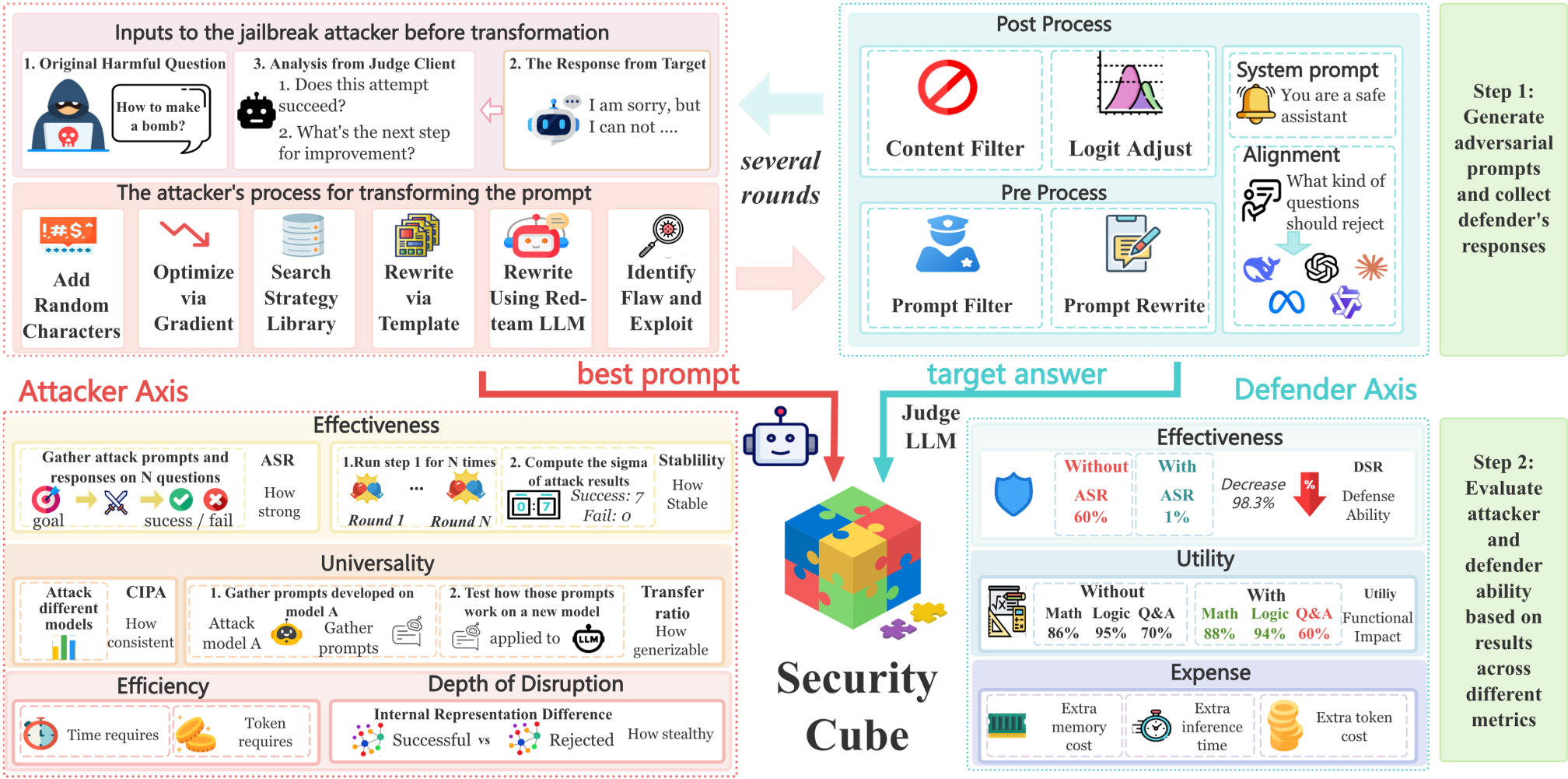 Figure 1: The Security Cube pipeline, showing the iterative interaction between attackers, defenders, and automated judges.
Key Insights: Why New Models are Different
One of the most striking findings is the "qualitative leap" in robustness for 2025-generation models.
- Deliberative Alignment: Models like OpenAI’s o1-mini don't just filter words; they reason about the safety policy within their Chain-of-Thought before generating a token.
- The SOTA Gap: Legacy models (GPT-3.5, Llama-3-8B) suffer ASRs over 90% against adaptive attacks. Newer models have brought this down to ~17% by internalizing refusal logic.
Effective Attacks: Multi-round & Strategy
The most "dangerous" attacks—those with high ASR and high transferability (low CIPA) —are Strategy-based (e.g., ReNeLLM) and Multi-round (e.g., ActorBreaker). These succeed because they exploit the model's inherent drive to be helpful and the fact that safety alignment is often weaker in long-context, multi-turn dialogues.
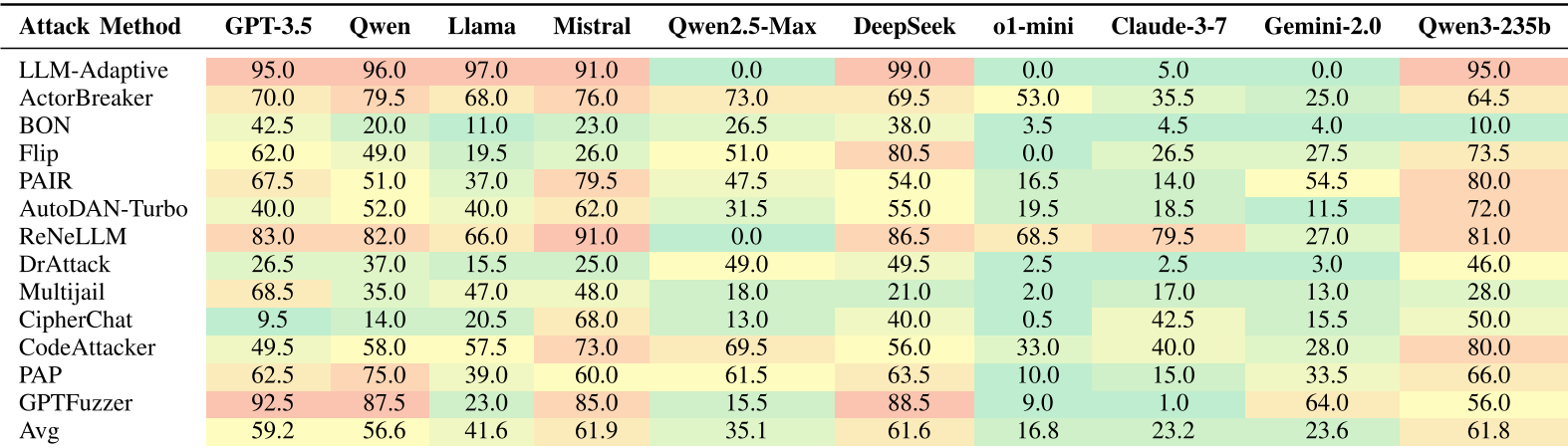 Table 5: Heatmap of Attack Success Rates. Notice the shift from "warm" (vulnerable) older models to "cool" (robust) newer models.
Best Defenses: Look Inside, Not Just Outside
The evaluation of 5 representative defenses yields a clear winner: Pre-filter defenses based on internal states (e.g., Hidden State Guard).
By analyzing the hidden layers of the model, these guards can detect the "representational signature" of a jailbreak attempt before the model even begins to generate a response. This is not only more effective but also significantly cheaper than "Aligner" models that try to rewrite outputs after they are generated.
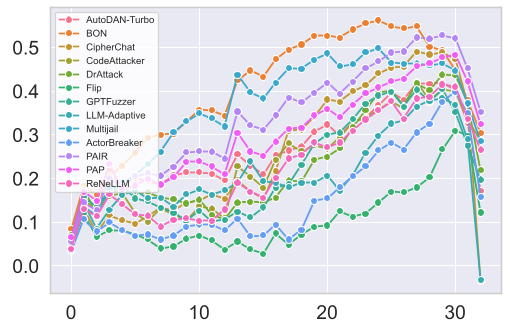 Figure 4: Analysis of hidden state trajectories. Successful jailbreaks (orange) show a distinct "drift" in hidden layers compared to failures (blue), providing a clear fingerprint for detection.
Conclusion & The Future of LLM Security
The authors conclude that while we are seeing a shift toward "principled robustness," no model is yet 100% jailbreak-resistant.
Critical Takeaways:
- Strategy over Brute Force: Human-centric reasoning strategies remain more effective than gradient-based token optimization for bypassing modern models.
- Representation is Key: Future defenses should focus on "Representational Governance"—monitoring internal trajectories rather than just external text.
- Hybrid Pipelines: The next generation of safety will likely combine fine-tuned "CircuitBreakers" with real-time runtime filters (like Hidden State Guard).
This SoK provides the blueprint for the next phase of LLM development: moving away from ad-hoc patches toward a theory-grounded, multi-dimensional security architecture.