
[CVPR 2026] S-VAM: Distilling Geometric and Semantic Foresight for Real-Time Robotic Mastery
S-VAM: Shortcut Video-Action Model by Self-Distilling Geometric and Semantic Foresight
The paper introduces S-VAM (Shortcut Video-Action Model), a novel robot learning framework that achieves high-fidelity visual foresight with real-time efficiency. By leveraging a self-distillation strategy, S-VAM maps noisy one-step diffusion features to stable geometric and semantic representations, achieving SOTA performance on CALVIN (Avg. Len 4.16) and MetaWorld (72.8% Success Rate).
Executive Summary
TL;DR: S-VAM (Shortcut Video-Action Model) is a breakthrough in robotic manipulation that resolves the long-standing conflict between visual foresight and inference speed. By "shortcutting" the video generation process, it extracts high-quality geometric and semantic blueprints from a single diffusion forward pass. This allows robots to anticipate future states with the precision of a multi-step generator but at the speed required for closed-loop control.
Background Positioning: This work sits at the intersection of Video Generation and Vision-Language-Action (VLA) models. While VLAs often lack temporal foresight, S-VAM treats a Video Diffusion Model (VDM) as a "world model" and distills its complex internal knowledge into a fast, executable policy.
The Dilemma: Accuracy vs. Real-Time Feedback
Modern robots need to "imagine" what happens next to handle complex tasks like pouring water or assembling parts. Currently, researchers use two main approaches:
- Generative Planning: The robot creates a full video of the task. Problem: Too slow (seconds per frame).
- Feature Extraction: The robot takes a "peek" at the first step of the diffusion process. Problem: The features are a "noisy mess" (entangled), making the robot's attention drift away from the target.
S-VAM identifies that the "noisy mess" of the first step actually contains all the necessary information—it just hasn't been organized yet.
Methodology: The Shortcut Mechanism
The core innovation of S-VAM is the Self-Distillation of Decouplers. Instead of waiting for the diffusion model to finish its iterative denoising, S-VAM uses two lightweight "Decouplers" to instantly translate noisy features into two distinct "Blueprints":
- Geometric Foresight (DPAv3): Provides the 3D structure and depth cues needed for spatial precision.
- Semantic Foresight (DINOv2): Ensures the robot keeps its "eye on the prize" by identifying task-relevant objects.
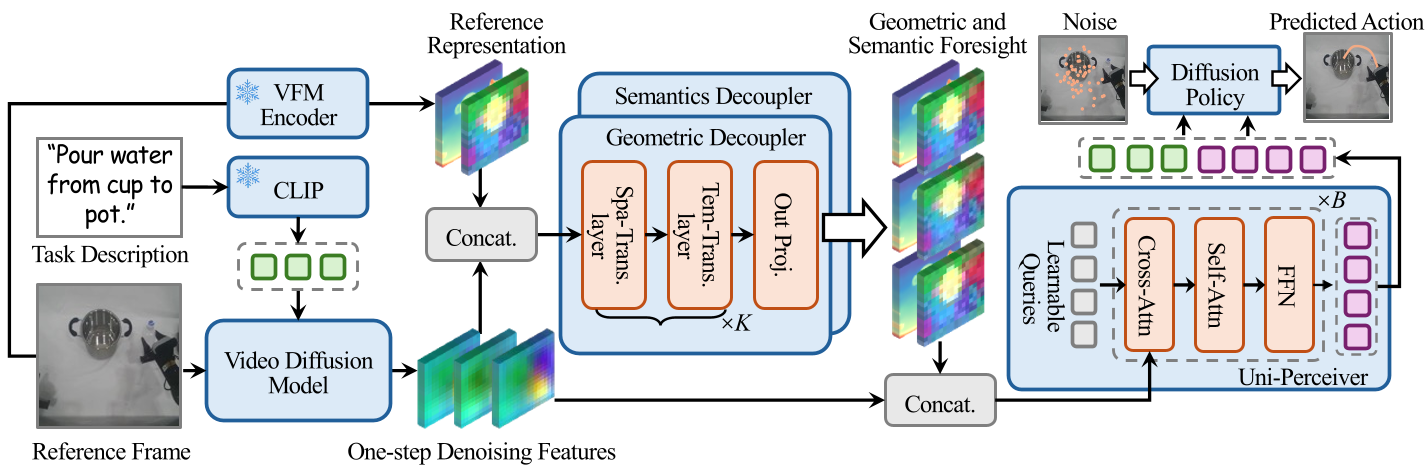
Why Self-Distillation?
The authors discovered that supervising the model with "Ground Truth" future frames actually hurts performance. Why? Because the noisy features belong to a specific "diffusion trajectory." By using the model's own multi-step predictions as the teacher, S-VAM ensures the distilled foresight is perfectly aligned with the features it extracts at runtime.
Experiments & SOTA Performance
S-VAM was tested against heavyweights like OpenVLA and Pi-0 across several benchmarks:
- CALVIN (Long-horizon tasks): Achieved a record 4.16 average sequence length, significantly more stable than the previous state-of-the-art, VPP.
- MetaWorld (Hard tasks): In tasks requiring fine-grained assembly, S-VAM's success rate was 68.4%, nearly 16% higher than VPP.
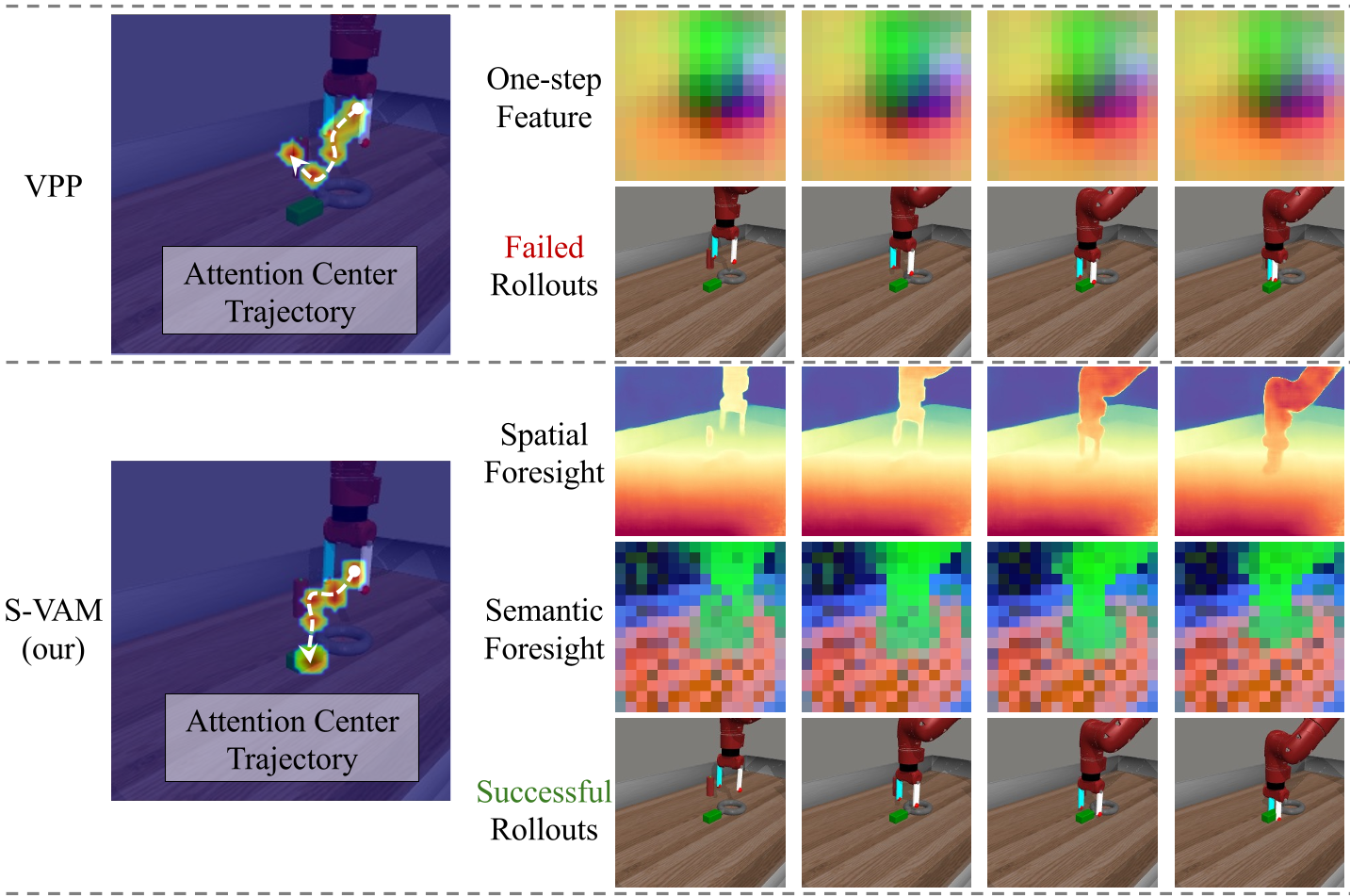
As seen in the attention trajectory visualization above, S-VAM maintains a laser-focus on the object (the "nut"), whereas earlier feature-extraction methods (VPP) see their attention drift into empty space.
Real-World Impact: Handling Translucency and Depth
In real-world tests using a Mobile ALOHA system, S-VAM demonstrated superior performance in challenging scenarios, such as picking up transparent cups. Transparent objects often break standard vision systems due to depth ambiguity. S-VAM’s geometric decoupler effectively "filled in" the missing depth information, doubling the success rate compared to baselines.
Deep Insight & Conclusion
S-VAM proves that we don't need to choose between the "richness" of generative models and the "agility" of direct-action models. The information is already there in the early stages of a diffusion model; we just need the right "decouplers" to unlock it.
Limitations: While the overhead is low (15.8%), it still requires a high-end GPU (like an RTX 3090) to maintain 25Hz. Future work could potentially shrink the Video Diffusion backbone itself to make this technology accessible to lower-power edge devices on mobile robots.
Final Takeaway: By turning "noisy foresight" into "structured blueprints," S-VAM sets a new standard for how robots can leverage internet-scale video dynamic knowledge for precise, real-time interaction.