
SAM: Solving the Scalability Paradox in Shape-Morphing Metamaterials
Scalable Active Metamaterials for Shape-Morphing
The paper introduces Scalable Active Metamaterials (SAM), a hierarchical design framework for aperiodic shape-morphing structures. By decoupling the problem into macro-scale mesh optimization (ConLME) and micro-scale unit-cell inverse design (using Diffusion Models or Adjustable Search), it achieves SOTA linear scalability in computational cost relative to structural resolution.
TL;DR
Designing materials that change shape (like a UAV wing or a soft surgical robot) usually involves a "curse of dimensionality": more resolution means exponentially more computing power. Scalable Active Metamaterials (SAM) breaks this curse. By using a clever hybrid of rigid and soft components and a Conditional Diffusion Model, researchers at Texas A&M have achieved linear scalability, allowing for complex, high-resolution shape-morphing designs that were previously computationally impossible.
The Bottleneck: Why Can't We Just Scale Up?
In the world of metamaterials, we usually choose between two evils:
- Periodic Designs: Simple to compute but boring. Everything moves the same way (like a repeating wallpaper).
- Aperiodic Designs: Infinite freedom but a nightmare to design. As you add more cells, the "integrated design" approach requires massive simulations where every cell influences every other cell, leading to a computational explosion.
Prevailing bar-based hierarchical models often fail because active materials are soft—they don't just "stretch" along an axis; they twist and bulge, creating "non-axial effects" that ruin the global shape accuracy.
The SAM Insight: Separation of Concerns
The authors proposed a "Divide and Conquer" strategy based on a Hybrid Architecture:
- The Hardware: Each unit cell is surrounded by stiff, rigid bars. These bars act as "insulators," suppressing the messy interactions between neighboring soft infills.
- The Software (Decomposition): Because the cells are isolated, the problem splits into two:
- Macroscale: Optimize the "skeleton" (the rigid mesh).
- Microscale: Design the "muscle" (the soft infill).
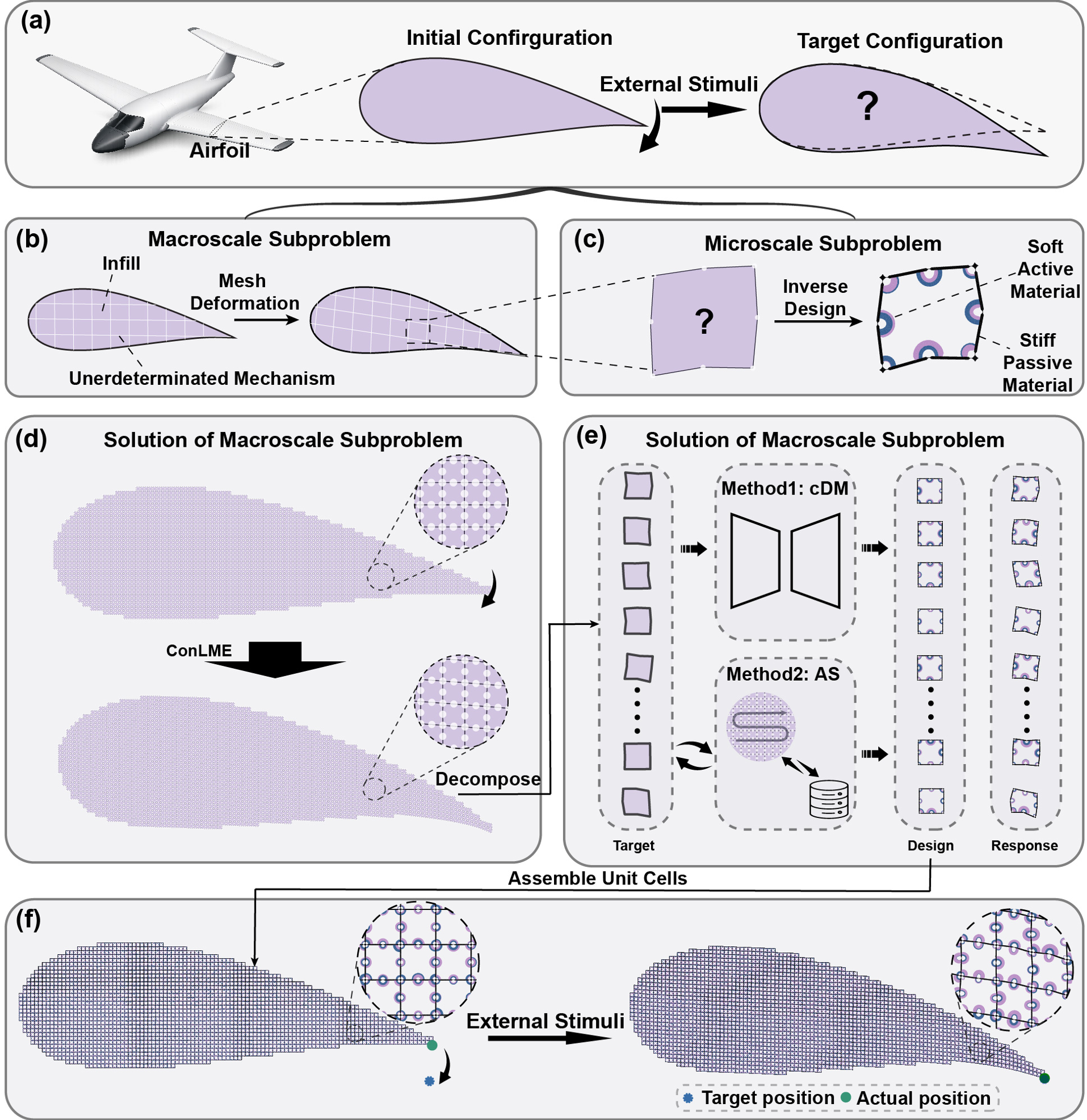 Fig 1: The SAM workflow—from target shape to decomposed mesh optimization, ending in diffusion-based unit design.
Methodology: ConLME and Diffusion Models
1. Macro-scale: Constrained Laplacian Mesh Editing (ConLME)
Rather than running expensive Finite Element Analysis (FEA) at the global level, the authors adapted a technique from computer graphics: Laplacian Mesh Editing. They added a "Configuration Consistency" term which acts as a data-driven soft constraint. This ensures the skeleton only bends into shapes that the soft "muscles" are actually capable of achieving.
2. Micro-scale: The Generative "Muscle" Maker
To fill the cells, the authors used a Conditional Diffusion Model (cDM).
- Input: The 8 target internal angles of the cell.
- Process: The model "denoises" a random pattern into a precise, curved-beam topology.
- Result: A design that deforms exactly as needed under heat (thermal stimuli), without needing a human to design it.
Results: Linear Efficiency and Global Accuracy
Small-scale tests are easy, but SAM shines as complexity grows.
- Linear Scaling: While traditional Topology Optimization (TO) costs grow cubically (O(N³)), SAM grows linearly (O(N²)). This makes designing 1,000+ cell structures a matter of minutes rather than days.
- Generality: The team demonstrated an Active Octopus (independently controlled tentacles), Airfoil Morphing (matching UIUC airfoil curves), and Active Tweezers.
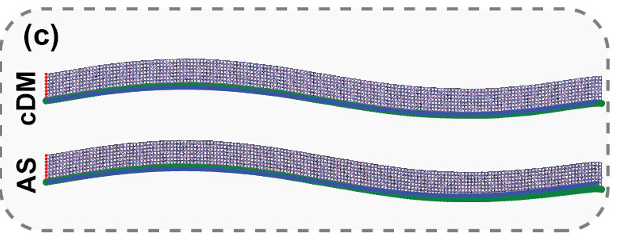 Fig 2: Scaling comparison. Note the linear runtime of cDM-based SAM vs. the exponential growth of other search strategies.
Critical Analysis & Future Outlook
SAM represents a major leap, but it’s not without limits:
- Physical Feasibility: If you ask the mesh to perform a "physically impossible" move (like a zero-radius fold), the ConLME will struggle, leading to local distortions.
- Volume Shrinkage: Interestingly, SAM structures tend to reduce in volume when actuated. This "Compactness" is a huge win for medical devices inside blood vessels but might be a limitation for applications requiring expansion.
The Takeaway: By treating metamaterial design as a Hierarchical Generative Task rather than a single massive optimization problem, we finally have a viable path to large-scale, adaptive machines that are as complex as biological tissues.