
[ArXiv 2026] SCALE: Redefining Virtual Cell Perturbation through Endpoint-Aligned Transport
SCALE:Scalable Conditional Atlas-Level Endpoint transport for virtual cell perturbation prediction
SCALE is a large-scale foundation model for virtual cell perturbation prediction that formulates the task as a conditional transport problem. Built on a BioNeMo-based framework, it achieves state-of-the-art biological fidelity, improving PDCorr by 12.02% and DE Overlap by 10.66% over the previous SOTA, STATE.
TL;DR
SCALE (Scalable Conditional Atlas-Level Endpoint transport) is a new foundation model designed to predict how cells respond to genetic, chemical, or cytokine interventions. By moving away from simple "reconstruction" and treating perturbation as an endpoint-aligned transport problem, SCALE achieves massive gains in biological accuracy (12% PDCorr improvement) and training efficiency (12.5x speedup) on giga-scale datasets like Tahoe-100M.
Background: The Virtual Cell Challenge
Virtual cell models aim to enable in silico experiments—predicting a cell's response to a drug or gene knockout before ever touching a wet-lab pipette. However, the field has hit a wall:
- The Pairing Problem: You can't measure the same cell "before" and "after" a treatment; it's destroyed during sequencing.
- The "Mean-Effect" Trap: Standard models minimize Mean Squared Error (MSE), which often leads them to predict a "safe" average state that misses crucial biological heterogeneity.
- Infrastructure Bottlenecks: Processing 100M+ cells requires more than just a better loss function; it requires a scalable system.
Methodology: Flow Matching Meets Cellular Sets
SCALE's architecture is built on two core pillars: Hierarchical Encoding and Conditional Latent Transport.
1. Hierarchical Set-Aware Encoder
Cells in a population are an unordered set. SCALE uses a two-level approach:
- Intra-cell: A LLaMA-style gene encoder captures dependencies between genes within a single cell.
- Inter-cell: A DeepSets aggregation layer captures the population-level structure without being sensitive to cell order.
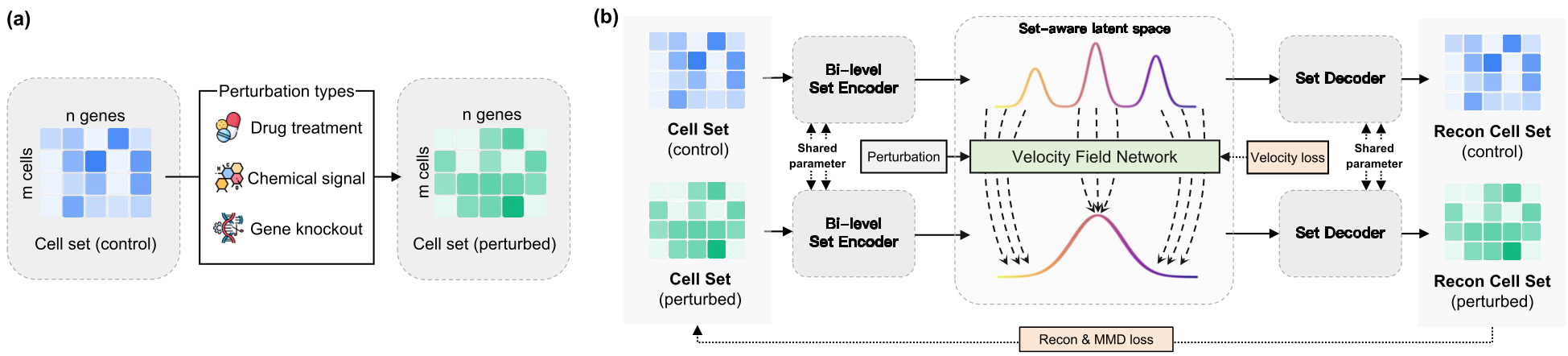
2. Endpoint-Aligned Transport (The JiT Strategy)
Rather than trying to model an unknown, continuous biological path, SCALE utilizes a JiT (Just-in-Time) parameterization. It learns the transport between the control population (Time 0) and the perturbed population (Time 1) in the latent space.
By supervising the endpoints rather than intermediate steps, the model avoids the instability of trajectory-based flow matching when only the start and end states are actually observed in the data.
Experimental Results: Precision Over Reconstruction
The most striking finding in SCALE is the decoupling of MSE and biological accuracy. While SCALE sometimes shows higher MSE than previous models, it destroys competition in PDCorr (Pearson Delta Correlation) and DE Overlap (recovering Differentially Expressed genes).
| Dataset | Metric | STATE (SOTA) | SCALE (Ours) | Improvement |
|---|---|---|---|---|
| Tahoe-100M | PDCorr ↑ | 0.850 | 0.953 | +12.02% |
| Tahoe-100M | DE Overlap ↑ | 0.728 | 0.806 | +10.66% |
| PBMC | PDCorr ↑ | 0.796 | 0.979 | +23.00% |
Why lower MSE doesn't mean a better model
Standard MSE treats every gene equally. However, a perturbation usually only affects 1-5% of genes. SCALE focuses on the direction and pattern of change. As the authors note: “Optimizing strictly for MSE often leads to a 'mean-effect' trap... smoothing out the strong signals needed to identify true biological responses.”

Infrastructure: Scaling to 100 Million Cells
Predicting perturbations across 1,100+ conditions and hundreds of cell lines requires immense throughput. Using a BioNeMo-based framework, SCALE achieved:
- 12.51× Speedup in pretraining.
- Optimized storage via LMDB shards.
- Batch-aware sampling to handle imbalanced datasets.
Critical Analysis & Takeaways
SCALE proves that the future of virtual cells isn't just "more parameters." The 184M parameter version of SCALE actually matched or outperformed the 280M version, suggesting we are hitting a data/recipe plateau rather than a capacity one.
Key Design Lessons:
- Adaptive Condition Injection: Using "Seed Attention" to inject drug/cell-type info is far superior to simple concatenation.
- Endpoint Supervision: Predicting the final state (x-pred) is more stable for biological transport than predicting velocity fields (v-pred).
- Gaussian-Control Mixing: Introducing a bit of noise (Gaussian) into the control prior helps the model avoid "shortcuts" where it simply copies the input to the output.
Conclusion
SCALE represents a shift in philosophy: from reconstructing matrices to transporting biological states. By aligning the mathematics of Flow Matching with the reality of experimental endpoints, it provides a robust foundation for the next generation of AI-driven drug discovery and genetic research.
Senior Editor's Note: SCALE signals the end of 'MSE-only' evaluation in this field. If you aren't capturing the DEGs (Differentially Expressed Genes), you aren't capturing the biology.