
Seeing Realism from Simulation: Bridging the VLA Sim-to-Real Gap with Efficient Video Transfer
Seeing Realism from Simulation: Efficient Video Transfer for Vision-Language-Action Data Augmentation
The paper introduces an efficient video augmentation framework that converts simulated Vision-Language-Action (VLA) data into realistic training videos. By utilizing conditional video diffusion and a three-stage velocity caching mechanism, it significantly improves the sim-to-real generalization of robotic models like RDT-1B and π0.
TL;DR
Simulated data is a goldmine for robotics, but its lack of realism often leads to brittle models. This paper introduces an end-to-end framework that transforms clean "sim-style" videos into high-fidelity "real-world" training data. By combining conditional video diffusion, a 60% faster velocity-caching inference, and strategic coreset sampling, the authors demonstrate significant performance boosts across major VLA benchmarks and real-world hardware.
The Problem: The "Memory Trap" of Static Simulations
In the world of Vision-Language-Action (VLA) models, simulation is a double-edged sword. While it provides infinite, safe data, these environments are often "sterile"—static lighting, uniform textures, and fixed camera angles.
The authors observed that models trained purely on these simulated datasets often achieve 95%+ success rates in the lab but fail catastrophically (dropping below 30%) with minor changes to the environment. This suggests the models are memorizing fixed trajectories rather than learning robust, semantic task understanding.
Methodology: High-Fidelity & High-Efficiency Pipeline
The proposed framework addresses this by essentially "re-skinning" simulation data to look and feel like the real world while keeping the robotic actions (the "Action" in VLA) intact.
1. The Video Transfer Pipeline
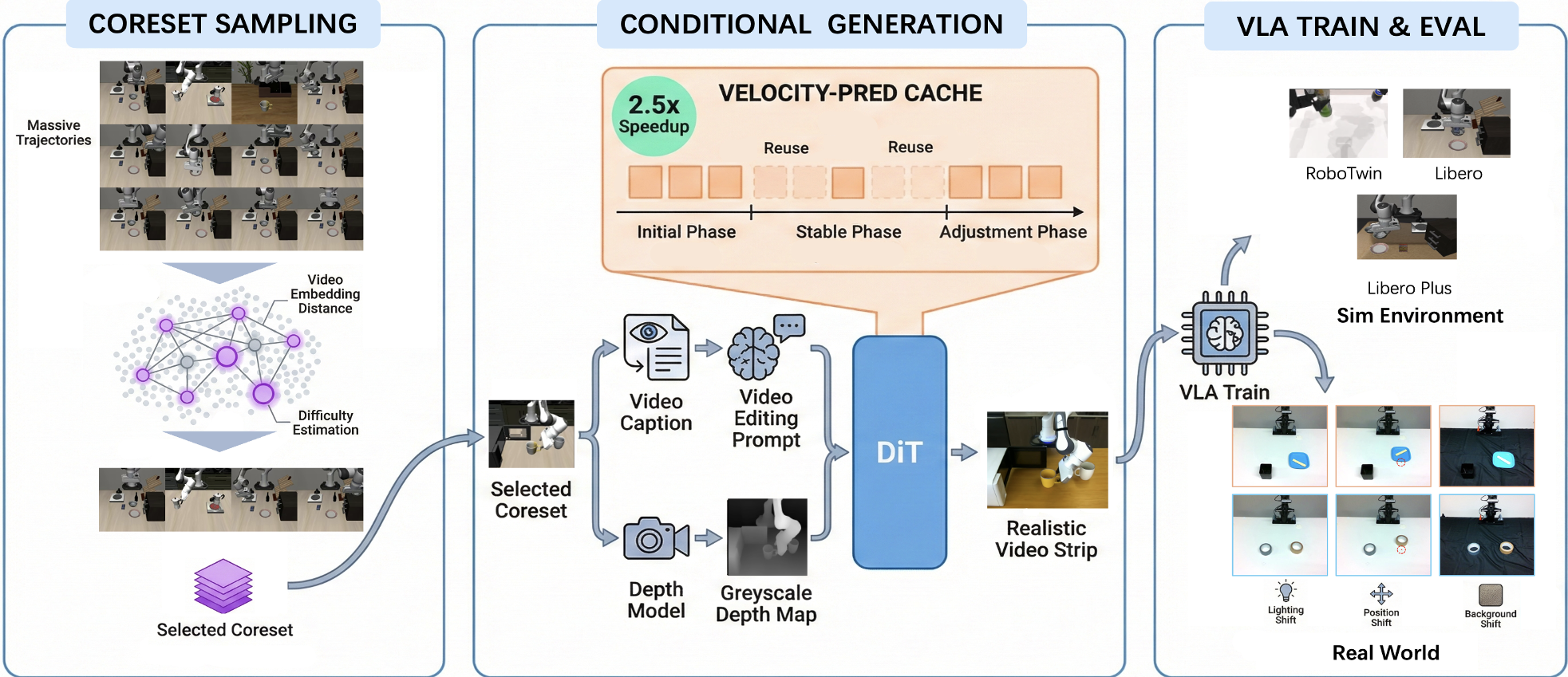
As shown in the architecture below, the process involves four critical steps:
- Structure Extraction: Using depth maps from the simulator to preserve the geometric "truth."
- Semantic Expansion: Generating captions with VideoChat2 and rewriting them using LLMs (Qwen3) to introduce varied backgrounds (e.g., "marble table," "polished steel").
- Conditional Synthesis: Using Cosmos-Transfer 2.5 to generate the final video based on the depth map and the new prompts.
2. Velocity Caching: Generating Videos 60% Faster
The biggest hurdle for video diffusion is the inference cost. The authors discovered a Three-Stage Denoising Pattern. Early in the diffusion process, the "velocity" of change is high; in the middle, it stabilizes; and at the end, it refines details. By caching and reusing velocity values during the stable phase, they cut generation time by over 60% with negligible loss in quality.
3. Coreset Sampling: Quality Over Quantity
Augmenting an entire dataset is overkill. The authors designed a sampling strategy that looks for:
- Difficulty: High loss in the current policy (what the robot is bad at).
- Diversity: Using visual embeddings (Cosmos-Embed1) to ensure the training data covers the entire "manifold" of possible scenarios.
Experiments and Performance
The framework was tested on Robotwin 2.0, LIBERO-Plus, and a physical AgileX Piper robot.
- Robustness to Perturbations: On LIBERO-Plus, which tests models against lighting and layout changes, the augmented π0 model achieved a 5.1% average gain, with specific boosts of up to 22% in language instruction robustness.
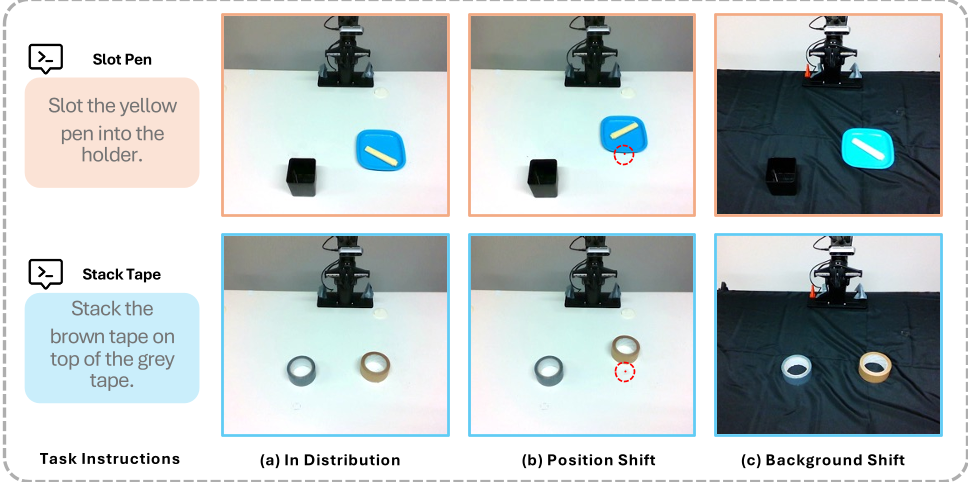
- Real-World Success: In tasks like "Slot Pen" and "Stack Tape," the augmentation provided 13-15% absolute gains in success rates during out-of-distribution tests (e.g., changing the table background from white to black).
Critical Analysis & Conclusion
This work highlights a shift in robotics from better architectures to better data engines. By treating simulation as a "semantic skeleton" and diffusion as the "visual skin," we can bridge the sim-to-real gap without the prohibitive cost of human teleoperation.
Limitations: The current method excels at appearance-based augmentation (textures, lighting) but struggles with geometric perturbations (camera viewpoints). Since the core "structure" is tied to the simulator's depth map, fundamental perspective shifts still require simulation-side changes.
Takeaway: If you want a robot that works in the real world, don't just give it more data—give it better world models that can turn the sterile "sim" into a diverse "real."