
SegVGGT: Bridging the Gap Between Seeing and Understanding in 3D
SegVGGT: Joint 3D Reconstruction and Instance Segmentation from Multi-View Images
SegVGGT is a unified end-to-end transformer framework that simultaneously performs 3D reconstruction and instance segmentation directly from unposed multi-view RGB images. By integrating learnable object queries into a visual geometry grounded transformer, it achieves state-of-the-art results on ScanNetv2 and ScanNet200 without requiring expensive point cloud post-processing or depth sensors.
TL;DR
SegVGGT is a breakthrough end-to-end framework that solves 3D reconstruction and instance segmentation in a single forward pass. Moving away from the "reconstruct-then-segment" paradigm, it uses a unified Transformer to process raw RGB images into semantic 3D volumes. It achieves SOTA performance on major benchmarks and runs nearly 70x faster than previous joint modeling attempts.
Background: The Fragmented 3D Pipeline
Until recently, if you wanted to segment objects in a 3D scene from images, you had to follow a painful, multi-stage workflow:
- Camera Registration: Structure-from-Motion (SfM) to find poses.
- Dense Reconstruction: Multi-View Stereo (MVS) or TSDF fusion to create a point cloud.
- Semantic Processing: Running a point-cloud-based segmenter (like Mask3D).
This pipeline is brittle—errors in camera poses lead to "ghosting" in geometry, which in turn causes the segmentation model to fail. SegVGGT asks: Why not do it all at once?
Methodology: Deep Integration and The Search for Focus
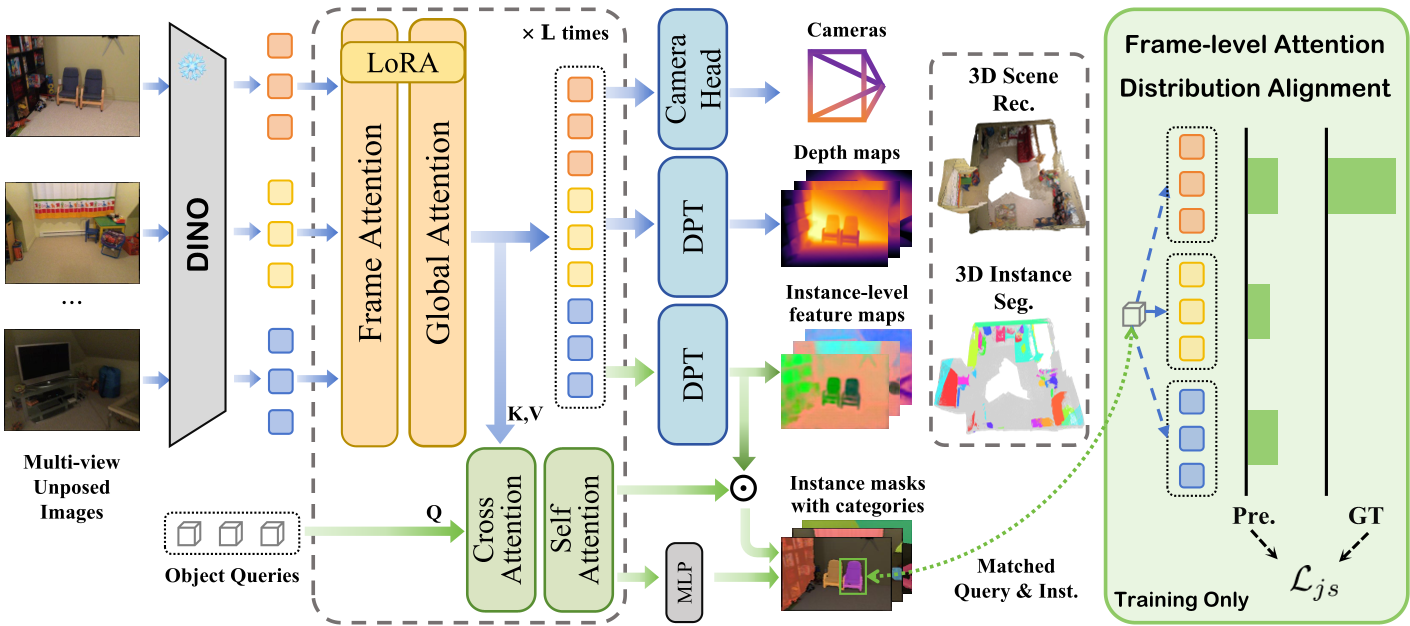
The core of SegVGGT is the Geometry Grounded Transformer. Unlike prior works that treat reconstruction as a frozen "backbone," SegVGGT allows object queries to interact directly with image tokens as the geometric features are being formed.
1. Unified Architecture
The model takes RGB images and learnable object queries. Through 24 layers of global and frame-level attention, these queries "absorb" the spatial cues needed to identify objects like chairs, tables, or sinks.
2. Solving Attention Dispersion with FADA
A major technical challenge in multi-view transformers is Attention Dispersion. When a model looks at 100 frames simultaneously, there are over 100,000 tokens. Without guidance, an object query for a "TV" might try to look at every frame, picking up noise from the kitchen instead of the living room.
The authors solve this with Frame-level Attention Distribution Alignment (FADA).
- The Insight: An object is only visible in a specific subset of frames.
- The Fix: During training, they force the query's attention weights to match the ground-truth "visibility" distribution of the object using Jensen-Shannon divergence. This "anchors" the query to the right frames without adding any computational cost during inference.
Experiments: Speed and Accuracy
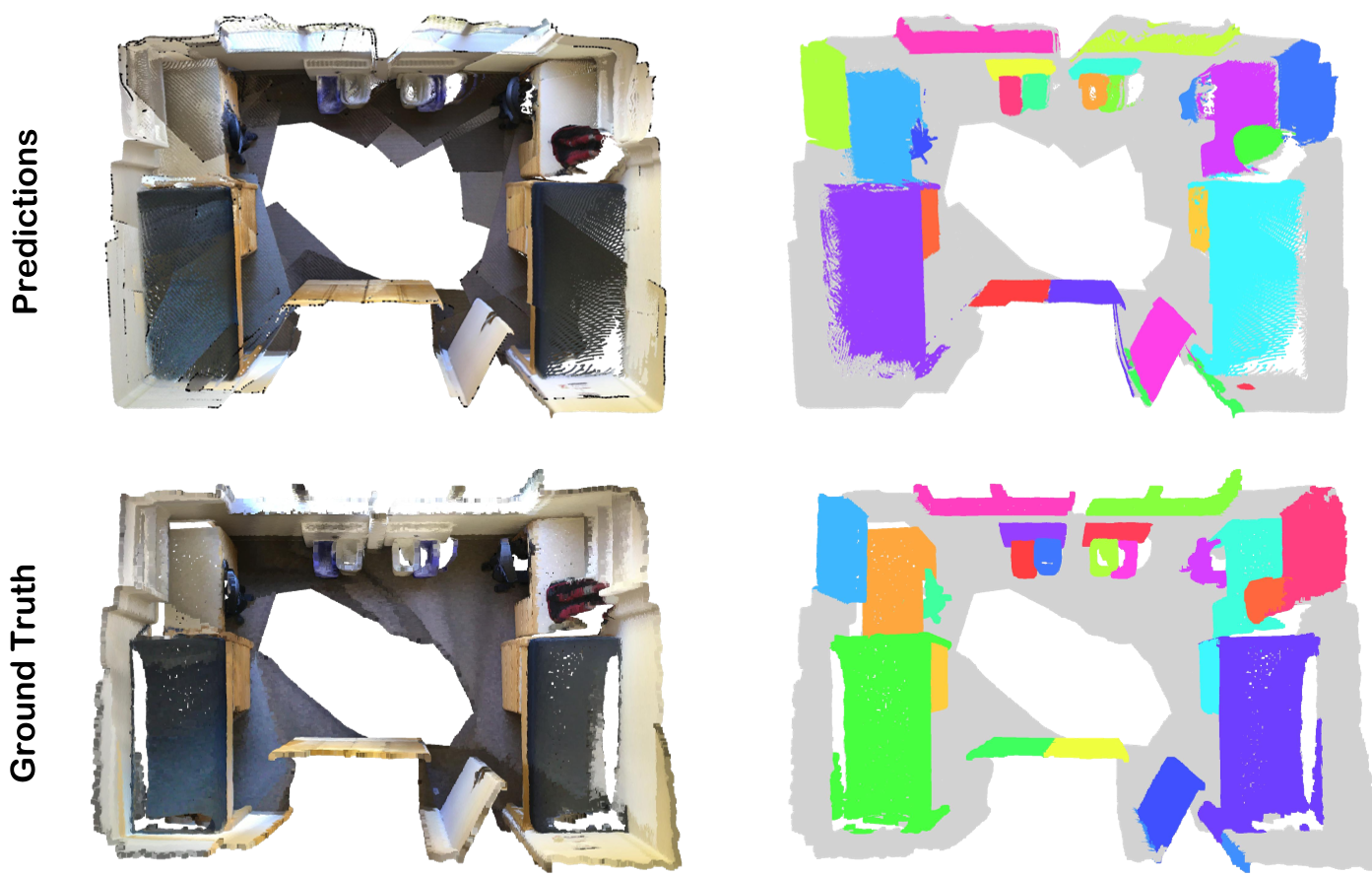
The results on ScanNet200 (a challenging long-tail dataset with 200 classes) are particularly impressive. SegVGGT achieved 31.9 mAP, surpassing traditional point-cloud methods that have the "unfair advantage" of using ground-truth depth sensors.
Performance vs. Efficiency
The efficiency gap is where SegVGGT truly shines. Previous "joint" models like IGGT rely on heavy clustering algorithms that take minutes to process a scene. SegVGGT handles 100 frames in 15.9 seconds.
Zero-Shot Generalization
Perhaps the most surprising result is the model's performance on ScanNet++. Even without being trained on ScanNet++, SegVGGT generalized better than models that were explicitly trained on it. This suggests that "co-evolving" geometry and semantics helps the model learn more fundamental visual principles than simple pattern matching.
Critical Analysis & Conclusion
Takeaway
SegVGGT marks a shift towards unified 3D vision. By treating reconstruction and segmentation as a single task, the model becomes more robust to noise and significantly more efficient for real-world robotics and AR applications.
Limitations
- Metric Scale: Like the VGGT backbone it is built on, it struggles to recover absolute "metric" size (e.g., knowing an object is exactly 1.2 meters wide) without external priors.
- Closed Vocabulary: It is currently limited to the classes it was trained on (though the authors suggest the framework could easily adapt to Open-Vocabulary models like CLIP).
In conclusion, SegVGGT demonstrates that the "Visual Geometry Grounded" approach is a powerful foundation for the next generation of embodied AI, where understanding what something is and where it is are two sides of the same coin.