
SIOP: Teaching Agents to Master Multi-Turn Tasks Without a Gold Verifier
Self-Induced Outcome Potential: Turn-Level Credit Assignment for Agents without Verifiers
The paper introduces Self-Induced Outcome Potential (SIOP), a verifier-free reinforcement learning framework for multi-turn agents. It clusters sampled final answers into semantic outcome modes and uses them as latent future states to assign turn-level rewards through potential-based shaping, achieving near-gold-supervised performance on seven search-QA benchmarks.
TL;DR
Training AI agents to handle long-horizon tasks (like multi-turn search) usually requires a "Gold Verifier"—someone or something to tell the model exactly when it's doing the right thing. But in the real world, gold answers are rare. Self-Induced Outcome Potential (SIOP) bridges this gap. By clustering its own sampled answers and treating those clusters as "latent future states," SIOP allows an agent to reward its own intermediate steps (thoughts, tool calls) based on how well they steer the trajectory toward a reliable final meaning.
The Credit Assignment Trap
In agentic Reinforcement Learning (RL), we face a "Sparse Reward" problem. Imagine an agent performing five search turns to answer a complex question. If it gets the answer wrong, was the first search query bad, or did the fourth observation mislead it?
Modern methods like GRPO or DeepSeek-R1 have popularized outcome-level rewards, but they struggle with "broadcasted advantages"—treating every step in a winning trajectory as equally perfect. While process rewards (PRMs) are a solution, they typically require human labels or a perfect answer key. How do we reward process without the key?
Methodology: Mining Gold from Internal Consensus
SIOP operates on a brilliant intuition: Semantic consistency is a proxy for truth.
1. Semantic Outcome Modes
Instead of looking for a single "Gold Answer," SIOP samples multiple trajectories for the same query. It clusters the results based on Bidirectional Semantic Entailment (using an NLI model). If five trajectories say "Paris" and two say "The capital of France," they belong to the same "Semantic Outcome Mode."
2. Reliability Calibration
Frequency isn't everything (models can be "confidently wrong"). SIOP calibrates these clusters using external evidence support. A cluster is considered "Reliable" if the retrieved text from the agent’s search turns actually supports that specific answer.
3. Potential-Based Shaping
This is the mathematical core. SIOP defines a Potential Function over these clusters. A turn receives a reward if the "belief" in a reliable cluster increases after that turn:
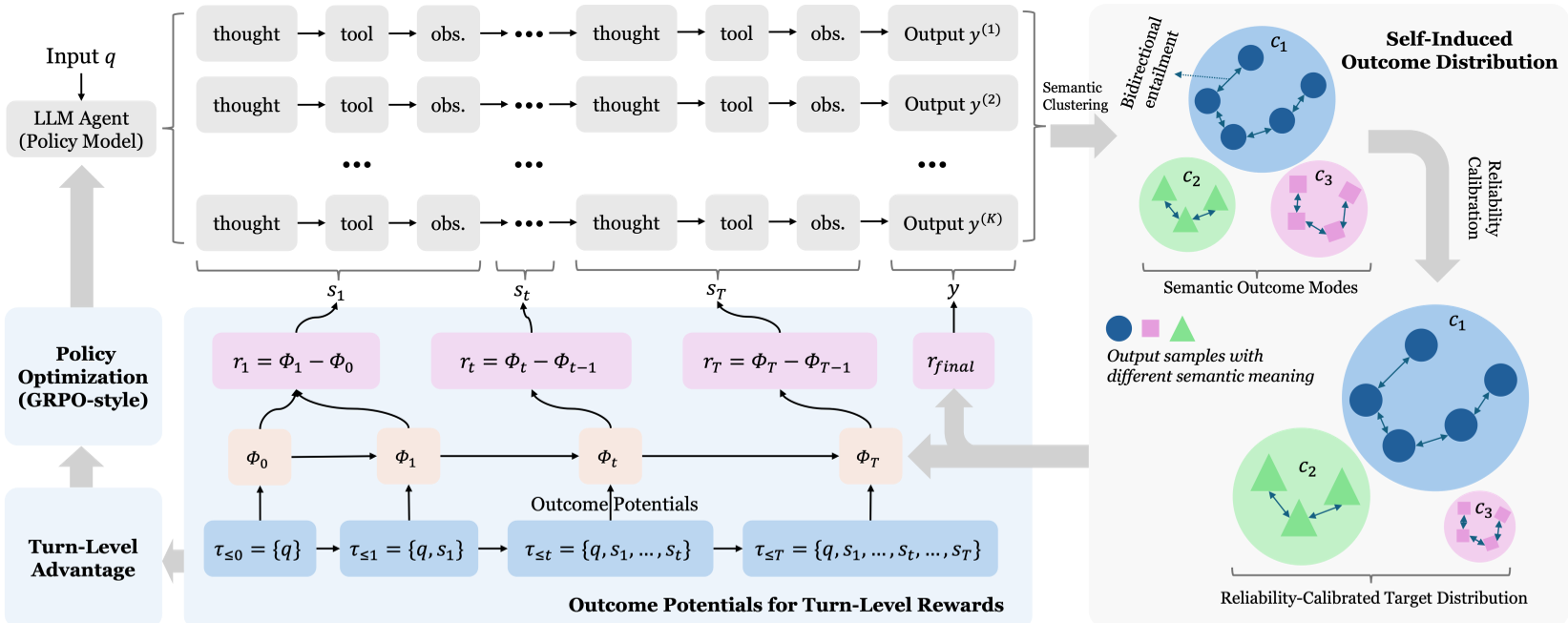 Figure 1: The SIOP pipeline—rollout sampling, semantic clustering, reliability weighting, and potential-based credit assignment.
Experimental Evidence: Closing the Supervision Gap
The authors tested SIOP on seven search-QA benchmarks using Qwen3-4B and 8B.
- Beating Outcome RL: SIOP significantly outperformed standard verifier-free baselines like EMPO and TTRL.
- Approaching the "Gold" Standard: Remarkably, SIOP (which sees no gold labels) nearly matched the performance of IGPO, a baseline that does have access to the correct answers during training.
Efficiency & Behavior
During training, SIOP didn't just get smarter—it became more efficient. As shown in the training dynamics (Figure 2 in the paper), the models learned to use fewer, higher-quality search turns and produced more concise reasoning, avoiding the "redundant search" trap common in agentic RL.
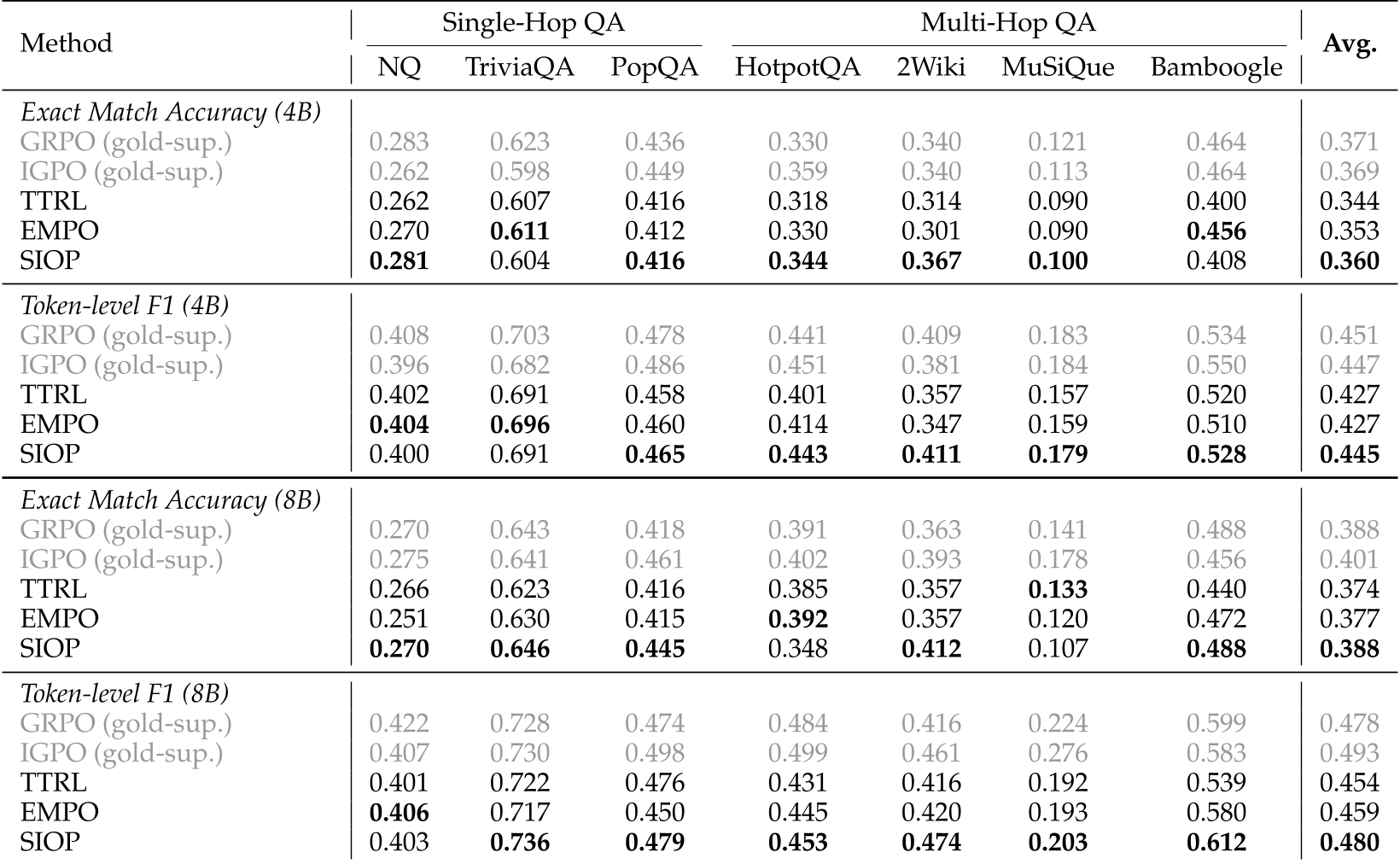 Table 1: SIOP vs. Baselines. Note how SIOP (Verifier-free) approaches the performance of Gold-supervised methods in Multi-Hop tasks.
Critical Analysis: Why This Matters
The breakthrough of SIOP is its ability to turn global consensus (what do multiple samples say?) into local credit (was this specific turn helpful?).
Limitations to Consider:
- Compute Overhead: SIOP requires multiple rollouts and extra forward passes to calculate cluster support, increasing training time by ~23%.
- Dependence on NLI: The system relies on a task-agnostic NLI model to judge semantic entailment. If the NLI model is weak, the clusters (and thus the rewards) break down.
Conclusion: The Future of Verifier-Free Agents
SIOP proves that we don't need a human in the loop to teach agents to think step-by-step. By mathematically formalizing "Outcome Potential," we can now train agents to evaluate their own progress in real-time. This is a vital step toward autonomous agents that can improve themselves in any environment—even those where no "Answer Key" exists.