
SAGR: Bridging the Gap Between LLM Reasoning and Multi-Robot Coordination via Semantic Graphs
Semantic Area Graph Reasoning for Multi-Robot Language-Guided Search
The paper introduces Semantic Area Graph Reasoning (SAGR), a hierarchical framework for multi-robot coordination in exploration and semantic target search. By abstracting dense maps into a room-level "Semantic Area Graph," it enables Large Language Models (LLMs) to perform high-level task allocation, achieving up to 18.8% efficiency gains in large-scale semantic search tasks compared to geometric baselines.
TL;DR
Coordinating a team of robots to find a specific object in an unknown building is a complex "needle-in-a-haystack" problem. While LLMs excel at understanding context, they struggle with raw spatial data. Semantic Area Graph Reasoning (SAGR) solves this by creating a "map of rooms" (a semantic-topological graph) that allows LLMs to direct robots toward likely target areas (e.g., bedrooms for a jacket) while leaving the messy details of pathfinding to traditional geometric algorithms.
Background: Beyond Geometric Frontiers
Most multi-robot systems (MRS) explore using Frontier-Based Exploration, where robots head toward the boundary between "mapped free space" and "unmapped territory." While efficient for making a map, it is "blind" to task intent. If you tell a group of robots to find a lost item, a purely geometric approach will treat a closet and a kitchen with equal priority.
Recent attempts to use LLMs as high-level planners typically feed the model raw images or grid maps. This is computationally expensive and often "distracts" the model with irrelevant pixel-level details.
Methodology: The Semantic Area Graph
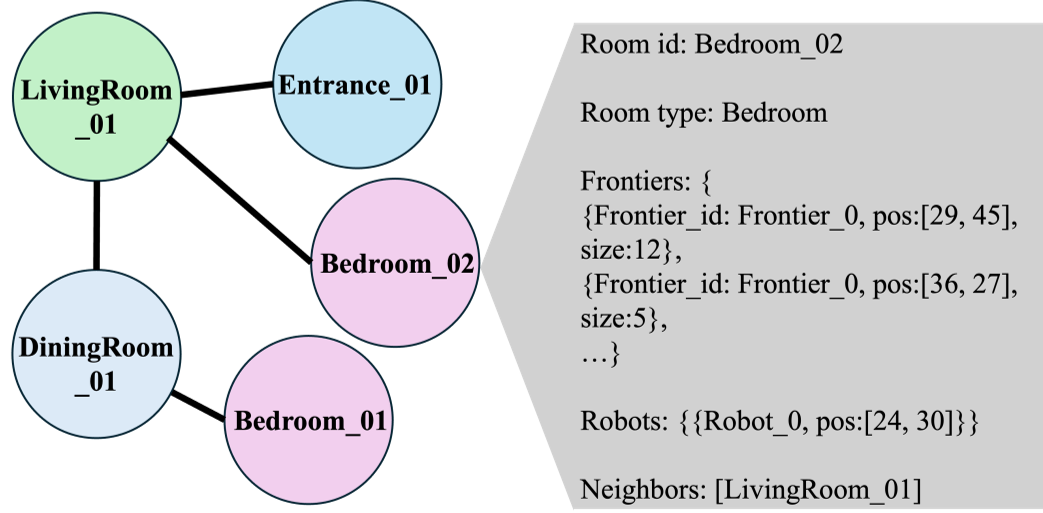
The core innovation of SAGR is the Semantic Area Graph (SAG). Instead of asking an LLM to look at a 2D occupancy grid, the system abstracts the environment into a graph where:
- Nodes: Represent specific room instances (e.g., "Bedroom_1", "Kitchen_1").
- Edges: Represent physical connectivity (doors or openings).
- Attributes: Include frontier availability (unexplored areas), robot occupancy, and room type.
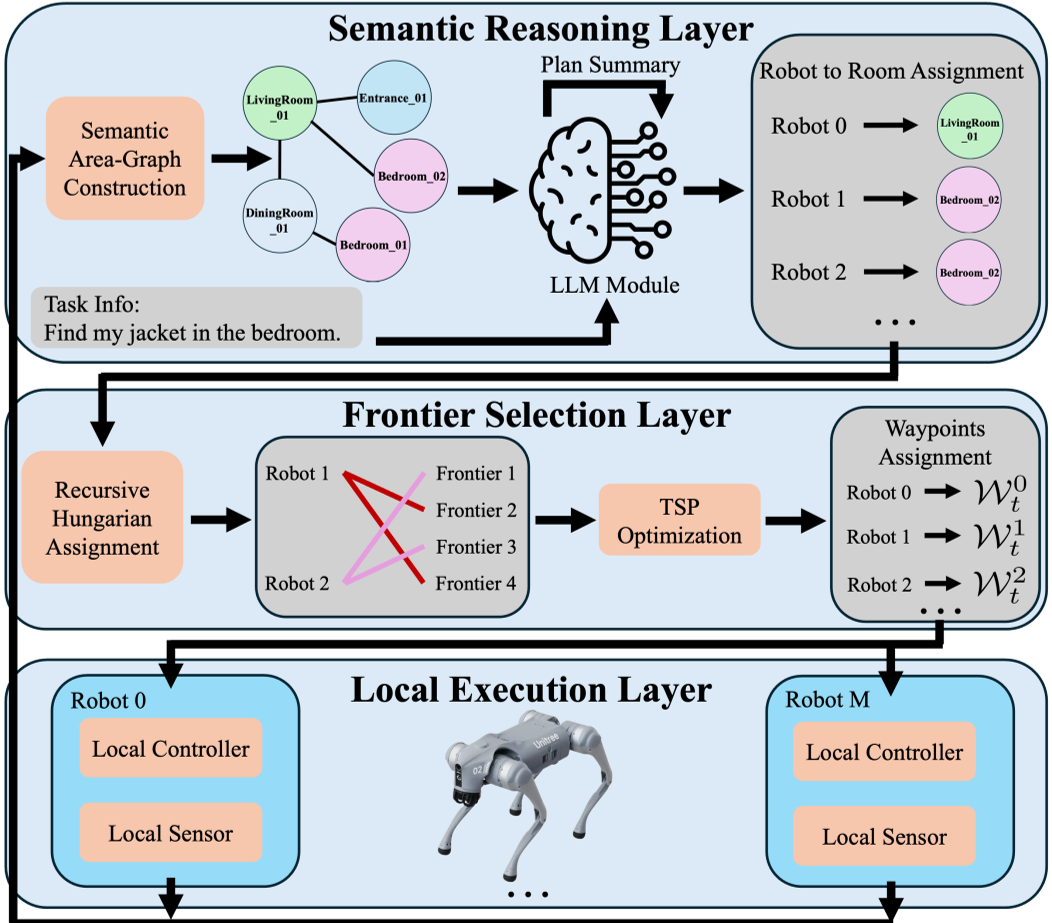
The Three-Layer Hierarchy
- Semantic Reasoning (LLM): Analyzes the serialized graph and assigns robots to specific rooms based on the search target (e.g., "Robot 1, go to the bedroom").
- Frontier Selection (Deterministic): Within an assigned room, the system uses the Hungarian Algorithm and a Traveling Salesman Problem (TSP) solver to divvy up specific waypoints among the robots.
- Local Execution: Classic motion planners handle obstacle avoidance and sensor updates.
Why It Works: The Power of Abstraction
By transforming a dense map into a text-based graph, the prompt size remains compact (<500 tokens). This enables real-time inference (~2.5 seconds) even with sophisticated models like GPT-4o or local models like Qwen-2.5-7B.
Experimental Performance
Testing on the Habitat-Matterport3D (HM3D) dataset—which provides hyper-realistic scans of actual apartments—SAGR was compared against SOTA baselines like RACER and AEP+DVC.
- Semantic Search: SAGR outperformed all geometric baselines, reducing search time by nearly 19% in large environments.
- Pure Exploration: While specialized geometric methods (like AEP+DVC) are slightly faster at pure "blind" mapping, SAGR remains highly competitive, proving that the semantic abstraction doesn't sacrifice coverage for intelligence.
| Strategy | Small Search (Steps) | Large Search (Steps) |
|---|---|---|
| Hungarian | 202.9 | 282.1 |
| AEP + DVC | 196.6 | 280.8 |
| SAGR (Ours) | 178.8 | 228.0 |
Critical Insight & Future Outlook
The ablation studies highlights that Spatial Context (knowing which room connects to which) and Plan Summaries (temporal consistency) are vital. Without them, the LLM-based "brain" becomes forgetful or loses the structural intuition of the building.
The Takeaway: The future of embodied AI isn't just about putting a bigger LLM in the loop; it's about designing the right interface for that LLM. SAGR demonstrates that a semantic-topological graph is a highly effective "common language" for bridging human-like reasoning with robotic precision.
Future Work: The authors suggest incorporating Graph-of-Thought reasoning to allow robots to plan multiple steps ahead (e.g., "If I don't find it in the master bedroom, I'll check the ensuite bathroom next").