
Rethinking Vector Search Evaluation: Semantic Recall and the End of "Mathematical Noise"
Semantic Recall for Vector Search
This paper introduces Semantic Recall, a novel metric for evaluating Approximate Nearest Neighbor Search (ANNS) that focuses on semantically relevant objects retrievable via exact search. The authors also propose Tolerant Recall as a proxy metric and demonstrate that optimizing for these metrics significantly improves the cost-quality tradeoff in vector databases.
Executive Summary
TL;DR: Traditional recall metrics in vector search are fundamentally flawed because they treat "mathematical neighbors" and "semantic neighbors" as identical. This paper introduces Semantic Recall, which ignores irrelevant noise in the ground truth, and Tolerant Recall, a practical proxy. By optimizing for these metrics, systems can achieve up to a 35% reduction in search costs without impacting the user experience.
Positioning: This work is a critical "metric-driven" intervention in the field of Approximate Nearest Neighbor Search (ANNS). It challenges the industry-standard benchmark (Traditional Recall) and provides a more efficient path for SOTA algorithms like ScaNN and FAISS to scale.
The Problem: The High Price of Mathematical Noise
In modern AI applications, we transform text and images into embeddings. We expect that proximity in vector space equals proximity in meaning. However, high-dimensional spaces are messy. Often, the "top 100" results of an exact search (the Ground Truth) contain "mathematical noise"—vectors that are numerically close but semantically irrelevant to the query.
Traditional recall penalizes an ANNS algorithm if it fails to find every single one of these noise vectors. This forces developers to tune their systems for extreme exactness, which requires more CPU, more memory, and more money, all to retrieve results that a human (or an LLM) wouldn't even find relevant.
Methodology: Semantic and Tolerant Recall
The authors suggest that we should only care about the Semantic Neighbors (SN)—the subset of the ground truth that actually matters.
1. Semantic Recall (srecall)
This metric counts how many of the retrieved results are in the "Semantic Neighbor" set. To find these, the authors use an LLM (like Gemini) to judge the top-k results of a brute-force search, labeling them as "Relevant" or "Not Relevant."
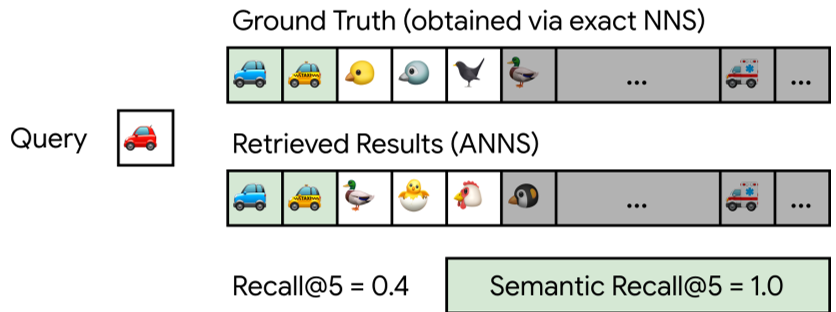 Figure 1: Semantic recall ignores the "red" irrelevant items in the ground truth, focusing only on the "green" relevant ones.
2. Tolerant Recall (trecall)
Since LLM-judging every query is expensive, the authors proposed Tolerant Recall. It allows a retrieved result to replace a ground-truth neighbor if its similarity score is "close enough" (e.g., within 1% tolerance). This handles cases where quantization or minor index perturbations reshuffle the ranking of near-identical vectors.
Experimental Insights: Better Pareto Frontiers
The researchers tested their theory on the MSMARCO (8.83M docs) and MIRACL datasets. They found that Semantic Neighbors (SN) have much larger "score deltas" than non-semantic ones. This means that relevant documents stand out, while irrelevant "noise" documents are crowded together at nearly identical distances.
Cost-Quality Tradeoff
By using Google Vizier to tune the ScaNN index, the authors proved that tuning for Semantic Recall is more efficient.
- Cost Efficiency: Tuning for Semantic Recall instead of traditional recall reduced search costs (bytes read) by 14% on MSMARCO.
- Scale Influence: On the 1-billion vector BigANN dataset, switching the target metric from 95% traditional recall to 95% tolerant recall slashed costs by 25%.
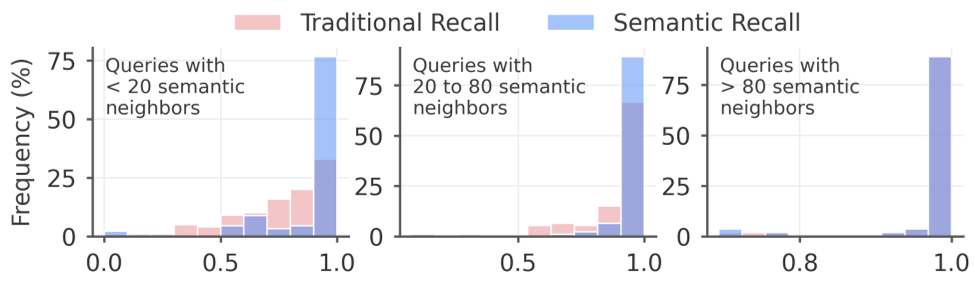 Figure 2: The "hockey stick" curve of vector search. Significant cost savings are found by avoiding the extreme right end of the traditional recall curve.
Critical Analysis & Takeaways
The core insight of this paper is that exactness is a false idol in vector search.
Key Takeaways:
- Stop Over-Tuning: If your traditional recall is 85% but your Semantic Recall is 95%, you might already be providing a perfect experience. Further tuning is just wasting electricity.
- Use Tolerant Recall for Ops: Tolerant recall is a drop-in replacement for monitoring production systems where you don't have human/LLM labels.
- Limitations: The metric is only as good as the judge. Using an LLM as a judge introduces a specific bias, and the metric is undefined if the embedding model fails so badly that there are zero relevant results in the top-k.
Future Outlook: We expect to see "Tolerant Recall" become a standard configuration in vector databases like Pinecone, Weaviate, and Milvus, allowing users to choose a "Semantic Accuracy" target rather than a "Mathematical Exactness" target.