
Beyond Generalized Entropy: A Semiclassical Diagnostic for Why Spacetimes Disappear
A Semiclassical Diagnostic for Spacetime Emergence
The paper introduces a semiclassical diagnostic for the failure of spacetime emergence in holography, focusing on "evanescent" Quantum Extremal Surfaces (QESs). It demonstrates that spacetime fails to emerge if there exists a QES homologous to the fundamental description with an area term bounded by , regardless of its bulk entanglement.
TL;DR
In the quest to understand how spacetime emerges from quantum information, we usually point to the "Generalized Entropy" of a surface as the key metric. However, Netta Engelhardt and Elliott Gesteau argue in their latest work that the decomposition of this entropy matters more than the total. Specifically, they identify Evanescent Quantum Extremal Surfaces (QESs)—surfaces where the area is tiny, even if the total entropy is huge—as the smoking gun for when a semiclassical spacetime fails to emerge from the underlying holographic theory.
The "Emergence" Crisis in Holography
The hallmark of a successful holographic duality is that the bulk Effective Field Theory (EFT) should be a "good" approximation of the fundamental theory (the CFT). Mathematically, this means the holographic map should be an isometry: it must preserve the inner products (overlaps) between states.
Recently, this premise has hit a wall. Certain geometries, such as closed baby universes or the interior of a black hole that has completely evaporated, seem to exist in our semiclassical calculations but "vanish" or fail to emerge when we try to map them back to the fundamental description. The problem? If the map isn't isometric, the semiclassical "reality" is a mirage.
The Insight: Classical vs. Quantum Connectivity
The core of the paper lies in a distinction between two parts of the Generalized Entropy ():
- Area Term (): Representing "Classical Connectivity."
- Bulk Entanglement Term (): Representing "Quantum Connectivity."
The authors argue that Classical Connectivity is what "squirrels away" information from the observer. If a surface has a large area, it makes it exponentially complex for an EFT observer to detect that the spacetime is an approximation. If the area is evanescent—meaning it is or smaller—the "shield" is gone. Even if the bulk entanglement is massive, the spacetime beyond that surface fails the test of emergence.
Methodology: Slice-Normal Tensor Networks
To prove this, the authors model the holographic map using Slice-Normal Tensor Networks. These networks represent the spatial geometry as a sequence of random unitaries and post-selections.
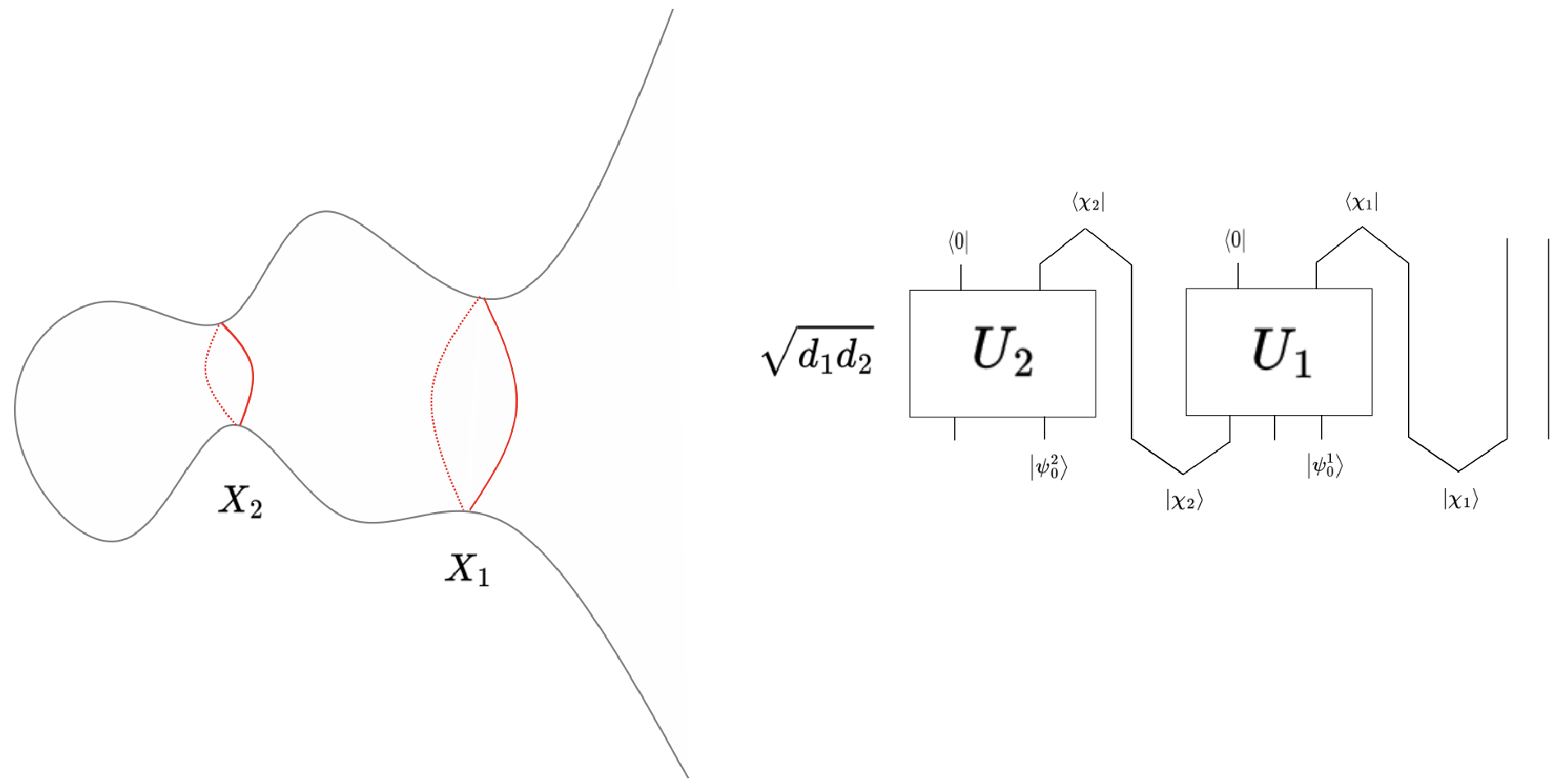 Figure 3: A heuristic picture of a slice geometry and the corresponding slice-normal tensor network. The network splits at QESs, where the "width" of the network legs represents the -entropy (Area).
The authors define Theorem 1, which provides a rigorous "if and only if" condition: Spacetime emerges on one or more copies if and only if every -state (the "area" legs in the network) satisfies: If the area is too small, the fluctuations in the state overlaps become , breaking the semiclassical approximation.
Case Study: The Fully Evaporated Black Hole
This diagnostic perfectly explains the "Fully Evaporated Black Hole" paradox. At the end of evaporation, the horizon area goes to zero, but the entanglement between the interior and the radiation is at its peak.
- Old View: is large, so maybe the interior is still there?
- Evanescent View: Because the Area term is evanescent (effectively zero), the QES homologous to the radiation is evanescent. Therefore, the interior does not emerge relative to the radiation. It must be "excised."
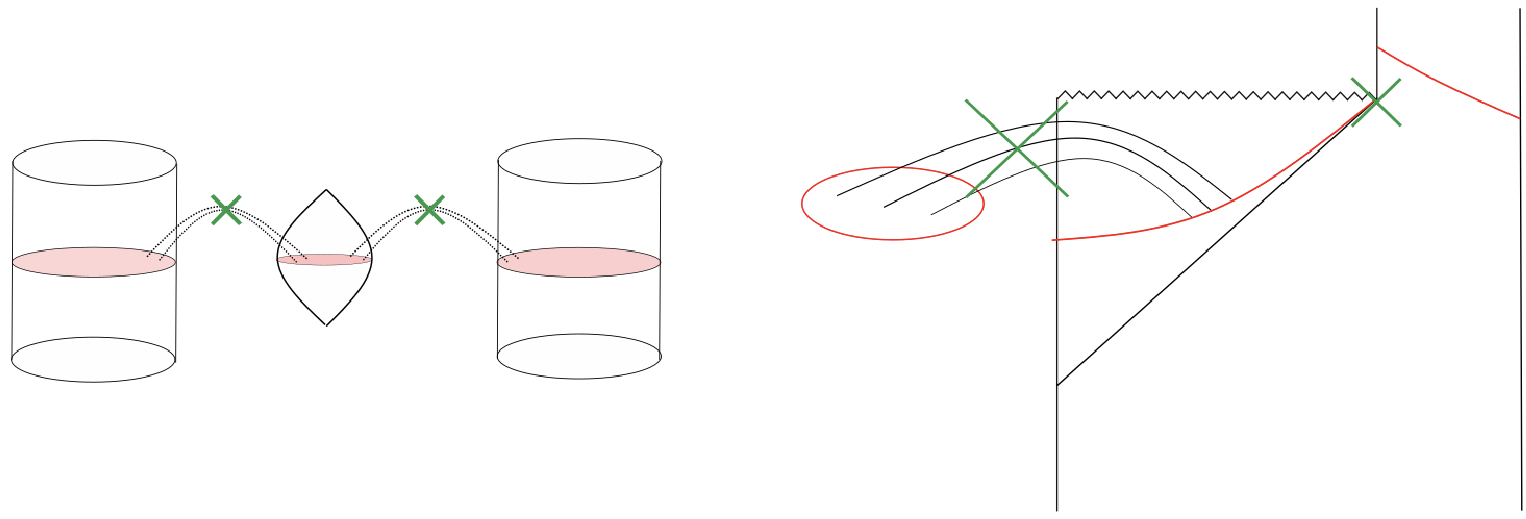 Figure 1: Comparison of the evanescent QES (green cross) in a baby universe (left) and an evaporated black hole (right). In both cases, the surface disconnects the "non-emergent" region from the boundary.
The Role of the Observer
Can we "save" these spacetimes by adding an observer? The paper explores "Observer Rules," where the holographic map is modified to account for the observer’s own entropy (). The threshold for emergence shifts: a surface is now "Ob-evanescent" if its area is smaller than the observer's resolution. However, the authors find a surprising limitation: an observer cannot save everything. If there are nested evanescent surfaces (a "Python's Lunch with no meat"), no single observer can make the entire geometry emerge simultaneously.
Critical Insight & Future Outlook
This work signals a shift in holographic research from simply calculating "how much" entropy there is to asking "what kind" of entropy it is.
- Quantum Volatility: The authors note that spacetimes with huge bulk entanglement but zero area are "quantum volatile"—they are extremely sensitive to the exact value of .
- Excision Protocol: The paper provides a formal way to "cut out" the parts of the math that don't correspond to a real, emergent geometry, leaving behind a consistent, isometric code subspace.
Conclusion: Spacetime is not just made of entanglement; it is made of hidden entanglement. Without the "bottleneck" of a classical area, the holographic dictionary collapses, and the semiclassical description is revealed as a beautiful, but non-emergent, mathematical artifact.