
Sharpness-Aware Pretraining: Solving the Catastrophic Overtraining Paradox
Sharpness-Aware Pretraining Mitigates Catastrophic Forgetting
This paper introduces Sharpness-Aware Pretraining as a strategy to mitigate catastrophic forgetting during subsequent post-training and quantization. By utilizing Sharpness-Aware Minimization (SAM), higher peak learning rates, and shortened annealing periods, the authors achieve state-of-the-art results in preserving base model capabilities, reducing forgetting by up to 80% on specific datasets and 40% under 4-bit quantization.
TL;DR
Improving pretraining loss doesn't always lead to a better model. In fact, "overtraining" often makes models brittle, causing them to lose original knowledge the moment they are fine-tuned or quantized. This paper proves that by flattening the loss landscape through Sharpness-Aware Minimization (SAM) and smarter learning rate schedules, we can reduce catastrophic forgetting by up to 80%, creating base models that are significantly more "adaptable" for downstream tasks.
The Problem: The Brittle Excellence of SOTA Base Models
Traditionally, we judge a base model by one metric: Pretraining Loss. The assumption is simple—a lower loss means a stronger starting point. However, this creates a hidden trap. As training progresses, the model often falls into "sharp minima"—mathematical pits in the loss landscape where the gradient is extremely steep.
While the model performs well at the bottom of that pit, even a tiny parameter update during Supervised Fine-Tuning (SFT) or 4-bit quantization pushes the model out of the pit, leading to a massive spike in loss and the erasure of pretrained knowledge.
Methodology: Mining for Flat Minima
The authors propose three primary interventions to bias the model toward "flat minima," where the loss remains stable even if parameters are slightly perturbed:
- Sharpness-Aware Minimization (SAM): Instead of just going down the gradient, SAM looks at a neighborhood around the current parameters and minimizes the maximum loss in that area.
- Implicit Regularization: Increasing the peak learning rate and shortening the annealing (cool-down) period prevents the model from settling into narrow, sharp pits.
- The Scalable "Anneal-with-SAM" Recipe: Since SAM is compute-intensive, the authors found that switching to SAM only during the final annealing phase (last 10% of training) provides nearly all the benefits of full-run SAM with minimal overhead.
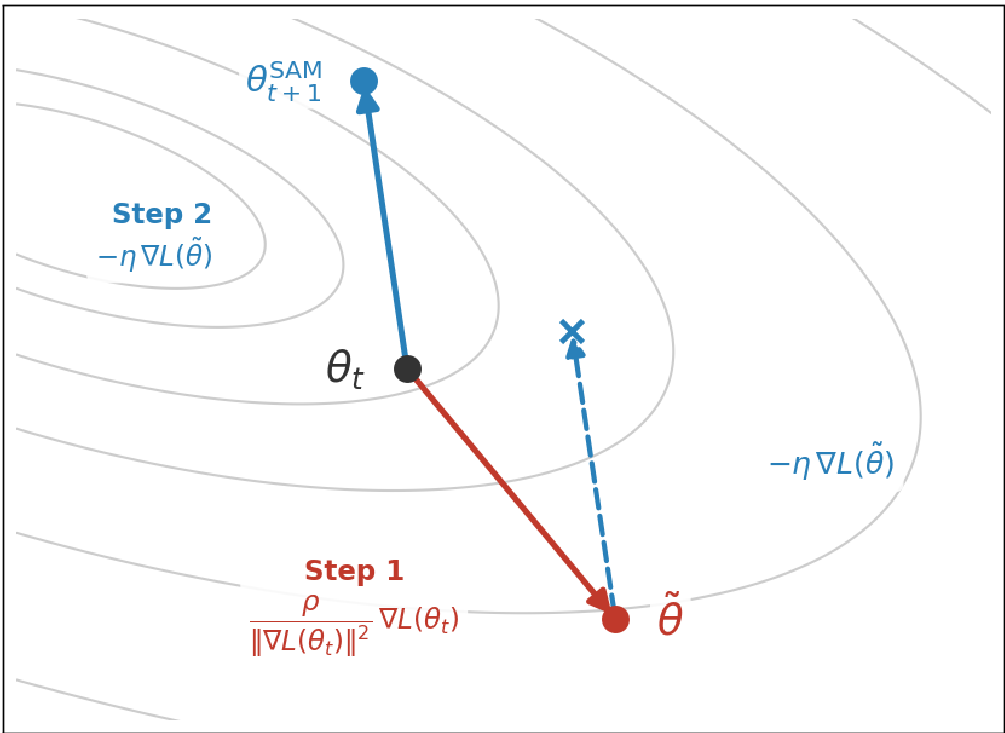 Figure 1: SAM update logic—calculating the perturbation to find flatter regions before the final update.
Experiments: Breaking the Forgetfulness Cycle
The researchers conducted over 3,500 fine-tuning experiments across various model sizes. The results were consistent:
- Forgetting vs. Learning: In a head-to-head comparison on StarCoder, the SAM-pretrained model reduced forgetting by 80% compared to the AdamW baseline when matched for the same fine-tuning performance.
- The 1B Scale Test: Using OLMo-2-1B, a short mid-training phase with SAM reduced benchmark degradation by 31% after math-specific post-training.
- Compression Robustness: Quantizing a sharp model to 4-bit is usually catastrophic. SAM-trained models showed 40% less performance drop under 4-bit quantization.
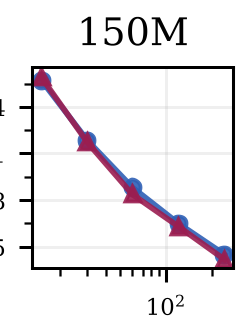 Figure 2: The Pareto frontier—SAM (blue) consistently stays lower in pretraining loss (less forgetting) for any given level of fine-tuning success.
Hessian Analysis: Why it Works
The paper validates the "Sharpness" hypothesis by calculating the Hessian (the second-order derivative of the loss). They found that SAM effectively slows the growth of directional sharpness in the loss landscape. Even though a SAM model might have a slightly higher pretraining loss initially, its "geometry" makes it a superior foundation for any future modifications.
Critical Analysis & Conclusion
The core takeaway of this research is a paradigm shift: We must stop optimizing base models in a vacuum.
A "strong" base model that breaks during quantization is practically useless for edge deployment. This work provides a concrete, scalable blueprint for building "elastic" models.
Limitations: One lingering question is the "MusicPile" exception identified in the 1B scale experiments, where SAM didn't significantly help. This suggests that the nature of the downstream data distribution relative to the pretraining data matters, and "flatness" might not be a silver bullet for every type of domain shift.
For practitioners, the message is clear: Shorten your annealing and consider a SAM-based mid-training phase before you commit to a major post-training run.