
Correcting the Classics: Resolving Sign Discrepancies in the Laws of Black Hole Mechanics
Sign Errors in "The Four Laws of Black Hole Mechanics"
This technical note identifies and resolves two internal sign errors in the seminal 1973 paper "The Four Laws of Black Hole Mechanics" (BCH). The author demonstrates that while the differential mass formula (the First Law) is physically correct, its intermediate derivation involves compensating errors in the definitions of particle number and entropy .
TL;DR
Even the most foundational papers in physics can contain "compensating errors." This note by Richard P. Behiel meticulously deconstructs the 1973 Bardeen, Carter, and Hawking (BCH) paper to show that two sign errors—one in the definition of thermodynamic quantities () and one in the mass formula derivation—cancel each other out perfectly. The physical validity of Black Hole Mechanics remains untouched, but the mathematical path is now cleared for students and researchers.
Background: The Thermodynamic Map
In 1973, the paper "The Four Laws of Black Hole Mechanics" mapped the laws of thermodynamics onto the physics of black holes. The First Law relates the change in mass () to changes in area (), angular momentum (), particle number (), and entropy (). However, researchers attempting to bridge the gap between the energy-momentum tensor variations (Eq. 32) and the final mass formula (Eq. 34) often found themselves haunted by phantom minus signs.
The Mathematical Tension
The core tension lies in BCH Equation (33), which represents the variation of the total energy-momentum integral. Behiel points out that if we follow the BCH definitions strictly, the terms involving the redshifted chemical potential () and temperature () should be subtracted, not added.
 Above: The starting point for the variation of the energy-momentum tensor.
The paper identifies that the discrepancy arises during the substitution of the four-velocity normalization . This introduces a negative sign that the original BCH paper seemingly omitted in its intermediate steps.
The "Double Negative" Fix
Why does the final law still work? Behiel discovers a second error in the definitions of and :
- BCH Original:
- The Problem: In the "mostly-plus" metric signature used, the volume element is negative. This results in a negative total particle number for a positive density —a physical impossibility.
- The Correction: The definitions must include an explicit minus sign: .
When this correction is applied, the differential and terms flip signs, perfectly canceling the errant minus signs discovered in the re-derivation.
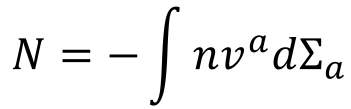 The corrected integral definitions for conserved quantities.
Critical Insight
The brilliance of the BCH paper was its physical intuition. Even though the "bookkeeping" of minus signs in the intermediate integrals was slightly flawed, the authors arrived at the correct physical symmetry. Essentially, they knew that and must contribute positively to the mass-energy of the system. Behiel’s note acts as a critical "patch" for the mathematical software of black hole thermodynamics, ensuring that the derivation is as robust as the conclusion.
Conclusion & Limitations
Behiel also catches a few minor typographical errors (e.g., missing factors in the Lie derivative identities), but confirms that all major conclusions of the 1973 paper remain valid. This work serves as a reminder that in theoretical physics, the "physicality" of a result (like the positivity of entropy) often guides the math even when signs become treacherous in complex tensor calculus.
For modern researchers, this note is an essential companion for deep-diving into the origins of the Holographic Principle and Black Hole Thermodynamics.