
[2025] SIM1: Bridging the Deformable Gap with Physics-Aligned Digital Twins
SIM1: Physics-Aligned Simulator as Zero-Shot Data Scaler in Deformable Worlds
SIM1 is a physics-aligned Real-to-Sim-to-Real (R2S2R) data engine designed to scale deformable object manipulation data. It achieves a 90% zero-shot success rate in real-world garment folding by aligning digital twins, stabilizing soft-body dynamics, and synthesizing trajectories via diffusion models.
TL;DR
Deformable manipulation has long been the "hard mode" of robotics due to the sheer complexity of cloth dynamics. SIM1 introduces a Real-to-Sim-to-Real (R2S2R) pipeline that doesn't just simulate cloth—it grounds it in reality. By aligning geometry, dynamics, and motion, SIM1 enables a robot to learn complex garment folding purely in simulation and maintain a 90% success rate when deployed on a physical bimanual robot for the first time.
The Grounding Problem: Why Sim-to-Real Fails for Cloth
Most simulators treat the world as a collection of rigid blocks. When they do attempt "soft" objects, they often produce what researchers call "unstable dynamics": cloth that stretches like rubber or jitters uncontrollably upon contact.
The authors of SIM1 argue that simulation fails not because it is "fake," but because it is ungrounded. If the virtual T-shirt doesn't have the same mass, friction, and elastic resistance as the real one, the data it generates is essentially "poison" for a learning model.
Methodology: The R2S2R Triangle
SIM1 solves the grounding problem through a three-pillared alignment strategy:
1. Geometric Alignment (SIM1-Scene)
Instead of using generic CAD models, SIM1 uses high-precision 3D scans (EinScan Rigil Pro) to create metric-accurate digital twins of garments. This ensures that every wrinkle and edge in the sim matches the real world with sub-millimeter precision.
2. Dynamical Alignment (SIM1-Sim)
This is the technical heart of the paper. Standard solvers often lag during rapid robot movements, causing the cloth to "stretch" unrealistically. SIM1 uses Augmented Vertex Block Descent (AVBD).
- The Intuition: It introduces virtual elastic constraints that activate only when an edge stretches beyond a threshold (e.g., 5%). This "injected" force accelerates convergence, making the cloth behave like a real fabric rather than a liquid.

3. Movement Alignment (SIM1-DataGen)
Scaling requires more than just repeating one trajectory. SIM1 uses a Diffusion-based trajectory generator. It takes a few human demonstrations, breaks them into "interaction segments" (grasps/releases), and uses a transformer-based diffusion model to "fill in the blanks" with smooth, human-like motion.
Experiments: Parity and Generalization
The results challenge the necessity of massive real-world datasets:
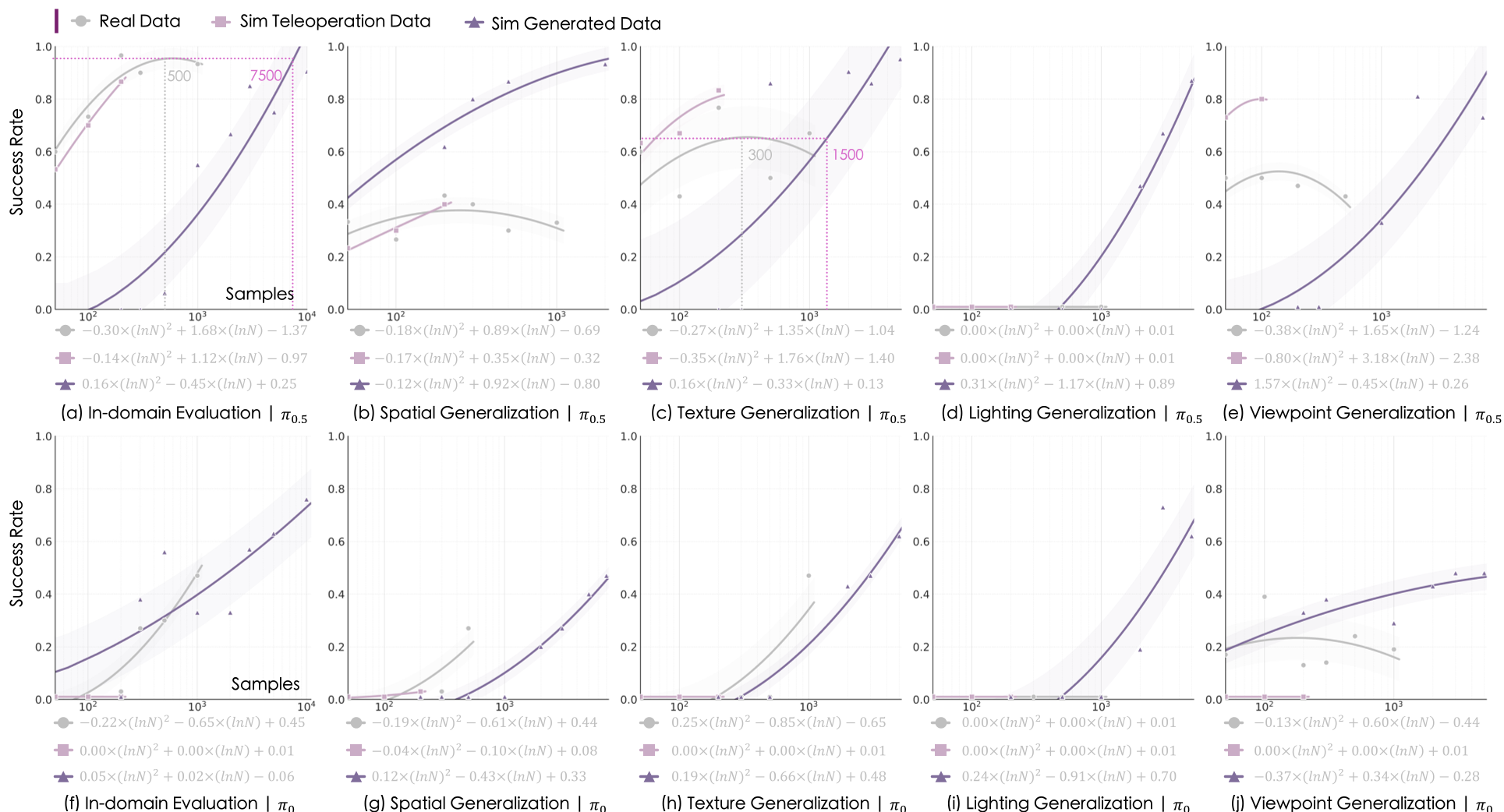
- 1:15 Equivalence: 15 synthetic samples from SIM1 provide the same training value as 1 real-world demonstration.
- Zero-Shot Success: A policy trained only on synthetic data achieved a 90% success rate on a real ARX ACONE robot.
- Generalization: While real-world data is often "brittle," SIM1's randomized synthetic data (varying lighting, textures, and positions) allowed the robot to handle 50% more out-of-distribution scenarios than a robot trained on real data.
Professional Insight: The Cost of Reality
One of the most striking parts of the paper is the Cost-efficiency Analysis.
- Real-world collection: $2.71 per trajectory (Manual labor + hardware wear).
- SIM1 (Simulation): $0.10 per trajectory.
By moving the "data bottleneck" from the physical lab to the GPU cluster, SIM1 reduces the cost of training a generalist robot by 27x.
Conclusion & Limitations
SIM1 proves that for deformable objects, physics alignment is the ultimate regularizer. However, it still requires an expert to manually tune physical parameters (Young’s modulus, friction) for each new material. The next frontier will likely be "Auto-Calibration," where the system learns to match simulation dynamics to a video of a real object automatically.
Takeaway: If you want your robot to fold your laundry, stop collecting real-world data and start building better digital twins.