
Skill Neologisms: Teaching LLMs New Tricks by Expanding Their Vocabulary
Skill Neologisms: Towards Skill-based Continual Learning
The paper introduces "Skill Neologisms," a method for skill-based continual learning in LLMs by optimizing soft tokens integrated into the model's vocabulary. It enables the acquisition of new procedural skills without weight updates, achieving state-of-the-art performance in zero-shot skill composition.
TL;DR
Researchers have developed a way to teach Large Language Models (LLMs) new procedural skills—like specific mathematical operations or reasoning patterns—without touching the model's original weights. By "injecting" new soft tokens (neologisms) into the model's vocabulary and training only these tokens on specialized datasets, models can learn new capabilities that compose perfectly with existing ones, even in zero-shot scenarios.
The Core Challenge: The Trilemma of Continual Learning
Expanding an LLM's capabilities usually faces a "trilemma":
- Finetuning: High expressiveness, but leads to Catastrophic Forgetting.
- In-Context Learning (ICL): Safe and flexible, but limited by context length and often fails at complex procedural logic.
- PEFT (e.g., LoRA): Efficient, but typically creates "task-locked" adapters that cannot be easily combined with other independently trained adapters.
The authors ask a fundamental question: Can we leverage the pre-existing compositional abilities of LLMs to learn new, composable skills without changing a single weight?
The Innovation: Skill Neologisms
The "Skill Neologism" approach is elegantly simple:
- Vocabulary Integration: Instead of a prefix (Prompt Tuning) or an adapter (LoRA), the skill is embedded as a new "word" in the vocabulary.
- Skill-Centered Training: The model is trained on data where the target skill is the star, mixed with a variety of other known skills.
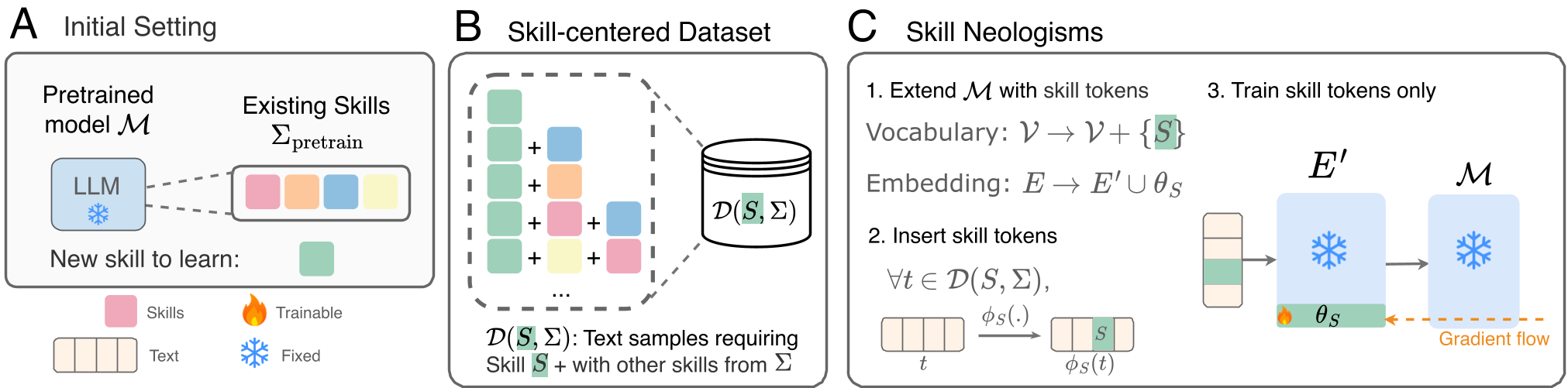
This setup forces the soft tokens to encapsulate the logic of the skill (the "How") rather than simply acting as a trigger for a specific task (the "What").
Methodology: High Context, Low Parameter
The researchers observed that LLMs naturally develop "skill tokens" during pre-training. For instance, the token XOR often acts as a procedural trigger for the bitwise operation.
By mimicking this, they optimize a small set of parameters () while keeping the LLM () frozen. The result is a modular "skill plug-in" that behaves like a native word.
Architectural Insights
- Neologism Length: Interestingly, having too many parameters for a skill token hurts generalization. A "sweet spot" (around 20 tokens) provides an inductive bias that prevents the model from "overfitting" to the training distribution, forcing it to learn a composable representation.
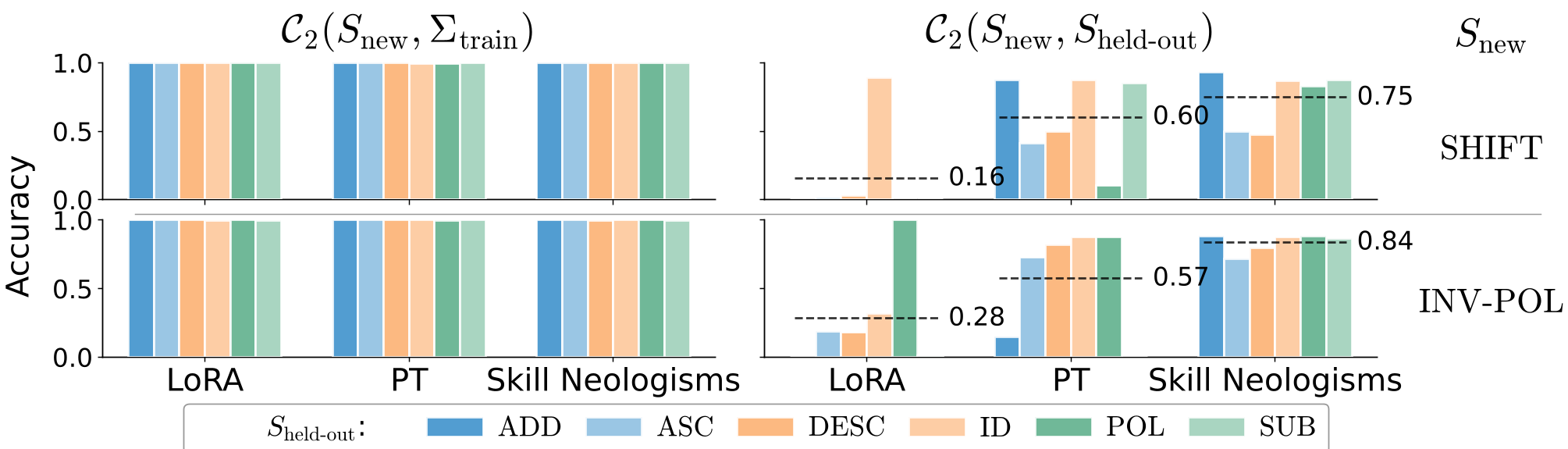
- Compositional Transfer: Unlike LoRA, which struggles with Out-of-Distribution (OOD) skills, Skill Neologisms retain high accuracy when used alongside skills the model never saw during the neologism's training phase.
Key Results: Modular Magic
In head-to-head tests against LoRA and Prompt Tuning:
- Zero-Shot Composition: Two independently trained neologisms (e.g.,
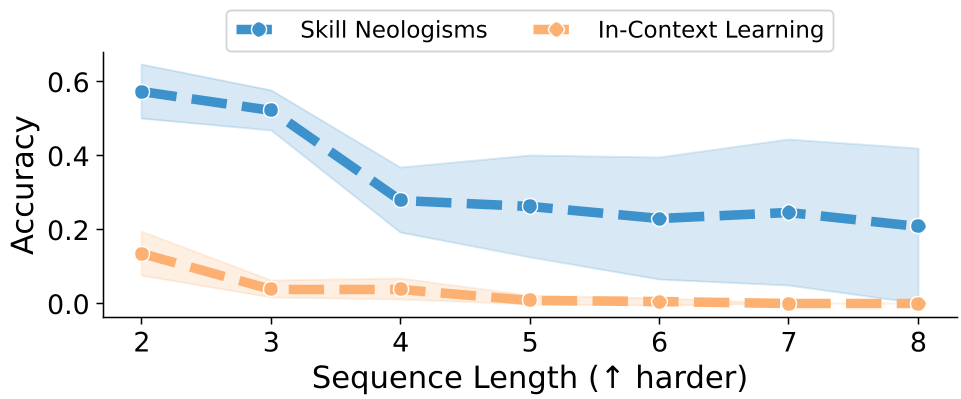
[SHIFT]and[INV-POL]) can be dropped into the same prompt and work perfectly together without any prior joint training. - Outperforming ICL: The method significantly beat In-Context Learning, especially as tasks became more complex, proving that these soft tokens are more efficient than natural language descriptions.
Critical Analysis & Conclusion
This work shifts the focus of continual learning from "How do we change the model?" to "How do we better communicate with the model's existing internal circuits?".
Takeaway: Skill Neologisms pave the way for a "Library of Skills" where users can download small token files to unlock specific procedural abilities in their LLMs without the risk of breaking the original model's safety or general knowledge.
Limitations: The main bottleneck currently lies in constructing high-quality "skill-intrinsic" datasets. As the complexity of the skill grows, defining the boundaries of that skill becomes an open research question.
Future Outlook
We are moving toward a modular AI future. Instead of massive monolithic updates, we may soon see "Vocabulary Stores" where specialized neologisms allow a general-purpose LLM to seamlessly switch between being a high-end mathematician, a legal expert, or a code optimizer—all through the addition of a few precisely tuned soft tokens.