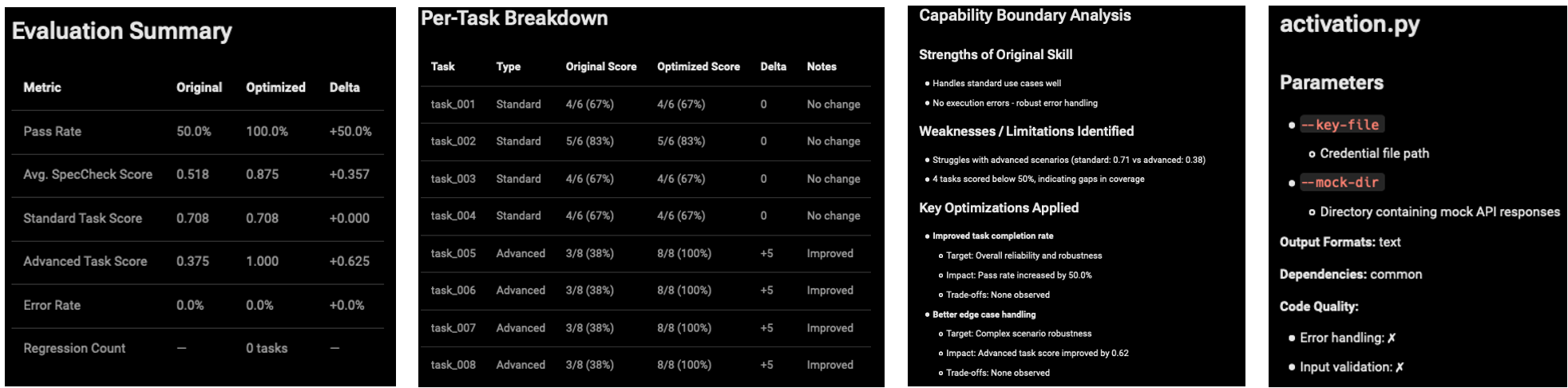
Skills-Coach: Scaling LLM Agent Capabilities via Autonomous Self-Evolution
Skills-Coach: A Self-Evolving Skill Optimizer via Training-Free GRPO
Skills-Coach is an automated framework designed to enable Large Language Model (LLM)-based agents to optimize their own "skills" (modular capability extensions). Combining automated task generation with a training-free Group Relative Policy Optimization (GRPO) mechanism, it achieves significant performance gains across 48 diverse skill categories.
TL;DR
Skills-Coach is a novel framework that allows LLM agents to automatically discover their own weaknesses and "rewrite" their skills to improve. By employing a Training-Free Group Relative Policy Optimization (GRPO) approach, it bypasses expensive manual prompt engineering and gradient-based fine-tuning, dramatically increasing skill success rates from ~33% to 88% on real-world benchmarks.
The Problem: A Fragmented Skill Ecosystem
As LLM agents move from toys to tools, "skills"—packaged sets of instructions, scripts, and resources—have become the standard for modular capability expansion. Platforms like ClawHub host over 56,000 such skills. However, most are:
- Hyper-localized: Designed for a single user's specific workflow.
- Fragile: Highly sensitive to prompt variations and lack robust error handling.
- Static: They do not learn from failure.
When an agent faces a complex task, these fragmented skills create functional gaps. The authors ask: Can an agent autonomously explore the boundaries of its existing skills and proactively expand them?
Methodology: The Four Pillars of Self-Evolution
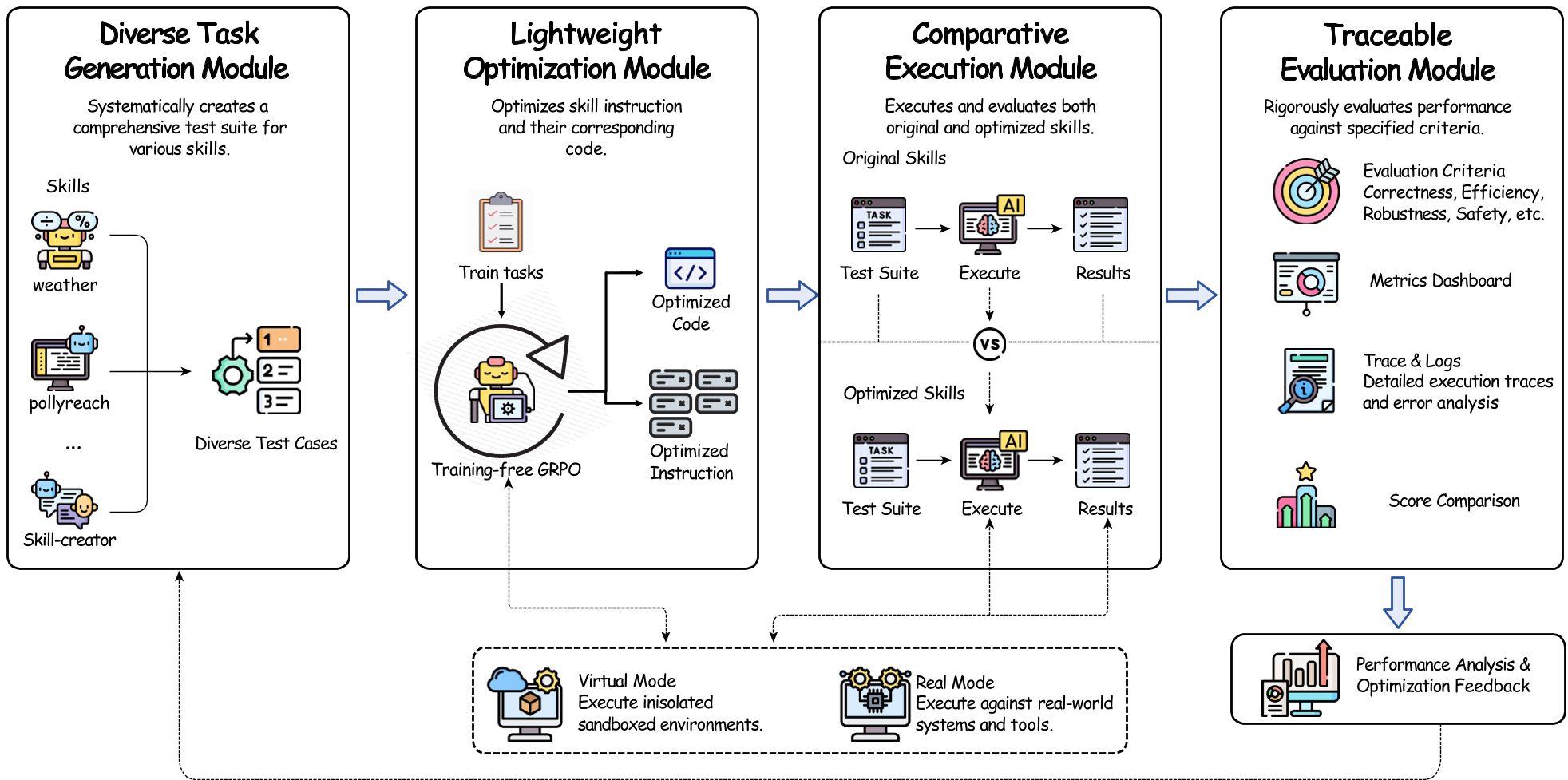
Skills-Coach operates as a closed-loop system that treats "skill optimization" as a search problem in the space of natural language instructions and Python code.
1. Probing the Boundaries
The Diverse Task Generation Module doesn't just create easy tests. It uses a hierarchical strategy to generate:
- Standard tasks: Routine operations.
- Advanced tasks: Multi-step workflows.
- Boundary tasks: Stress tests (invalid inputs, resource constraints).
2. Training-Free GRPO: The Optimization Engine
The most technically interesting component is the Lightweight Optimization Module. Instead of traditional RL that updates model weights, it applies GRPO in a training-free manner.
- It generates multiple "rollouts" (variants of the skill's instruction/code).
- It scores them against the training tasks.
- It uses the relative performance within the group to select the best "evolved" version.
3. Real vs. Virtual Execution
To save costs, the framework offers a Virtual Mode, which uses keyword-based heuristics to estimate success. However, its true power lies in Real Mode, where the agent actually executes code in an isolated sandbox, capturing logs and stack traces to feed into an Auto-Fixer loop.
Experimental Results: From Zero to Hero
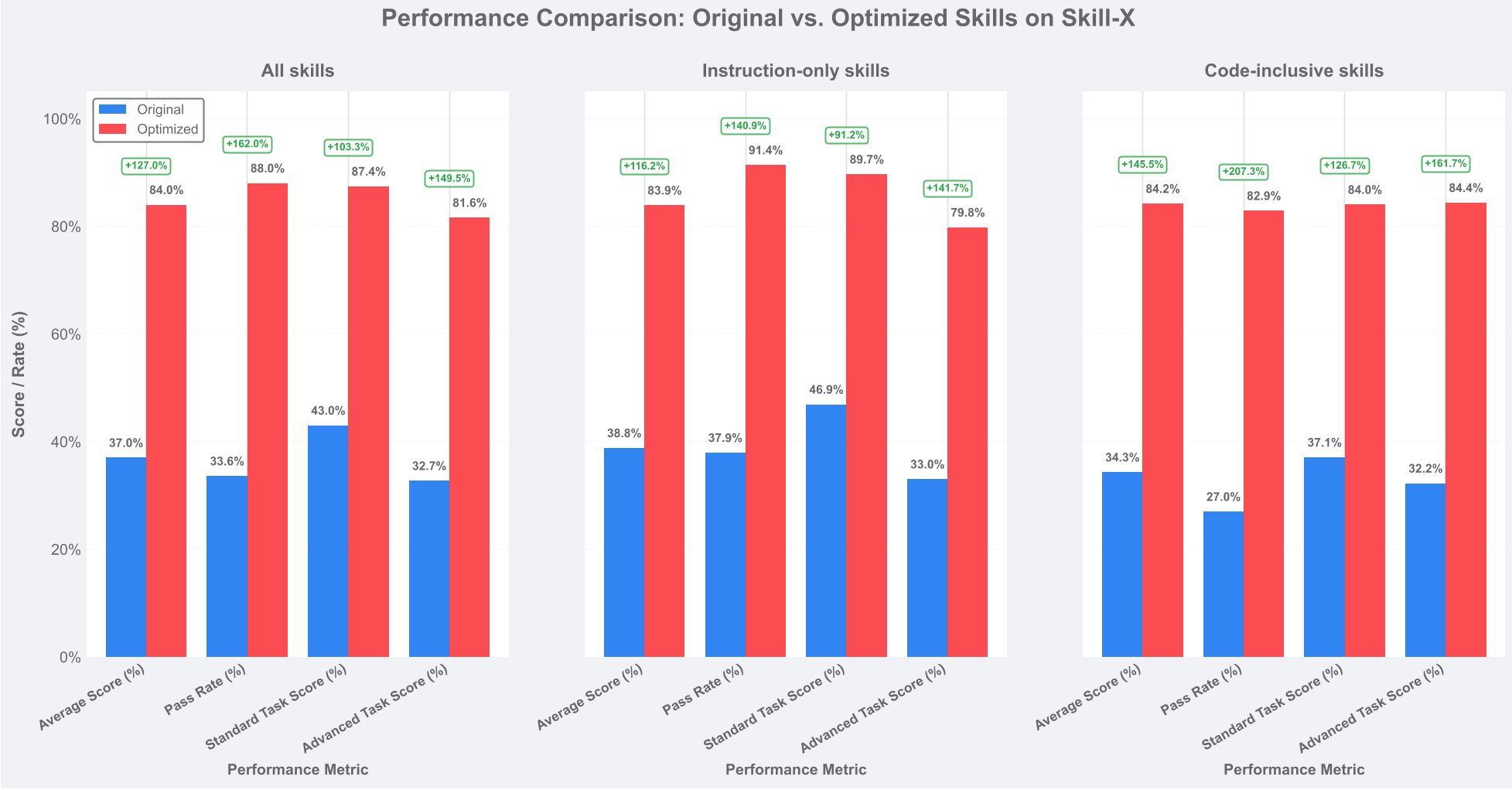
The authors introduced Skill-X, a benchmark of 48 skills. The results were transformative, especially for skills that initially failed completely.
| Metric | Original Skill | Optimized Skill | Improvement |
|---|---|---|---|
| Average Score | 0.378 | 0.84 | +127% |
| Pass Rate | 33.59% | 88.02% | +54.43% |
Deep Insight: Diminishing Returns
The study noted that while underperforming skills (like "Browser" or "Ontology") saw leaps from 0% to 100% success, skills that were already "perfect" (1.0 score) saw no benefit. This emphasizes the need for agents to selectively allocate "cognitive energy" to optimizing high-potential, low-performance areas.
Critical Analysis & Conclusion
Skills-Coach represents a pivot from "Human-in-the-loop" to "LLM-in-the-loop" development. By formalizing skill evolution as a traceable, automated process, it reduces the maintenance burden on developers.
Limitations:
- Computing Cost: While "Training-free," the sheer amount of LLM inference required for multi-epoch GRPO and task generation can be high.
- Sandbox Security: Real-mode execution requires robust isolation to prevent adversarial code generated during the "evolution" phase from escaping.
The Future: We are entering an era where agents will come with a "basal" set of skills and, much like a human apprentice, will refine their own documentation and scripts as they encounter more difficult tasks in the wild.