
[ALIFE 2026] The Architecture of Social Reality: How Active Inference Balances Conformity and Creativity
Social Reality Construction via Active Inference: Modeling the Dialectic of Conformity and Creativity
This paper introduces a multi-agent active inference model that formalizes the "social construction of reality" by simulating the dialectic between individual creativity and social conformity. Using a decentralized generative model framework on a structured social network, the authors demonstrate how informationally cohesive social groups and shared representational norms emerge endogenously through local interactions.
TL;DR
Researchers from the University of Osaka have bridged the gap between sociology and computational neuroscience by proposing a multi-agent model where "Social Reality" is an emergent property of Active Inference. By formalizing the tension between the "Internalization" of norms and the "Externalization" of creative acts, the model shows how distinct cultural niches and representational clusters form endogenously without any centralized controller.
The "Me" vs. the "I": The Computational Motivation
Sociologists like Mead and Berger & Luckmann have long argued that society is a dialectical process. We are shaped by the collective ("the Me"), but we also reshape that collective through spontaneous action ("the I").
Until now, Artificial Life (ALife) models struggled to capture this. Most models were either Top-Down (agents learn to follow pre-existing rules) or Bottom-Up (simple agents interact to form patterns). The authors argue that a true social agent needs a Generative Model—an internal probabilistic engine that tries to predict the world while simultaneously acting to change it to match its own hidden states.
Methodology: Adversarial Harmony
The core of the paper lies in a clever mathematical "tug-of-war" within each agent's architecture.
1. Social Conformity (Top-Down)
Agents minimize Variational Free Energy (VFE). When they communicate with neighbors via a "Naming Game" (Metropolis-Hastings sampling), they update their internal neural networks () to align with the social prior (). This is the pressure to "fit in" and share a common language.
2. Creative Deviation (Bottom-Up)
Agents minimize Expected Free Energy (EFE) to create "artifacts" (new observations ). The EFE objective includes a term that rewards Epistemic Value—essentially encouraging the agent to create things that are surprising relative to the shared social norm but consistent with the agent's own internal knowledge.
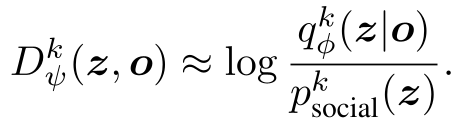 The discriminator bridges the gap, allowing the agent to quantify how much its beliefs deviate from social expectations.
Experiments: The Emergence of Cultural Niches
The authors tested their agents on a connected caveman graph—a network with two tight clusters connected by a few "hub" agents.
Key Finding 1: Representational Alignment
Over 5,000 simulation steps, the agents' internal "concepts" (social representations) began to diverge based on their social cluster. Agents in Cluster 0 developed similar internal maps, while Cluster 1 developed a different set, even though they started with identical parameters.
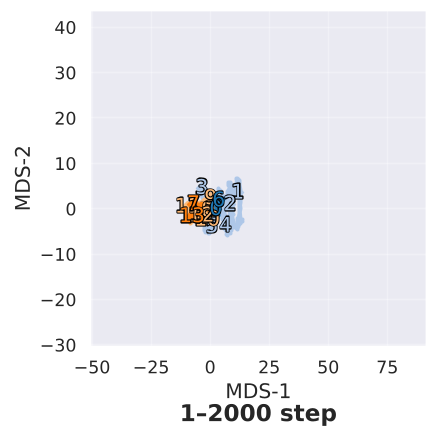 Figure 2: The Wasserstein distance matrix shows the emergence of a block-diagonal structure, indicating that agents within a cluster "think" alike.
Key Finding 2: The Role of Creativity
In the "w/o creation" condition (where agents were passive), the alignment between what agents saw and what they thought (RSA similarity) collapsed over time. However, in the "w/ creation" condition, agents actively produced new artifacts that "reified" their internal beliefs into the physical world. This circular constitution allowed the social reality to remain stable yet evolving.
 Figure 4: Note how agents first consolidate into cluster-level "arches" before branching out into unique, creative territories.
Critical Insight: Hub Agents and Selective Pruning
The study highlights the fascinating role of "Hub Agents." These agents, caught between two clusters, never fully converge to a single norm. Instead, they oscillate in a state of high uncertainty. Interestingly, the propagation of creations (artifacts) was much more selective than the propagation of meanings (representations), suggesting that while we might share a language with many, we only "build" worlds with a few close partners.
Conclusion & Future Work
This work provides a mathematically rigorous foundation for the "Social Self." By using Active Inference, it shows that creativity is not just "noise"—it is a functional necessity for maintaining a coherent social reality.
Future versions of this model could incorporate active partner selection (letting agents choose who they talk to) or embodiment, where the "artifacts" created are actual physical objects in a shared 3D environment. This brings us one step closer to understanding how human culture—from languages to laws—self-organizes from the simple desire to minimize surprise.
Author Analysis: This paper is a significant leap for the Collective Predictive Coding (CPC) hypothesis. By placing the "social representation" inside the agent rather than as a global variable, the authors have successfully moved from modeling "consensus" to modeling "culture."