
[YITP-26-35] Taming the Infrared: Why Hořava Gravity Can't Hide in Static Space
Space- vs Time-dependence in taming the infrared instability of projectable Ho\v rava Gravity
This paper investigates the infrared (IR) instability of Minkowski spacetime in projectable Hořava gravity. The authors examine whether higher-derivative terms can lead to static, inhomogeneous, or periodic ground states (similar to "modulated phases" in condensed matter) to tame this instability. The study concludes with a no-go theorem, proving such solutions do not exist within the considered symmetry classes.
TL;DR
Projectable Hořava Gravity—a promising candidate for quantum gravity—suffers from a chronic instability in flat spacetime. This paper asks: can the universe "settle down" into a static, wavy, or periodic structure instead of blowing up? By proving a rigorous No-Go Theorem, the authors demonstrate that such spatially modulated ground states are mathematically impossible under standard symmetries. This leaves "Spacetime Foam" or complex time-dependencies as the only survivors for this theory's viability.
Background Positioning: The Ghost-Free Contender
Hořava Gravity (HG) attempts to solve the UV divergence of General Relativity by introducing anisotropic scaling between space and time (). By adding higher spatial derivatives without extra time derivatives, it remains renormalizable and avoids "ghost" instabilities. However, there is a catch: the breaking of Lorentz invariance introduces a scalar graviton that becomes unstable at low energies (IR) on a flat Minkowski background.
Problem & Motivation: The Quest for a New Vacuum
The IR instability in projectable HG is not necessarily a "death sentence." In condensed matter physics, systems with similar instabilities often undergo a phase transition into a modulated phase (Lifshitz phase)—a state that isn't uniform but is periodic and stable.
The authors investigate whether the universe, rather than expanding or collapsing, could simply organize itself into a "static wavy pattern" (planar symmetry) where the curvature averages out to near-zero.
Methodology: Hunting for Modulated Solutions
The team focused on the "Projectable" version of the theory, where the lapse function depends only on time. They used a metric Ansatz with planar symmetry ( symmetry in the plane):
The Mathematical Insight
By varying the action, they derived a set of differential equations for the metric function . The "smoking gun" for their no-go theorem was the discovery of a function that obeys:
Intuition: If a solution were periodic, would have to be periodic too. But the equation above shows that is strictly monotonic (always decreasing) unless is a constant. This simple yet powerful observation kills any possibility of a static, periodic spatial modulation.

Experiments & Results: Maximally Symmetric Spaces
Before concluding, the authors classified all "maximally symmetric" spaces (spheres and hyperboloids ).
| Solution | Topology | Stability () | Hamiltonian Constraint |
|---|---|---|---|
| S+ | Sphere | No | Compatible |
| S- | Sphere | Yes | Not Compatible |
| H+ | Hyperboloid | Yes | Compatible |
| H- | Hyperboloid | No | Not Compatible |
While and show some stability, they are highly curved. Specifically, their curvature is of the order of the Lorentz-violating scale—far too large to match our observed, nearly-flat universe.
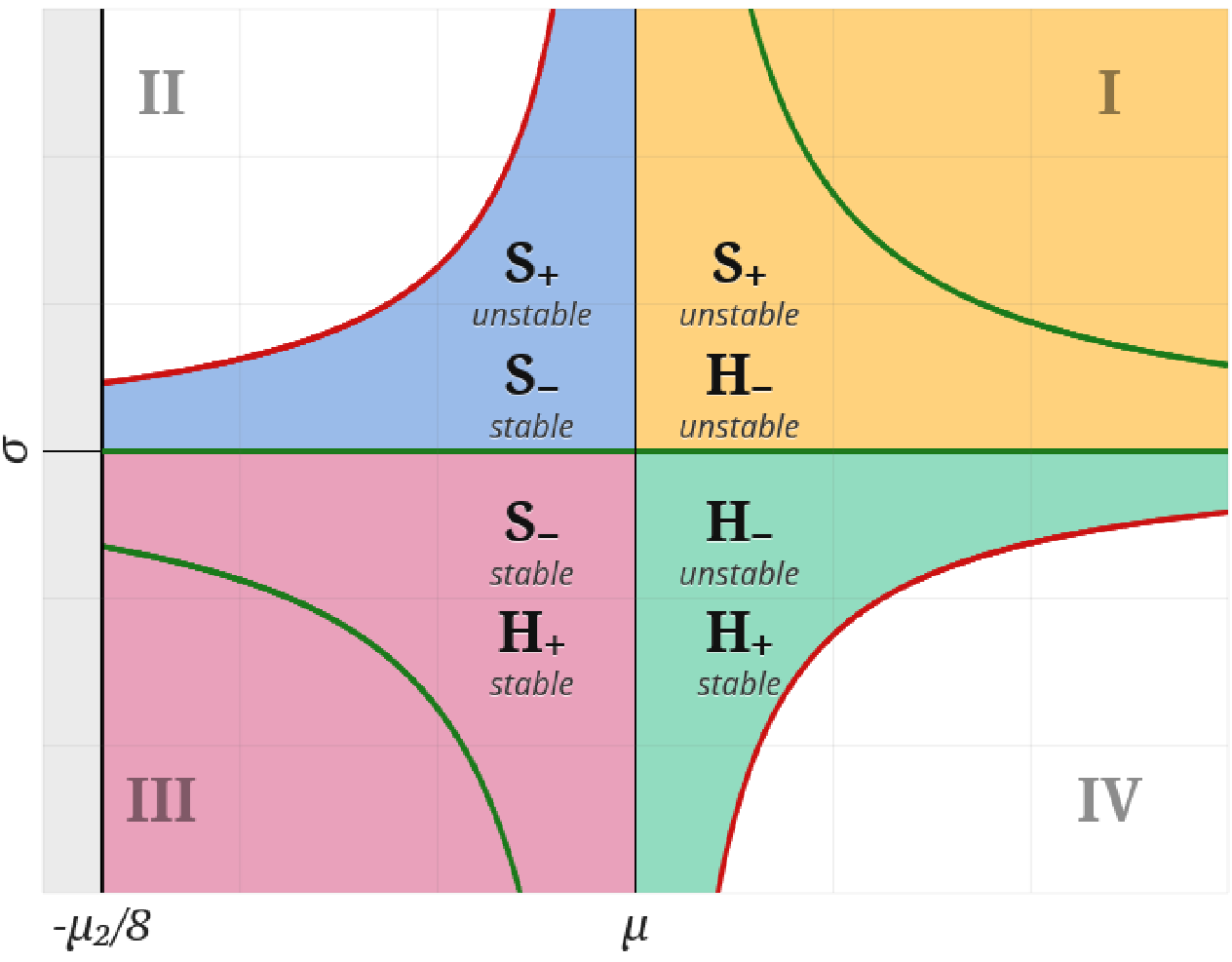
The figure above illustrates where different geometric solutions exist. The gray region is excluded by UV stability requirements.
Critical Analysis & Conclusion
Takeaway
The "Space-dependence" route for taming Hořava gravity's IR instability is a dead end. Since we cannot find a static, wavy ground state to replace Minkowski space, the theory must be dynamical.
Limitations
- Symmetry Constraints: The no-go theorem specifically targets planar and maximal symmetry. It remains theoretically possible (though unlikely) that a totally asymmetric "chaos" or a 3D-periodic crystal-like vacuum exists.
- Truncation: The study ignored 6th-order derivative terms. While unlikely to change the qualitative result, they are technically part of the full theory.
Future Outlook
The focus now shifts back to Time-dependence. The authors suggest that the instability might lead to a "spacetime foam"—a turbulent, high-frequency bubbling of geometry at microscopic scales that averages out to the smooth General Relativity we see at large scales. Proving this will require the "holy grail" of the field: Non-linear resummation and full-scale numerical simulations of quantum gravity.