
SpanVLA: Redefining VLA Efficiency and Robustness via Action Bridging and Negative-Recovery Learning
SpanVLA: Efficient Action Bridging and Learning from Negative-Recovery Samples for Vision-Language-Action Model
SpanVLA is an end-to-end Vision-Language-Action (VLA) framework for autonomous driving that integrates a VLM backbone with a flow-matching action expert. It introduces an efficient "action bridging" mechanism and a GRPO-based post-training method to achieve SOTA performance on NAVSIM benchmarks while significantly reducing inference latency.
TL;DR
Autonomous driving is entering the VLA (Vision-Language-Action) era, but two "elephants in the room" remain: latency and robustness. SpanVLA tackles both by replacing slow autoregressive action generation with an efficient flow-matching expert and introduces a groundbreaking training regime that learns from human "takeovers" and mistakes (negative-recovery samples) using GRPO.
Problem & Motivation: The Latency-Robustness Paradox
Most Vision-Language-Action models treat driving like a chat-bot task: they predict action tokens one by one. While this inherits the "reasoning" of Large Language Models (LLMs), it creates a bottleneck—driving requires high-frequency control (often >10Hz), but LLM decoding is notoriously slow.
Furthermore, imitation learning (predicting what the expert did) is brittle. If a model encounters a situation never seen in the training "success stories," it doesn't know how to recover. The authors argue that to be truly robust, a model must understand negative behaviors (what to avoid) and recovery behaviors (how to get back on track).
Methodology: The Core Innovations
1. Efficient Action Bridging
Instead of decoding actions as text, SpanVLA uses the VLM (Qwen2.5-VL) as a "thinking" backbone and extracts features from sparse layers. These features are fed into a Flow-Matching Action Expert.
- Historical Initialization: Unlike standard diffusion models that start from pure noise, SpanVLA initializes the flow from historical trajectories. This provides a strong physical prior, making the "denoising" process much faster and more accurate.
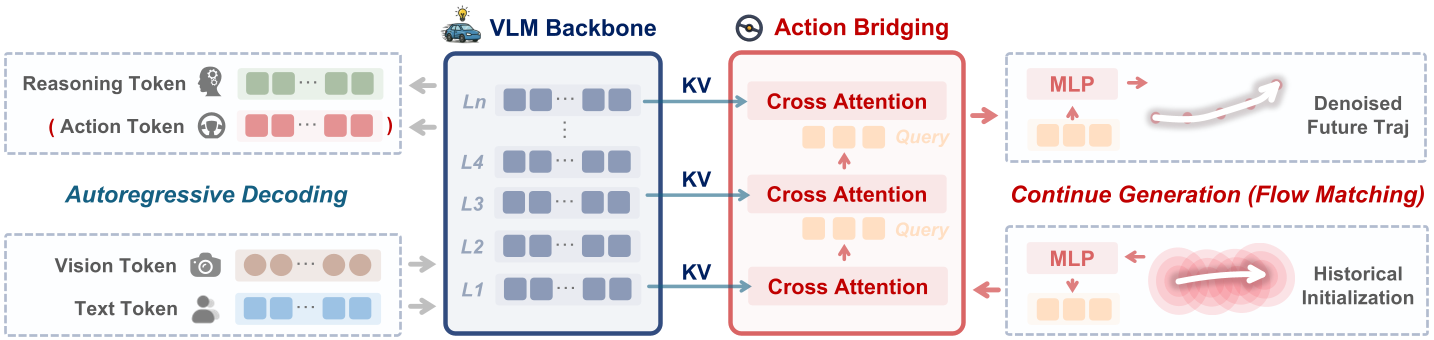 Figure 1: The SpanVLA framework, showcasing the VLM backbone and the Action Bridging module.
2. Learning from the "Bad" and the "Fix"
The creators introduced mReasoning, a dataset containing 30,000 reasoning samples and 6,000 negative-recovery scenarios.
- Negative Samples: Suboptimal trajectories (e.g., stopping too early at a turn).
- Recovery Samples: Expert corrections that fix those specific mistakes.
By using Group Relative Policy Optimization (GRPO), SpanVLA samples multiple paths and uses a specialized reward function to penalize proximity to "bad" trajectories while rewarding alignment with "recovery" actions.
Experiments & Results: Speed Meets Safety
SpanVLA was tested on the rigorous NAVSIM benchmarks (v1 and v2).
| Method | PDMS (Performance) | Latency (50 Waypoints) |
|---|---|---|
| AutoVLA (Baseline) | 89.1 | 2.57s |
| SpanVLA (Ours) | 90.3 | 0.67s |
The results show a massive 74% reduction in total latency compared to standard autoregressive models.
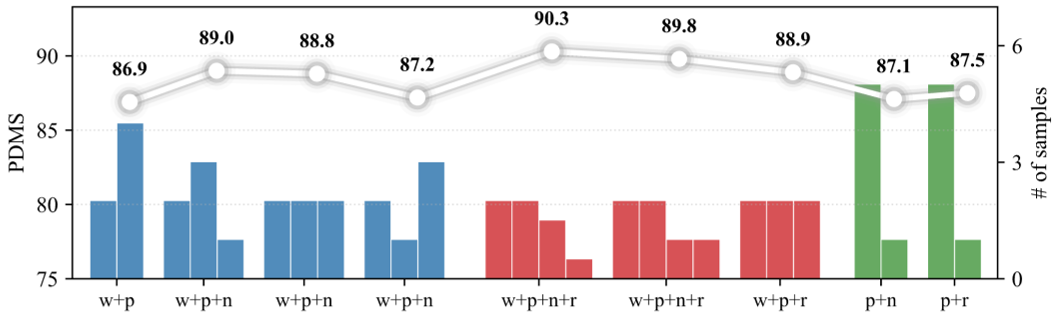 Figure 2: RFT Data-recipe comparison showing how adding negative and recovery samples boosts performance over positive-only training.
Qualitative Impact
In complex construction zones, the Post-RFT SpanVLA model demonstrates "decisive" behavior—merging early rather than hesitating and being forced to stop. When it accidentally "borrows" a lane to pass an obstacle, the recovery training allows it to smoothly return to the target lane, a feat many pure imitation models fail to achieve.
Global Insight & Conclusion
SpanVLA proves that the future of VLA in robotics isn't just "bigger models" but better architectural bridges and diverse data recipes. By treating "failure" as a first-class citizen in the training data, the researchers have moved us closer to an autonomous system that doesn't just copy humans, but understands the boundaries of safe driving.
Takeaway: The transition from SFT (Supervised Fine-Tuning) to RFT (Reinforcement Fine-Tuning) with negative constraints is likely the next major frontier for all embodied AI agents.