
Spark3R: Breaking the Quadratic Barrier in 3D Reconstruction via Asymmetric Token Reduction
Spark3R: Asymmetric Token Reduction Makes Fast Feed-Forward 3D Reconstruction
Spark3R is a training-free acceleration framework for feed-forward 3D reconstruction models (e.g., VGGT, π3, Depth-Anything-3) that introduces asymmetric token reduction. By decoupling the compression of query and key-value tokens, it achieves up to 28× speedup on 1,000-frame video inputs while maintaining or even improving reconstruction quality.
TL;DR
Feed-forward 3D reconstruction—the ability to estimate 1,000+ frame geometry in one go—has long been limited by the cost of global attention. Spark3R solve this using a "don't treat all tokens equal" philosophy. By merging Query tokens conservatively and pruning Key-Value tokens aggressively, it achieves up to 28× speedup without any retraining, while actually improving the accuracy of models like VGGT on long sequences.
Background: The Scalability Wall
Recent SOTA models such as VGGT, π3, and Depth-Anything-3 have moved away from slow per-scene optimization (like NeRF) toward direct feed-forward inference. However, they share a fatal flaw: to maintain global consistency, they use global attention layers. As you increase the number of video frames , the computation grows by .
Previous attempts to fix this, like uniform token merging, hit a quality ceiling. If you compress everything by 10x, the geometry falls apart. Spark3R identifies why: the roles of Queries and Key-Values in 3D vision are fundamentally different.
The Core Insight: Asymmetric Sensitivity
The authors discovered a critical "Asymmetry" in how 3D models perceive data:
- Query Tokens (Q): These represent "Geometric Requests." Each query is tied to a specific pixel in a specific view. If you merge them too much, you conflate two different viewpoints, leading to blur and drift.
- Key-Value Tokens (KV): These represent "Shared Context." Since multiple frames often look at the same object, the KV space is highly redundant. You can throw away 90% of them, and the remaining ones still provide enough "context" for the queries to find what they need.
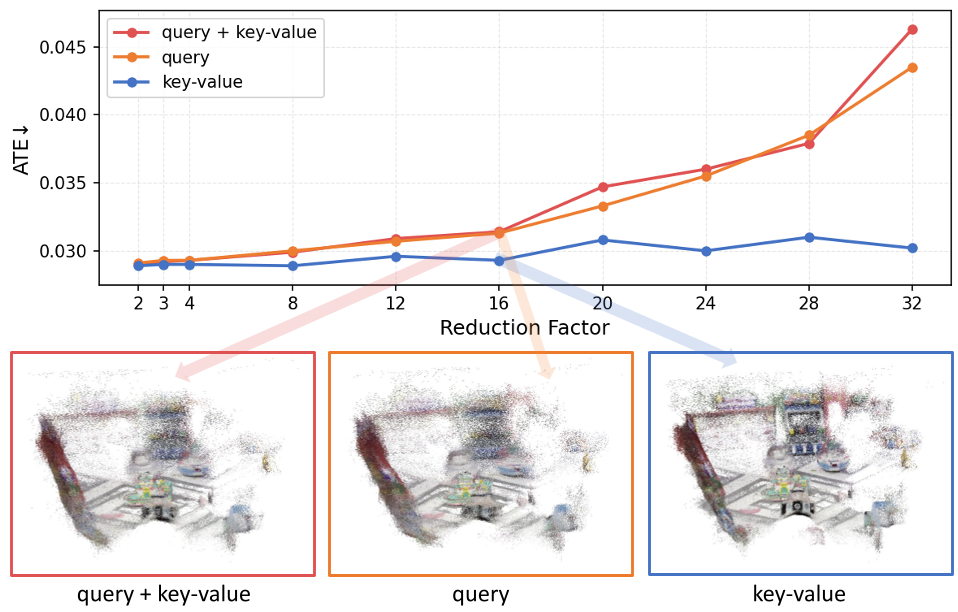 Figure 1: Comparison of error rates when compressing Q only, KV only, vs. joint uniform compression.
Methodology: How Spark3R Works
Spark3R introduces a three-pronged, training-free strategy:
1. Intra-Group Query Merging
Instead of matching queries across 1,000 frames (quadratic cost), they found that tokens mostly merge with their immediate temporal neighbors. By partitioning frames into groups (), they discover almost all beneficial merges with linear complexity.
2. Lightweight KV Pruning
Since KV tokens are highly redundant (cosine similarity > 0.9), the authors realized that the "average" step in standard merging is unnecessary. They replace complex merging with simple temporal stride pruning—just keeping every -th frame's KV pairs. This has effectively zero computational overhead.
3. Layer-Adaptive Scheduling
Not all transformer layers are equally important. By running a quick offline "sensitivity probe," Spark3R identifies which layers are robust. They apply a base reduction to sensitive layers and a much harsher multiplier () to the robust ones, squeezing out extra efficiency.
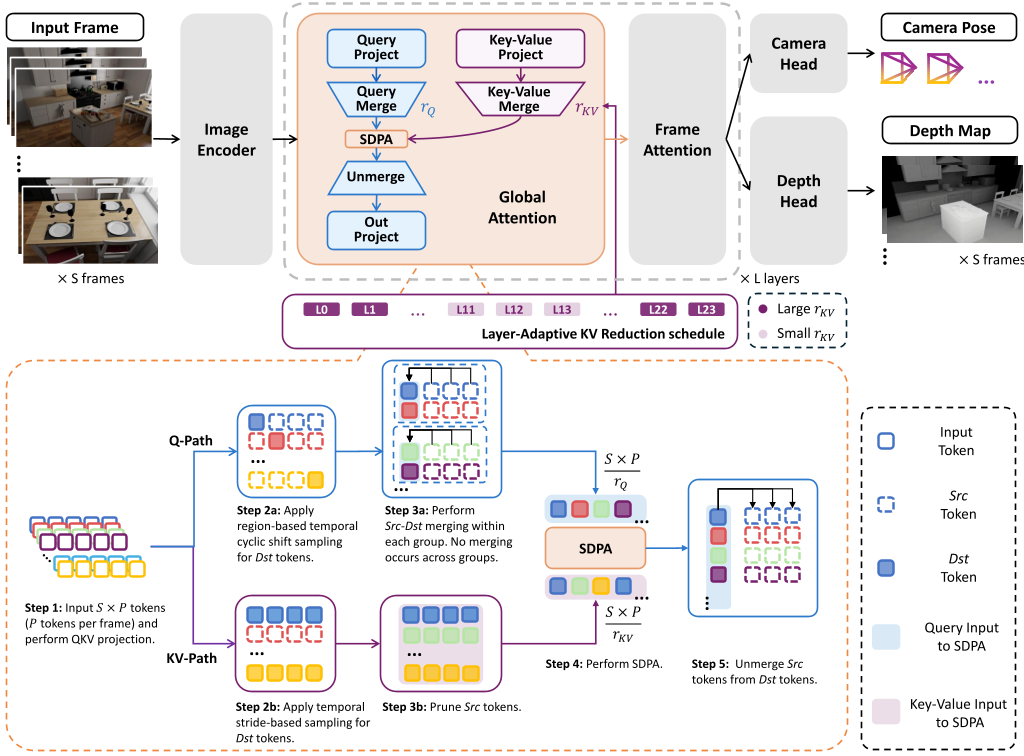 Figure 2: The Spark3R workflow showing decoupled Q and KV reduction paths.
Experimental Triumphs: Faster and Sharper
The most surprising result isn't just the speed (though 28× faster is massive). It's that on long sequences, Spark3R often outperforms the original model.
- The "Attention Dilution" Effect: In standard global attention, a query's attention mass is spread thin across thousands of tokens. This introduces noise.
- The Solution: By pruning the KV tokens, Spark3R forces the model to focus on the most salient context, resulting in sharper point clouds and less pose drift.
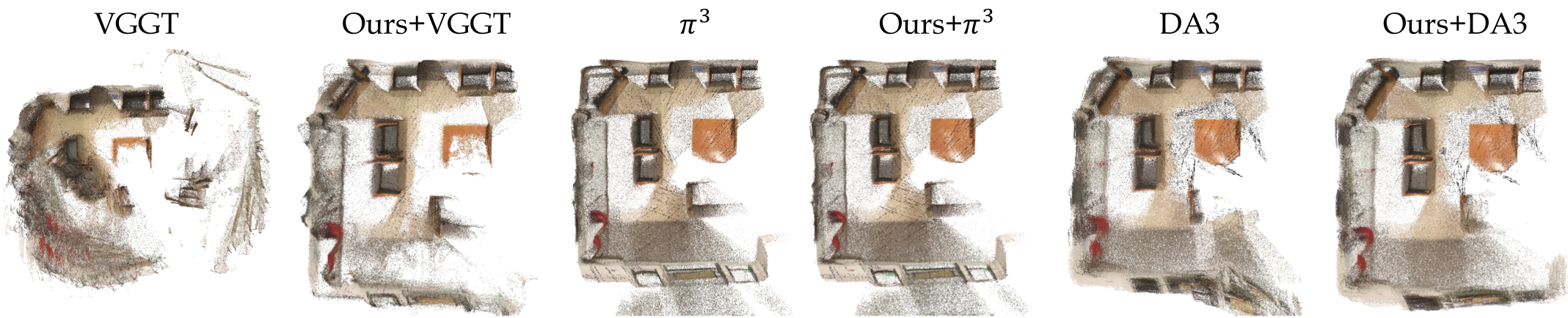 Figure 7: Point cloud comparison. Note how Spark3R+VGGT corrects the massive structural drift seen in the unaccelerated baseline.
Conclusion & Key Takeaways
Spark3R proves that for 3D reconstruction, "less is more." By recognizing that Queries need precision while KV needs efficiency, we can scale feed-forward models to kilometer-scale trajectories that were previously impossible to process.
- Plug-and-Play: Works with VGGT, π3, and DA3 out of the box.
- Retraining-Free: No need for expensive H100 clusters to "re-learn" attention.
- Future Impact: This asymmetric approach likely applies to other "Video-to-X" tasks where temporal redundancy is high but per-frame detail is sacred.
Limitations
As a training-free method, it cannot fix architectural bugs inherent in the base models. The authors suggest that fine-tuning the models specifically to handle compressed tokens could push the Pareto frontier even further.