
SPEC CPU2026: Redefining General-Purpose Benchmarking in the Accelerator Era
SPEC CPU2026: Characterization, Representativeness, and Cross-Suite Comparison
This paper presents the first comprehensive microarchitectural characterization of the SPEC CPU2026 benchmark suite across nine hardware platforms. It introduces representative subsets and positions the suite against SPEC CPU2017, DCPerf, and MLPerf, demonstrating its role as a modern general-purpose CPU evaluation standard.
TL;DR
The CPU landscape is shifting from "primary compute" to "system orchestrator." This paper introduces SPEC CPU2026, the biggest update to the industry-standard benchmark suite in nearly a decade. By analyzing it across nine diverse platforms (Intel, AMD, Ampere, Nvidia), the authors reveal that SPEC CPU2026 drastically increases instruction volume and memory footprints, focusing on new bottlenecks like L1 Instruction Cache (L1I) pressure.
The "Orchestrator" Motivation: Why CPUs Still Matter
In an era of GPUs and TPUs, it is easy to assume CPU benchmarking is a solved problem. However, CPUs remain the backbone of datacenter services and orchestrate the data flow to accelerators. The authors argue that as workloads shift, our benchmarks must follow. Prior work, such as SPEC CPU2017, lacks the instruction footprint and translation-lookaside buffer (TLB) stress seen in today's hyperscale applications.
Methodology: Trimming the Fat
Evaluating 52 individual benchmarks is computationally expensive. Using Principal Component Analysis (PCA) and Hierarchical Clustering, the authors identified that you don't need the whole suite for architectural research.
- Key Insight: A subset of just 4–5 workloads per category can replicate over 96% of the full suite's behavior.
- Efficiency: This reduces simulation and testing time by orders of magnitude while preserving microarchitectural fidelity.
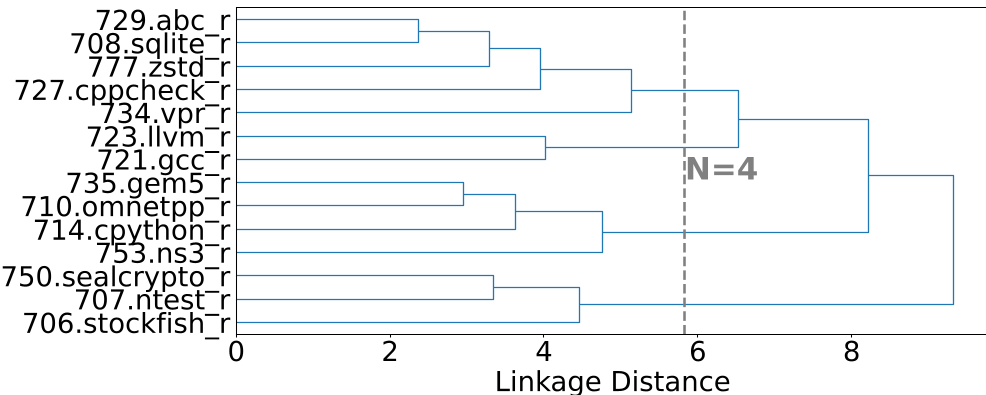 Figure: Hierarchical clustering used to identify representative subsets (medoids) for SPEC CPU2026.
SPEC CPU2026 vs. The World: DCPerf & MLPerf
The study places SPEC CPU2026 in a "Golden Triangle" with DCPerf (Datacenter) and MLPerf (Machine Learning).
- Instruction Cache Pressure: SPEC CPU2026 shows a 5.9x increase in L1I stress over SPEC CPU2017, moving it closer to the "frontend-heavy" profiles of real-world datacenter services (DCPerf).
- Vector Intensity: Unlike MLPerf, which is dominated by vector instructions (AVX/SVE), SPEC CPU2026 remains balanced, emphasizing control flow and general-purpose integer arithmetic.
- Memory Footprint: The suite increases the Resident Set Size (RSS) by ~1.4x, testing the limits of modern memory allocators and page sizes.
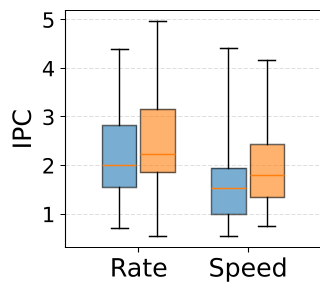 Figure: Boxplots showing that SPEC CPU2026 (Green) captures significantly wider L1I and L1D pressure ranges compared to SPEC CPU2017 (Orange).
Deep Insight: Scaling on Chiplets vs. Monolithic
One of the most valuable case studies in the paper explores SoC Interconnect. As core counts soar, the design of the "glue" between cores (the interconnect) becomes the bottleneck.
- Monolithic Wins: In communication-sensitive workloads (e.g., synchronization-heavy SPEC CPU2017 tasks), monolithic designs like Intel Ice Lake outscaled chiplet designs.
- Chiplet Scalability: SPEC CPU2026 includes more multi-threaded "Speed" workloads that favor the massive L3 cache capacities found in modern chiplet architectures (e.g., Sapphire Rapids), showing higher scalability up to 40 cores.
Critical Analysis & Future Outlook
The introduction of the Rolling Round-Robin (RRR) mode is a game-changer. By staggering different benchmarks across cores, researchers can simulate "noisy neighbors" in a multi-tenant cloud environment.
Limitations: While SPEC CPU2026 is a massive leap forward, it still doesn't fully capture the extreme "frontend bound" nature of massive microservices (e.g., Google’s "Google-tax" workloads), for which DCPerf remains superior.
Verdict: SPEC CPU2026 isn't just an incremental update; it’s a necessary pivot toward instruction-cache stress and many-core scalability. For the next decade of CPU research, this is the new baseline.