
SpecKV: Taming the Speculation Tradeoff with Compression-Aware Adaptation
SpecKV: Adaptive Speculative Decoding with Compression-Aware Gamma Selection
SpecKV is an adaptive speculative decoding controller that dynamically selects the optimal speculation length (γ) per step. By using a lightweight MLP trained on draft model signals (entropy and confidence), it achieves a 56.0% improvement in expected tokens per step over the industry-standard fixed-γ=4 baseline while maintaining negligible overhead (<0.34ms).
Executive Summary
TL;DR: SpecKV is a lightweight adaptive controller that boosts speculative decoding efficiency by 56%. It replaces the static speculation length () with a dynamic decision engine that senses draft model confidence and target model compression levels to pick the perfect for every single generation step.
Background: In the landscape of LLM serving, speculative decoding is a cornerstone for speed. However, most implementations (like those in vLLM or TensorRT-LLM) use a hardcoded . SpecKV proves this is inefficient, especially when using quantized models (INT8/NF4), and provides a zero-cost way to fix it.
The Hidden Coupling: Compression & Speculation
The core "Aha!" moment of this paper is that Quantization changes the math of speculation.
When you compress a model to INT8 using BitsAndBytes, you introduce dequantization overhead. This makes the "cost" of a target model forward pass higher relative to the draft model. To make that cost worthwhile, you need to accept more tokens per pass. Consequently, the optimal shifts:
- FP16 (Uncompressed): Verification is fast; keep low (2-4) to avoid wasting time on unlikely tokens.
- INT8 (Compressed): Verification is heavy; go big () to maximize the "bang for your buck" per verification cycle.
Methodology: The SpecKV Controller
SpecKV operates as a "Contextual Bandit" style regulator. It looks at four specific signals from the draft model that are usually thrown away:
- Mean/Max Entropy: How "confused" is the draft model?
- Mean/Min Confidence: How sure is the draft model of its top pick?
The Architecture
The authors designed a tiny MLP (16 hidden units) that takes these signals + the current compression level as input. It predicts the expected acceptance rate for and picks the winner.
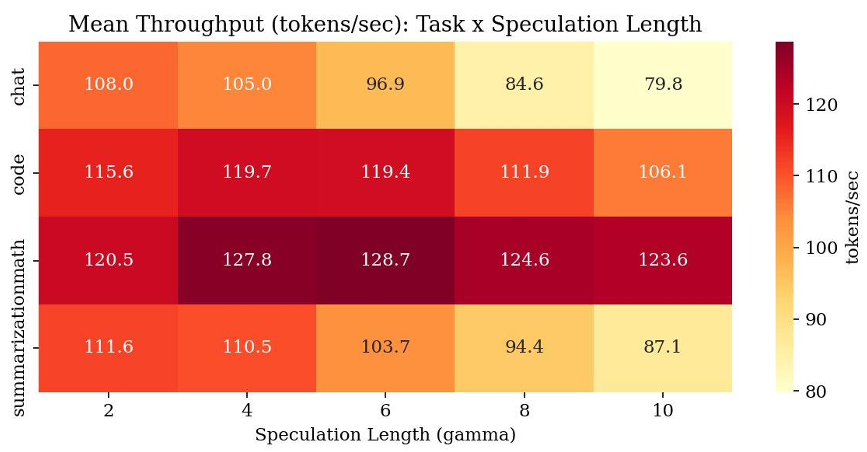 Above: Throughput (tokens/s) varies wildly across tasks. SpecKV finds the peak for each.
Experimental Battlecard
The results show that the adaptive approach is strictly superior to any fixed-length strategy.
| Strategy | Expected Tokens/Step | Improvement vs. Default |
|---|---|---|
| Fixed-4 (Standard) | 3.73 | Baseline |
| SpecKV-Fast | 5.82 | +56.0% |
| Fixed-Best (Oracle) | 5.81 | +55.7% |
Key Insight from Ablation
The most informative features for the controller were Min Confidence and Max Entropy. This makes sense: speculation is a chain; it only takes one "weakest link" (a high-entropy token) to break the entire sequence. By detecting that weak link early, SpecKV reduces to save compute.
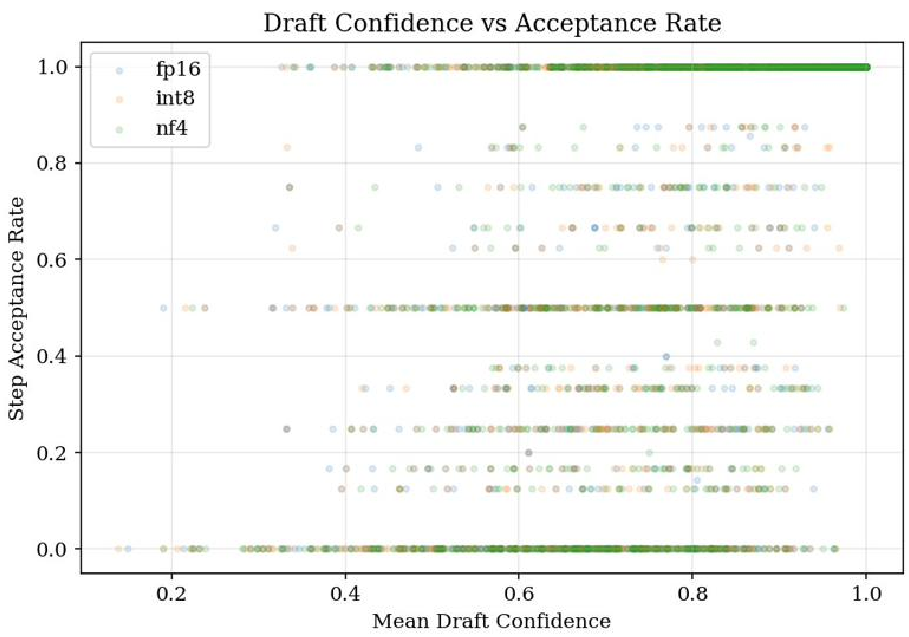 Above: The strong correlation (~0.56) between draft signals and actual acceptance rate across all compression levels.
Critical Analysis & Professional Perspective
The "Why" it Works: SpecKV succeeds because it respects the Pareto Frontier of inference. By adding a mere 0.34ms of overhead (0.5% of a typical 70ms step), it buys a 56% throughput increase. This is a classic "system-level win" where a small amount of intelligent meta-computation yields massive gains in the heavy-lifting phase.
Limitations:
- Model Scale: Tested on 1B/3B pairs. While promising, the dynamics might change with 70B+ models where the draft/target gap is wider.
- Static Training: The MLP is currently trained offline. An online, self-correcting version (using reinforcement learning) would be the next logical step for production environments with shifting data distributions.
Takeaway for the Industry
If you are running LLM inference in production, stop using fixed . The interaction between your quantization choice (INT8 vs NF4) and your speculation length is a major source of "dark latency." SpecKV provides a blueprint for an adaptive, signals-driven approach that can be integrated into engines like vLLM with minimal friction.