
[CVPR 2026] SpecEyes: Bypassing the Sequential Bottleneck of Multimodal Agents with Speculative Planning
SpecEyes: Accelerating Agentic Multimodal LLMs via Speculative Perception and Planning
SpecEyes is an agentic-level speculative acceleration framework designed for Multimodal LLMs (MLLMs) that replaces iterative visual tool-calling loops with a "think fast, think slow" approach. By utilizing a lightweight, tool-free MLLM as a speculative planner, it achieves a 1.1–3.35× speedup and up to a +6.7% accuracy improvement across benchmarks like V* and POPE.
TL;DR
SpecEyes is a breakthrough framework that addresses the "latency explosion" in agentic Multimodal Large Language Models (MLLMs). By introducing a "Think Fast, Think Slow" architecture, it uses a tiny, tool-free model to "speculate" the answer to complex visual queries. If the small model is confident—determined by a new Answer Separability metric—it bypasses the expensive, multi-step tool-calling process entirely. The result? Up to 3.35x faster inference with better-than-baseline accuracy.
The Problem: The "Agentic Depth" Disaster
The current paradigm for advanced MLLMs (like OpenAI o3 or Gemini Agentic Vision) involves "Agentic Reasoning." Instead of looking at an image once, the model performs a loop: Observe -> Reason -> Call Tool (e.g., Zoom) -> Observe again.
While powerful, this creates what the authors call Agentic Depth (D). Because each tool call depends on the previous output, the system suffers from:
- Latency Explosion: Response time grows linearly with the number of tool calls.
- Concurrency Collapse: Traditional GPU batching fails because each query is "stateful" (mutating its own trajectory), leaving hardware parallelism wasted.
Methodology: The Architecture of SpecEyes
SpecEyes transforms the rigid serial pipeline into a Heterogeneous Parallel Funnel.
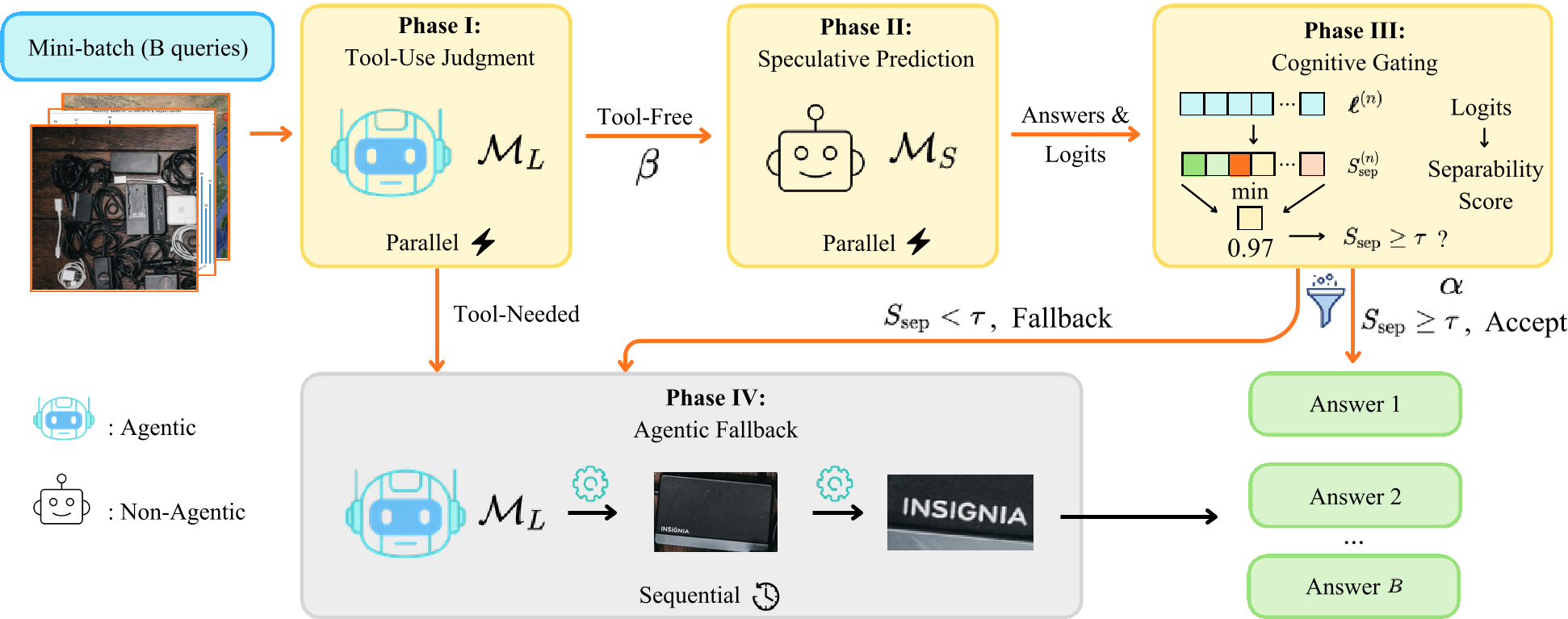
1. Heuristic Screening (Phase I)
The large model () first performs a "vibes check"—a single-token binary classification to see if the query actually needs tools. If the image is simple, it passes to the speculative branch.
2. Speculative Perception (Phase II & III)
A small, tool-free model (, e.g., Qwen3-VL-2B) attempts to solve the query in a single pass. To ensure we don't trade accuracy for speed, the authors introduce Cognitive Gating via Answer Separability ().
Unlike standard probability (Softmax), which is often overconfident, measures the Decision Margin: It calculates how far the top predicted token stands apart from its top-K competitors. By using a Min-Aggregation strategy (thresholding the weakest token in a sentence), SpecEyes acts as a "worst-case guard" to prevent hallucinations.
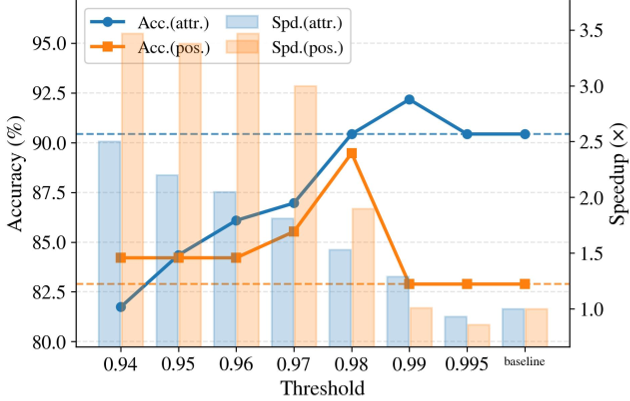 Figure: KDE plots showing that (c) provides the cleanest separation between correct and incorrect answers compared to standard methods.
3. Agentic Fallback (Phase IV)
If is unsure, the system "falls back" to the complex agentic model. Because most queries (avg. 71% in experiments) are accepted by the gate, the heavy model is reserved only for truly difficult cases.
Experimental Performance
The framework was tested on several benchmarks including V Bench* (fine-grained perception) and POPE (hallucination robustness).
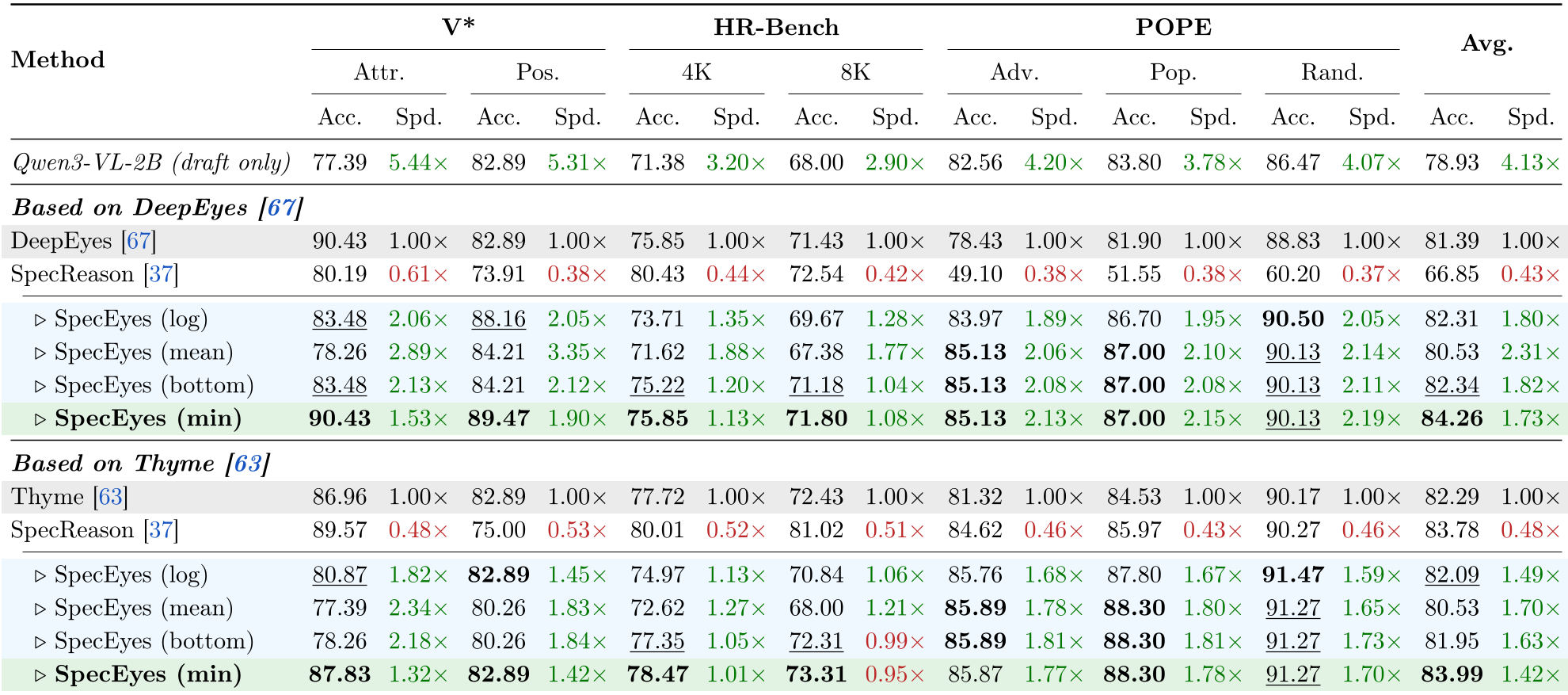
- Speedup: SpecEyes achieved a 1.73x average speedup across all tasks. On spatial reasoning tasks (V* Position), this went as high as 3.35x.
- Accuracy Boost: Interestingly, SpecEyes often outperformed the full agentic baseline (up to +6.7%). This suggests that for some queries, the iterative tool-calling loop actually introduces "noise" or "reasoning drift," and the small model's "intuition" is more robust.
- Throughput: Because the small model is stateless, it can be batched easily. As batch sizes increase, the system-level throughput gain becomes even more pronounced.
Critical Analysis & Insights
Why does this work?
The success of SpecEyes lies in the realization that agentic reasoning is an "overkill" for a significant portion of user queries. By identifying "easy" cases via logit-space separability, we can reclaim the lost hardware efficiency of non-agentic models without losing the "slow thinking" capability of agentic models.
Limitations
The primary bottleneck remains high-resolution benchmarks like HR-Bench. In these cases, the small model (which doesn't use tools like zoom-in) rarely achieves high confidence, meaning most queries still fall back to the slow path. The speedup here is marginal (1.01x - 1.13x).
Future Outlook: Multi-Depth Speculation
The authors suggest that the next step is Multi-Depth Speculation. Instead of just "No Tools" vs "Full Tools," the system could allow the small model to perform 1 or 2 lightweight tool calls before deciding whether to escalate to the massive backbone. This would bridge the gap for high-resolution tasks where a single "glance" isn't enough, but a full 5-step loop is too much.
Conclusion: SpecEyes effectively "unclogs" the pipeline of modern AI agents, making real-time, high-accuracy multimodal interaction a feasible reality for production systems.