
[Physical Review] Sign Control of Photocurrents: Breaking Spin-Group Symmetry in Altermagnetic Insulators
Sign control of photocurrents by spin-group-symmetry breaking in altermagnetic insulators
The paper proposes a novel mechanism for controlling charge and spin photocurrents in altermagnetic insulators (AMIs) through spin-group-symmetry breaking. Specifically, it demonstrates that applying shear strain to the AMI CuWP2S6 activates previously forbidden second-order optical responses, where the direction of the photocurrent is deterministically locked to the sign of the strain.
TL;DR
Researchers have uncovered a way to "unlock" and control the direction of charge and spin currents in altermagnetic insulators using nothing but mechanical strain. By breaking the delicate spin-group symmetry of the material, they created a Spin-Gap Asymmetry (SGA) that makes the material respond differently to light depending on the direction of the applied shear. This provides a revolutionary probe for altermagnets—materials that have the high-speed benefits of antiferromagnets but the spin-splitting of ferromagnets.
Context: Why Altermagnets?
Altermagnets are the "rising stars" of spintronics. They boast vanishing net magnetization (no stray fields) and ultrafast dynamics like antiferromagnets, but unlike traditional AFMs, they possess spin-split band structures similar to ferromagnets. However, probing these properties in insulating altermagnets is notoriously difficult because standard electrical transport requires a Fermi surface, which insulators lack.
The Problem: Symmetry-Enforced Silence
In a pristine altermagnetic insulator (AMI), the electronic structure is highly symmetric. Even though the bands are spin-split, the spin-group symmetry (which links spatial rotations to spin flips) ensures that the direct energy gaps for spin-up and spin-down electrons are identical ().
Because of this equivalence, the photocurrents generated in the two spin channels often cancel each other out or are restricted to specific, orthogonal directions. To make these materials useful for devices, we need a way to break this balance and gain deterministic control over the output current.
Methodology: Inducing Spin-Gap Asymmetry (SGA)
The paper introduces a clever "trilinear coupling" mechanism. By applying shear strain ( ), the researchers break the spin-group symmetry. This results in Spin-Gap Asymmetry (SGA):
The Intuition
Think of SGA as a "spectral filter." When , the energy gap for spin-down electrons is smaller. If you shine light with a frequency that sits between the two gaps, you selectively excite only one spin channel. This turns the material into a spin-selective engine.
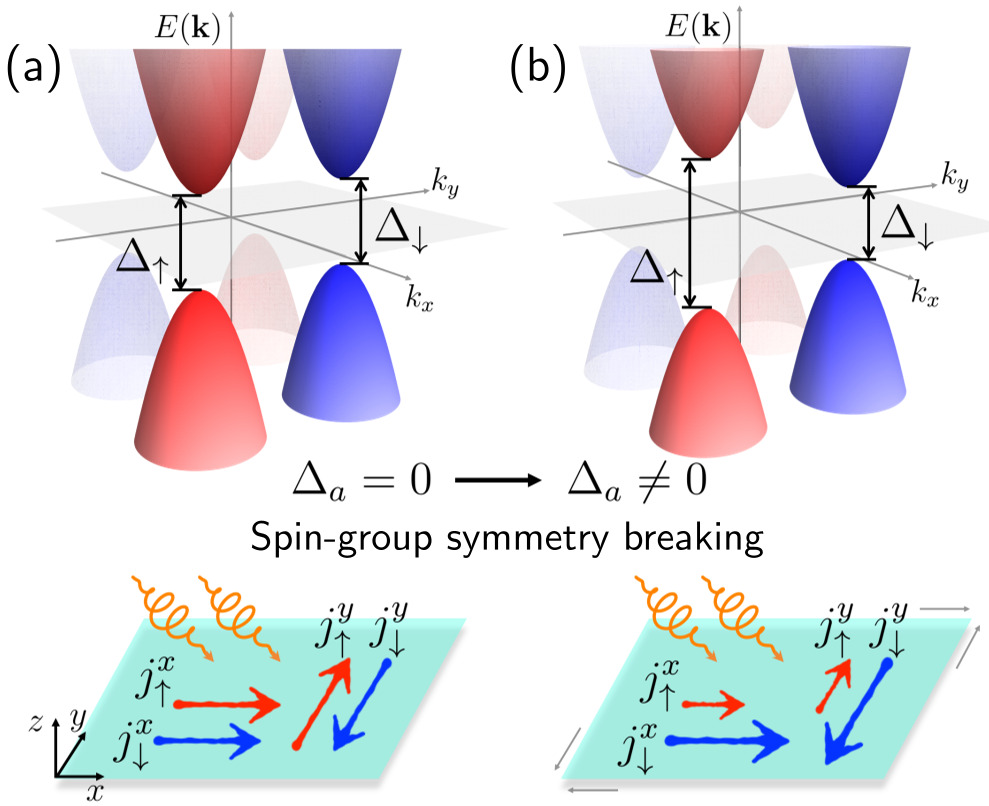 In Fig 1: (a) Pristine altermagnet with balanced gaps leads to orthogonal spin/charge currents. (b) Strained system with SGA allows parallel currents via spin-selective excitation.
Material Evidence: CuWP2S6
The team tested this theory using DFT calculations on CuWP2S6, a recently proposed 2D altermagnet.
- Symmetry Mapping: They showed that the -wave spin splitting is perfectly preserved in the pristine monolayer.
- Strain Response: Applying shear strain shifted the bands such that the spin-up and spin-down Joint Density of States (JDOS) became imbalanced.
- Sign Locking: Crucially, the direction of the activated charge current () and spin current () flipped exactly when the strain changed from positive to negative.
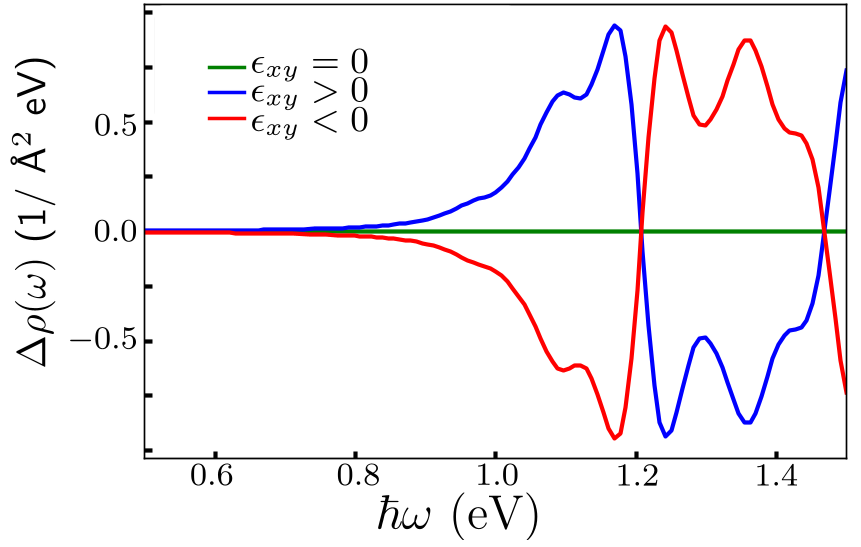 Fig 3: The momentum-resolved imbalance () flips sign completely under strain reversal, acting as the microscopic driver for the current sign-locking.
Deep Insight: A New Paradigm for Optospintronics
The most profound takeaway is that we can achieve deterministic control of spin/charge currents without needing Spin-Orbit Coupling (SOC) or external magnetic fields. Instead, we rely on the geometric and symmetry properties of the altermagnetic state.
Limitations and Outlook
- Signal Strength: The strain-induced currents are currently weaker than the naturally allowed ones. However, as noted in the paper, rotational scans (polar angle plots) can enhance detection.
- Future Applications: This theory opens the door to "strain-tronics," where mechanical deformation of a 2D AMI acts as a logic gate for light-induced information.
Conclusion
This work elevates Nonlinear Optical Responses (NLORs) from a mere characterization tool to a functional control mechanism. By understanding and breaking spin-group symmetries, we are one step closer to practical, ultrafast, and energy-efficient spintronic devices based on the unique physics of altermagnets.