
StableI2I: Detecting the "Ghost in the Machine" of Image-to-Image Transitions
StableI2I: Spotting Unintended Changes in Image-to-Image Transition
StableI2I is a unified evaluation framework and a multimodal large language model (MLLM) designed to assess content fidelity in image-to-image (I2I) tasks. It specifically targets "information drift" by measuring semantic, structural, and low-level appearance consistency without requiring reference images, outperforming SOTA models like Gemini-3-pro and GPT-5 in diagnostic accuracy.
TL;DR
While modern AI can "replace a building with a tree" with stunning realism, it often quietly alters the clouds, repaints the grass, or shifts the camera angle—unintended changes known as information drift. StableI2I is a new specialized MLLM designed to act as a rigorous judge, spotting these subtle fidelity errors across semantic, structural, and low-level dimensions with higher accuracy than GPT-5 or Gemini.
The Problem: The High Cost of "Unintended Creativity"
In image editing and restoration, "quality" is a double-edged sword. A model might produce a beautiful restored photo that looks nothing like the person in the original. Current benchmarks like CLIP-IQA or aesthetics-based metrics reward the beauty of the output but ignore the truth of the transition.
The authors identify a critical gap: General MLLMs are "blind" to pixels. They understand that a "dog" is still a "dog" (semantic level), but they fail to notice if the dog's fur texture has been entirely repainted or if its position has shifted by 10 pixels (structural level). In high-stakes fields like medical imaging or remote sensing, these "hallucinations" are not just errors—they are dangerous.
Methodology: Training a Judge with "Texture-Aware" Vision
StableI2I isn't just a prompt-engineered version of an existing model; it is a specialized tool built through a sophisticated three-stage pipeline:
- Error-Amplification Pipeline: To teach the model what failure looks like, the authors used a "corrupt-and-restore" cycle. They deliberately fed incorrect semantic info to restoration models to force "semantic drift," creating a goldmine of hard-to-detect errors.
- Multidimensional Evaluation: The model judges along three axes:
- Semantic Level: Did objects vanish or appear without permission?
- Structure Level: Was the layout warped or the texture "repainted"?
- Low-level Appearance: Did the edit introduce artifacts, blur, or noise?
- Texture-Aware Training: To fix the "pixel-blindness" of standard ViT encoders, the authors used images cropped by 95-98%. This forced the model to ignore global semantics and focus purely on micro-level alignments.
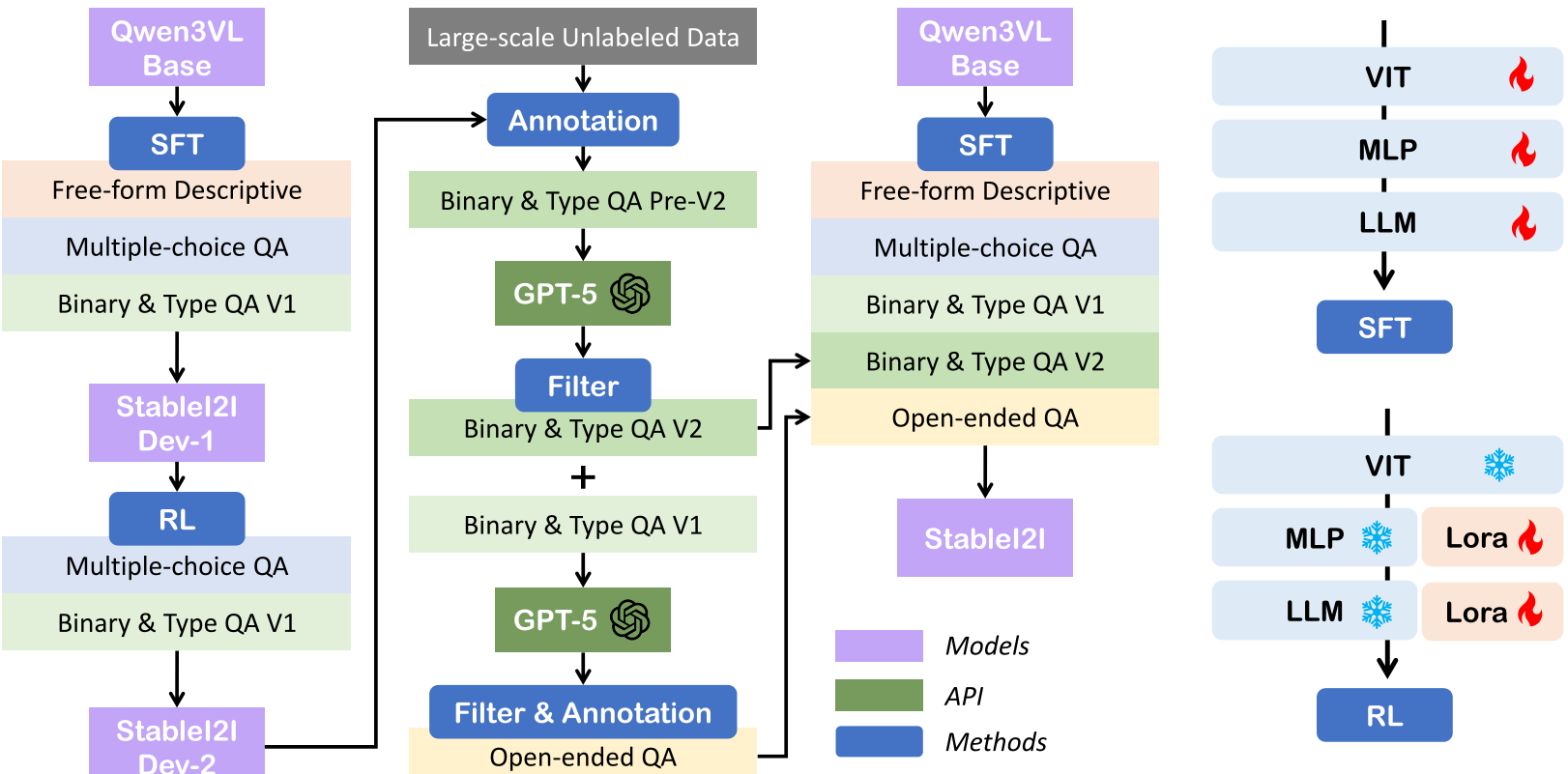 Figure: The multi-stage training pipeline including SFT, Reinforcement Learning (GRPO), and data augmentation.
Experiments: Surpassing the Giants
The authors pitted StableI2I against the heavyweights: GPT-4o, GPT-5, Gemini-3-pro, and Claude-Sonnet-4.5.
The result? StableI2I dominated, particularly in the Structure Level category, where proprietary models often struggle to detect "repainting."
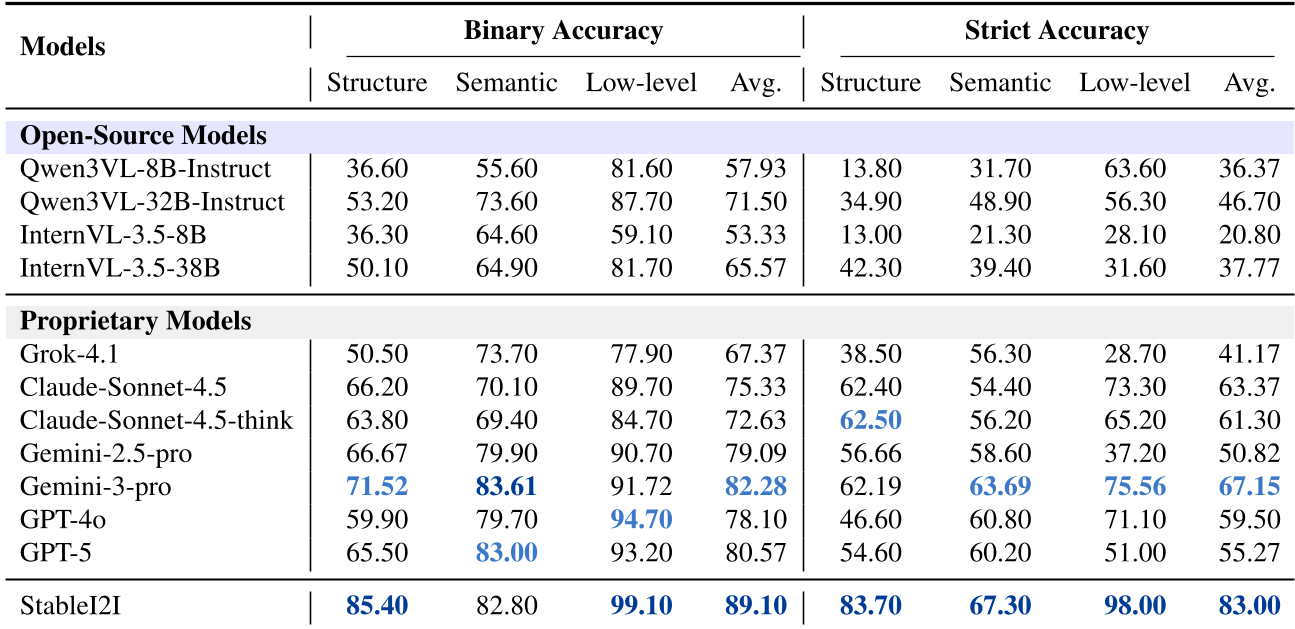 Table: StableI2I outperforms mainstream proprietary models on the StableI2I-Bench.
One of the most revealing findings was the "Template Sensitivity" experiment. While general MLLMs rely heavily on complex, information-rich prompts to make correct judgments, StableI2I remains robust even with minimal instruction, proving that its consistency-detection capability is "hard-coded" into its weights.
Deep Insights: The "Repainting" Epidemic
In their analysis of existing SOTA models like Flux.1-dev and GPT-Image-1, the authors found a startling trend: these models have extremely low Structure Level scores. They tend to discard the original structural layout and regenerate the image from scratch.
StableI2I provides a "Thinking" process that makes its judgments interpretable. Instead of a simple "Yes/No," it identifies why a transition failed—e.g., "The shelf with the teapot disappeared," or "The background was replaced with a neutral outdoor scene."
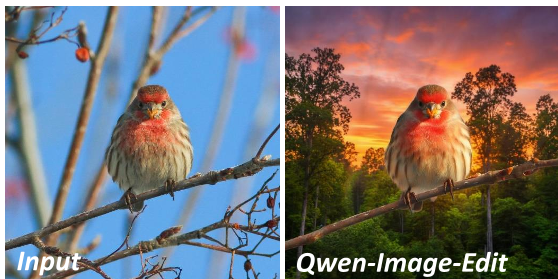 Figure: Qualitative examples of the model's "think" and "problem" output format.
Conclusion & Future Impact
StableI2I represents a shift toward responsible AI generation. By providing a tool that prioritizes fidelity over flashiness, the authors have created a framework that could lead to more reliable image editing tools for professionals.
However, limitations remain: tasks like "style transfer" are still tricky, as the model may flag a legitimate stylistic change as "repainting." Future work will likely focus on better distinguishing between "intentional artistic drift" and "unintentional information loss."
Author Analysis: This work is a crucial "sanity check" for the generative AI field. As models become more "creative," we desperately need specialized observers that are grounded in the physical reality of the source image. StableI2I is the first major step in that direction.