
STARFlow2: Establishing Normalizing Flows as the Foundation for Unified Multimodal AI
STARFlow2: Bridging Language Models and Normalizing Flows for Unified Multimodal Generation
STARFlow2 introduces a unified multimodal framework that bridges Large Language Models (LLMs) and Normalizing Flows via the "Pretzel" architecture. It achieves high-fidelity image generation and multimodal understanding by treating both as a single-pass, autoregressive process under a unified causal Transformer mechanism.
TL;DR
STARFlow2 solves the "structural fragmentation" of multimodal models. While most models either use lossy discrete tokens or clunky diffusion-LLM hybrids, STARFlow2 uses Autoregressive Normalizing Flows to generate continuous visuals. By employing the Pretzel architecture, it vertically stacks a frozen VLM with a flow-based generator, achieving high-fidelity image synthesis and deep understanding within a single causal KV-cache framework.
The "Unification" Dilemma: Why Hybrid Models Fail
The quest for General Purpose AI requires models that can seamlessly "think" in text and "visualize" in images. However, current "unified" models suffer from three main violations:
- Fidelity Loss: Discrete tokenization (masking images as "words") targets quantization rather than the continuous nature of pixels.
- Architectural Asymmetry: Diffusion models require iterative denoising, making them incompatible with the fast, single-pass causal decoding used by LLMs.
- Catastrophic Forgetting: Fine-tuning a Vision-Language Model (VLM) for generation often "erazes" its hard-won reasoning capabilities.
STARFlow2's core insight is that Normalizing Flows are Autoregressive Transformers. They share the same mask, the same KV-cache, and the same left-to-right logic as LLMs. The only difference is the output: instead of a word logit, it predicts the parameters for a continuous latent transform.
Methodology: The Pretzel Architecture
To satisfy the need for both stable reasoning and creative generation, the authors developed Pretzel. It vertically interleaves two streams:
- The VLM Stream: A frozen Qwen2.5-VL-7B that provides the "brain" for understanding.
- The TARFlow Stream: A 24-layer Transformer that predicts affine transformations for continuous latents.
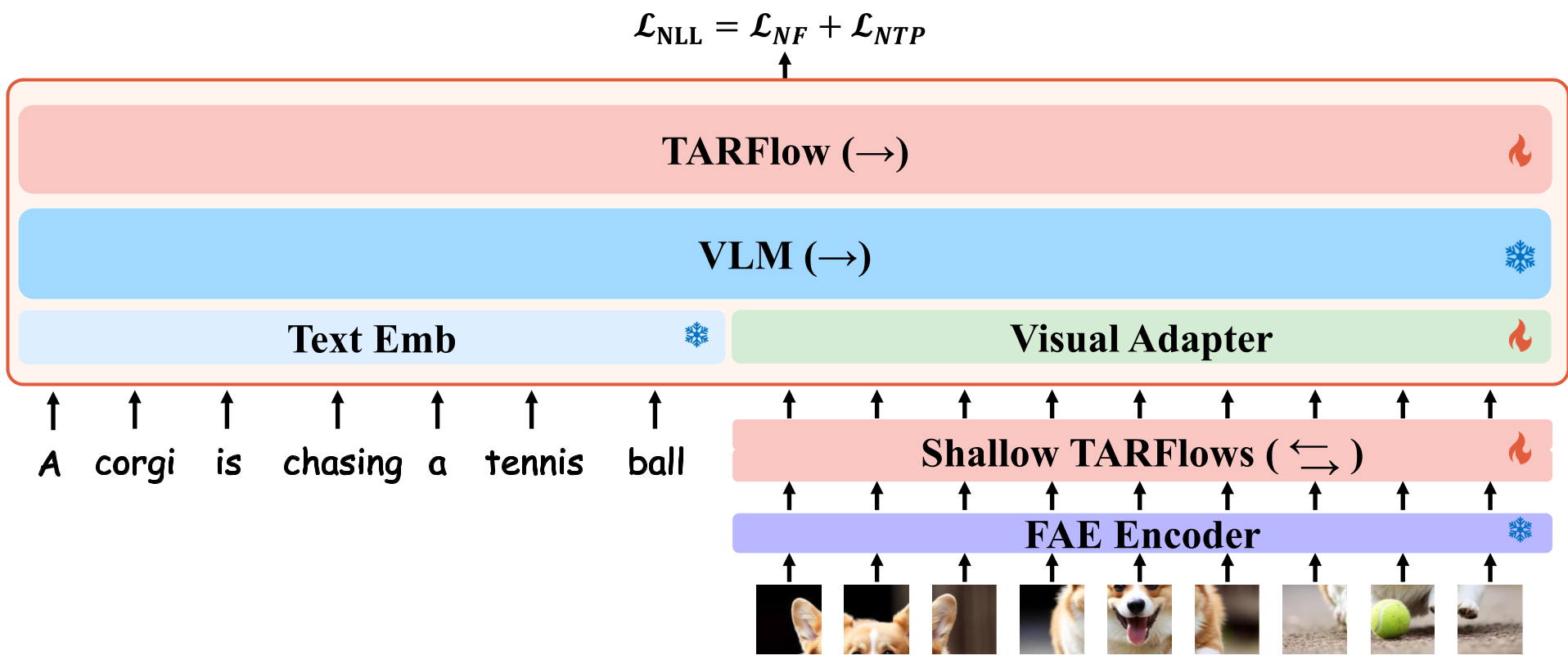
The vertical skip connections (the "crossing" of the pretzel) allow the VLM to inform the generator at every layer, while the generator provides "multimodal corrections" to the text stream. Unlike "horizontal" Mixture-of-Transformers (MoT) which routes tokens to specific experts, Pretzel allows both streams to attend to all tokens simultaneously.
Deep-Shallow Factorization
Visual data has intense local spatial correlation. STARFlow2 uses a Deep-Shallow design:
- Deep Flow: Captures global structure and cross-modal context.
- Shallow Flow: Acts as a "refiner" to handle local pixel-level complexity.
Experiments: Performance without Compromise
The training follows a 3-stage pipeline: 1) Generation pre-training, 2) Alignment for understanding, and 3) Joint "Interleaved" fine-tuning.
Quantitative SOTA
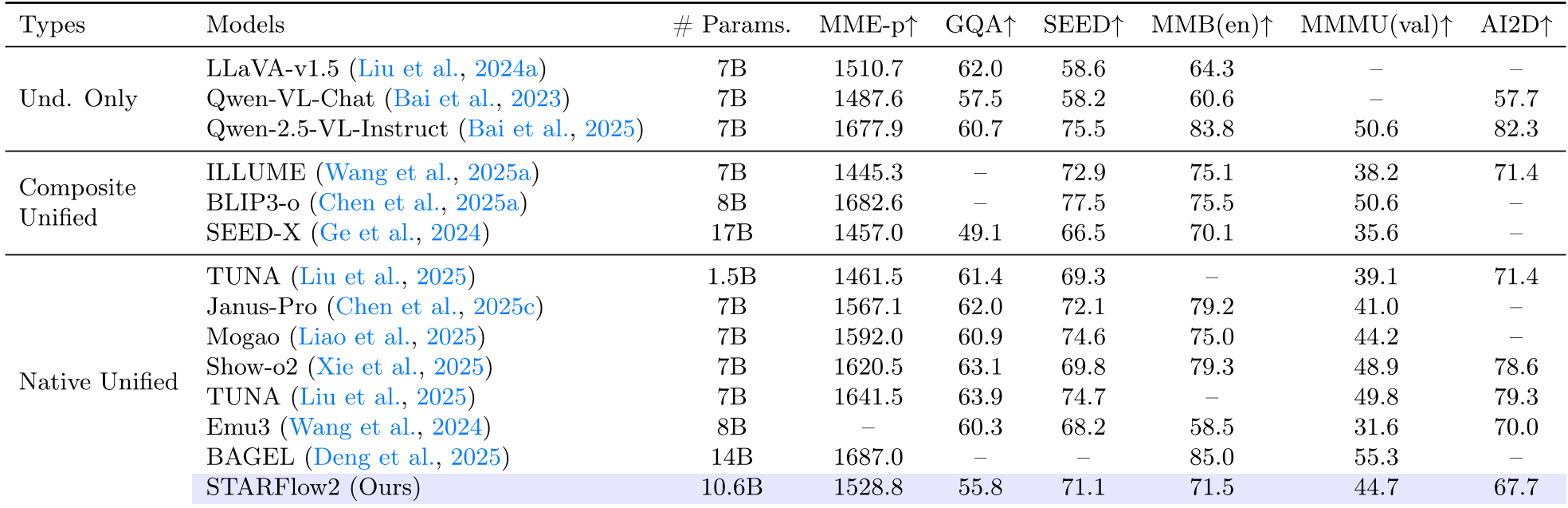
STARFlow2 holds its ground against specialized models. On GenEval (a benchmark for instruction following in images), it matches FLUX.1 [dev] at 0.82, a remarkable feat for a unified model. Crucially, it does not sacrifice understanding; its MME-P scores remain competitive with "Understanding-only" models.
Visual Quality
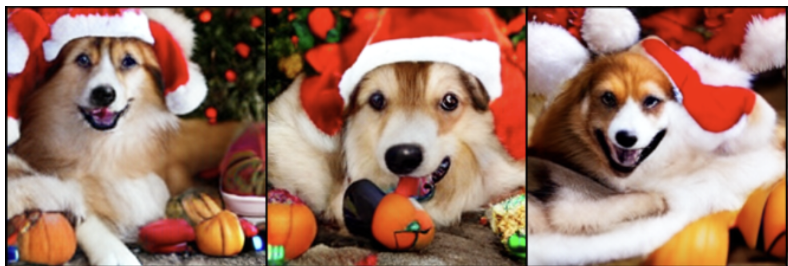
As seen in the qualitative results, STARFlow2 generates complex scenes with high spatial accuracy and handles "interleaved" tasks—such as generating an image based on a conversation and then editing it—fluidly.
Deep Insight: Pretzel vs. Bagel (MoT)
The paper provides a critical analysis of why their vertical approach beats the popular horizontal Mixture-of-Transformers (like the BAGEL model). In MoT, freezing the VLM leads to poor generation because the flow can't "see" enough VLM context. If you unfreeze it, the VLM forgets how to reason. Pretzel's vertical skip connections provide the "best of both worlds"—rich conditioning from the VLM without disturbing its internal weights.
Conclusion and Future Outlook
STARFlow2 is a blueprint for the next generation of multimodal models. By proving that autoregressive flows can match diffusion quality while fitting perfectly into the LLM's causal structure, it paves the way for truly "native" multimodal agents.
The main limitation currently lies in the resolution (256x256), constrained by the FAE latent space. Future iterations scaling to higher resolutions and using pixel-level embeddings could potentially make diffusion models obsolete in the unified AI landscape.
Takeaway: The "Next Gaussian Prediction" (NGP) of flows is the continuous twin of the LLM's "Next Token Prediction." Unifying them is not just an architectural choice; it's a mathematical necessity for seamless AI.