
SLQ: Bridging the Gap Between Efficient and Lossless LLM Quantization
Statistically-Lossless Quantization of Large Language Models
The paper introduces SLQ (Statistically-Lossless Quantization), a framework for near-lossless LLM weight compression that achieves significant speedups (1.7–3.6×) with state-of-the-art accuracy. It defines two rigorous tiers of losslessness—Task-Lossless (TL) and Distribution-Lossless (DL)—and achieves SOTA results using a layer-wise non-uniform scalar quantization pipeline.
TL;DR
Quantization is usually a "pick your poison" scenario: choose lossy methods (GPTQ/AWQ) for 4-bit speed but lose accuracy, or lossless methods that save disk space but don't speed up inference. SLQ (Statistically-Lossless Quantization) breaks this dichotomy. By redefining "lossless" through a statistical lens, SLQ achieves preservation of the original model's output distribution at ~5-6 bits and benchmark accuracy at ~3.3 bits, all while delivering up to 3.6x throughput gains over BF16.
The Motivation: When is a Model Truly "Lossless"?
Most LLMs are deployed with stochastic sampling (temperature > 0). This means the model's output already has a natural variance. The authors argue that if a quantized model stays within this "natural noise floor," it is, for all practical purposes, lossless.
They categorize this into two levels:
- Task-Lossless (TL): Preserves zero-shot benchmark scores.
- Distribution-Lossless (DL): The stricter standard. The quantized model's next-token probability distribution must be indistinguishable from the original.
Methodology: The Math of Asymmetry
One of the paper's most elegant contributions is the Gamma-Squared Variance Law.
The authors prove that for skewed weight distributions (common in LLMs), symmetric quantization is mathematically inefficient. If the centering inefficiency (skewness) is , symmetric quantization inflates the noise variance by compared to asymmetric quantization.
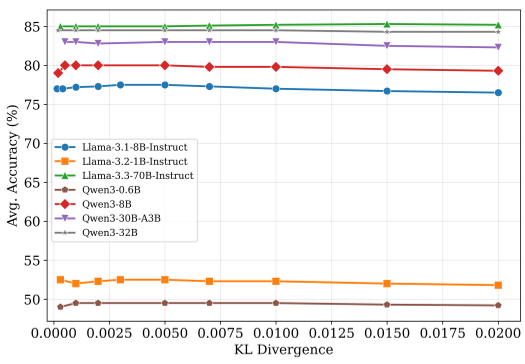
This insight leads to a core design choice: asymmetric quantization is non-negotiable for high-fidelity models. Symmetric grids waste representational capacity on "empty space," leading to significantly more token flips.
The SLQ Pipeline
To achieve these results, SLQ uses:
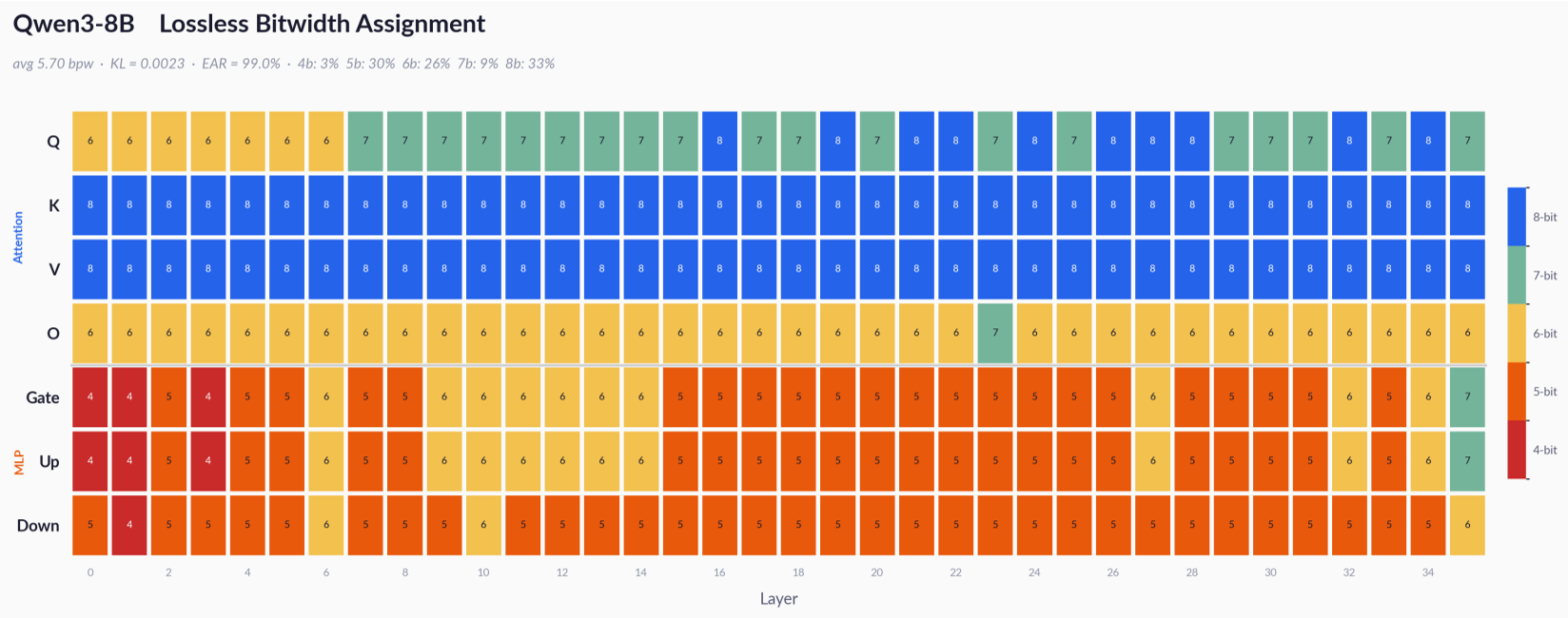
- Multi-Bitwidth Shapley Estimation: A game-theoretic approach to determine which layers (like Attention K/V) are most sensitive and need higher precision (e.g., 8-bit), while MLC layers can be squeezed further.
- Expected Acceptance Rate (EAR): A new metric derived from speculative decoding that measures the shared probability mass between the original and quantized model.
Experiments & SOTA Results
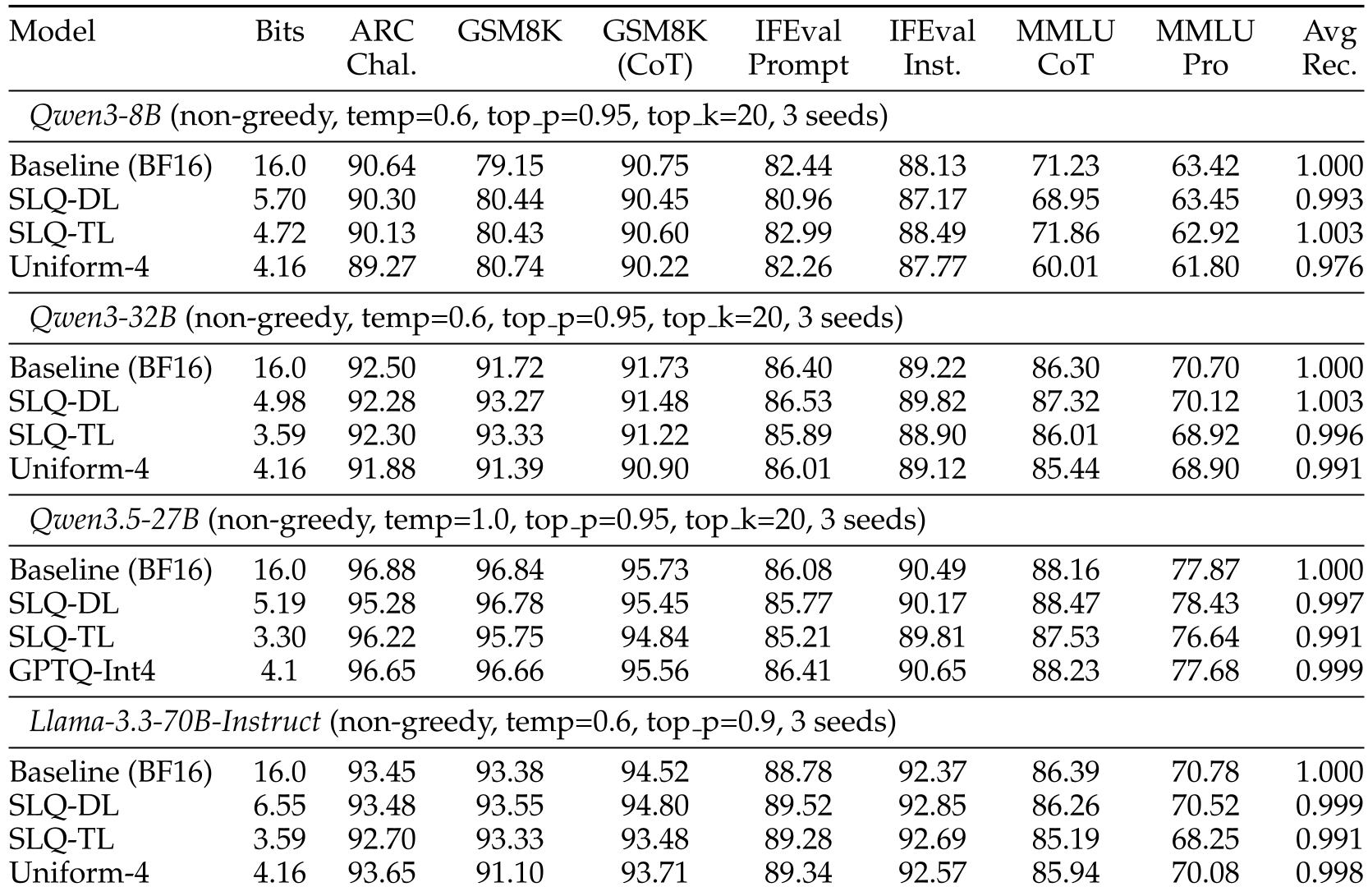
The results across Qwen and Llama models are striking. By using non-uniform bitwidths (searching across {2, 3, 4, 5, 6, 7, 8}), SLQ finds the "sweet spot" that uniform quantization misses.
- Fidelity: On Llama-3.3-70B, SLQ-DL matches the original distribution with over 99% agreement at 6.55 bpp.
- Aggressive Compression: For task-level preservation, Qwen3.5-27B was compressed to 3.30 bpp while maintaining >99% recovery of its BF16 accuracy.
- Inference Speed: Using optimized Humming kernels, SLQ-DL is not just faster than BF16, but even outpaces FP8 inference because it reduces the number of GPUs required (e.g., fitting Qwen-32B on 1 GPU instead of 2).
Critical Analysis & Conclusion
The real value of SLQ lies in its principled approach to sensitivity. Instead of treating every layer equally, it recognizes that LLMs are heterogeneous. By proving the high cost of symmetric grids and providing an interpretable metric like EAR, the authors have provided a roadmap for "production-grade" quantization.
Limitations: While SLQ dominates in weight-only quantization, the paper notes that weight+activation (W+A) quantization is significantly harder, requiring ~1-1.5 additional bits per parameter to maintain the same fidelity.
Takeaway: If you are deploying LLMs in production, the transition from fixed 4-bit quantization to statistically-guided asymmetric non-uniform precision is likely the next major frontier for efficiency.