
Steer Like the LLM: Closing the Gap Between Prompting and Activation Steering
Steer Like the LLM: Activation Steering that Mimics Prompting
The paper introduces Prompt Steering Replacement (PSR), a novel activation steering framework that mimics the internal mechanics of prompt-based steering. By distilling the activation changes induced by successful prompts into simpler, token-specific steering models, PSR achieves State-of-the-Art (SOTA) performance across multiple benchmarks, including AxBench and Persona Steering.
TL;DR
Researchers have long sought to control LLM behavior through "activation steering"—direct surgical interventions in the model's hidden states—as a more robust alternative to prompting. However, steering has historically underperformed compared to simple prompts. This paper introduces Prompt Steering Replacement (PSR), a method that learns to mimic how a prompt changes a model's internal activations. By replacing uniform interventions with token-specific, dynamic coefficients, PSR matches or exceeds prompt-level performance.
The Problem: The "Uniformity" Fallacy
In the current literature, most steering methods assume that if you want a model to be "humorous," you should add a "humor vector" to every single token in the sequence.
The authors of this paper prove this assumption is fundamentally flawed. By analyzing the "ground truth" of prompt steering (i.e., comparing the activations of a model with and without a steering prompt), they discovered that prompt steering is highly non-uniform. Large language models naturally apply massive interventions on specific tokens (like punctuation or key verbs) while practically ignoring others.
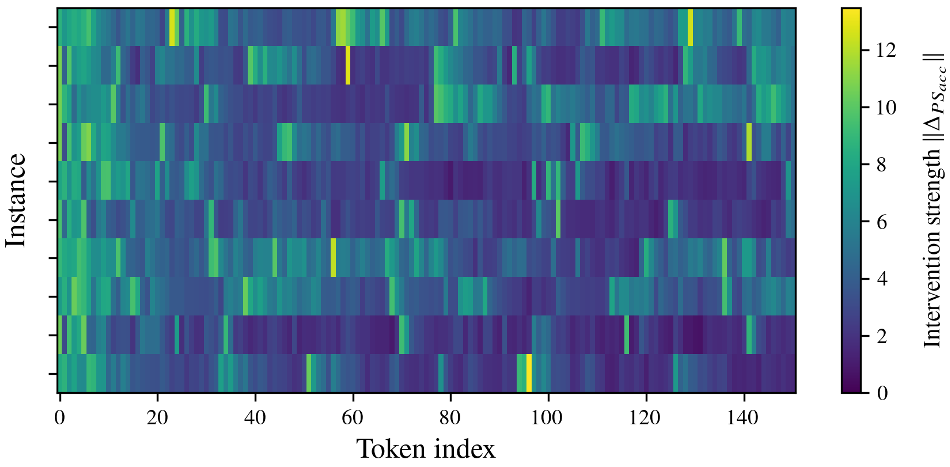 Figure: The strength of prompt steering varies wildly across token positions, a reality current constant-steering methods ignore.
Methodology: Distilling the Prompt's "Secret Sauce"
The core insight of PSR is to relax the "Constant Magnitude" assumption. Instead of a fixed coefficient, PSR uses a small trainable probe to look at the current token's activation and decide: "How much steering does this specific token need?"
The Formalism
Standard steering is defined as:
PSR replaces this with a dynamic function :
Where is a ReLU-activated probe that learns the "importance" of the current token relative to the target attribute.
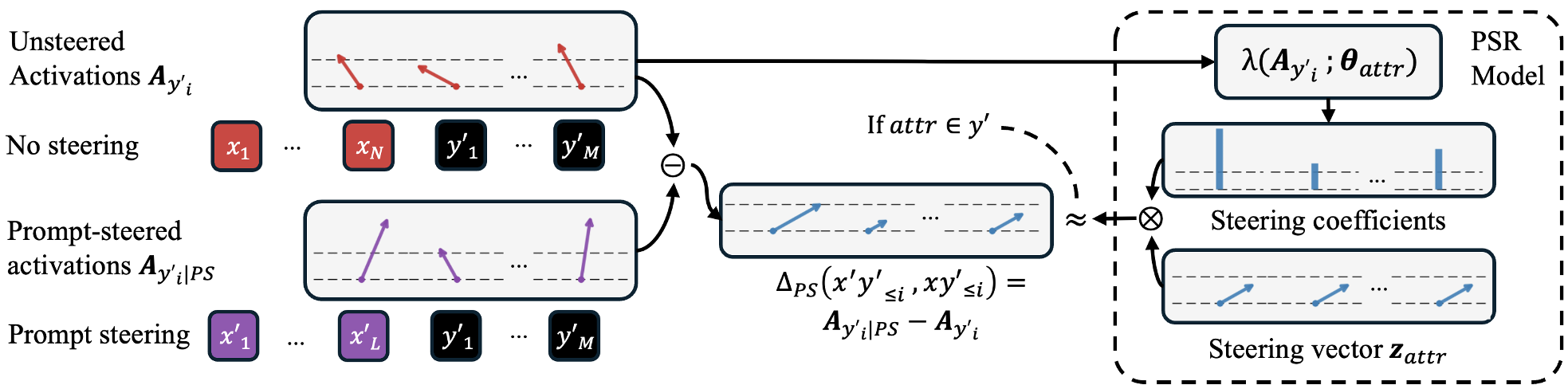 Figure: The PSR framework distills successful prompt steering behavior into an interpretable activation steering module.
Experiments & Results: Surpassing the Prompt
The authors tested PSR across Persona Steering, Instruction Following (IFEval), and the extensive AxBench suite.
- Faithfulness: A-PSR (the multi-layer version) achieved a significantly lower Root Mean Squared Error (RMSE) compared to the actual prompt-steered activations than any other method.
- Performance: On Persona Vectors, PSR consistently outperformed existing SOTA baselines (like CAA or ITI). Most impressively, on AxBench (Gemma-2-9B), PSR achieved a higher overall steering score than even the gold-standard prompts.
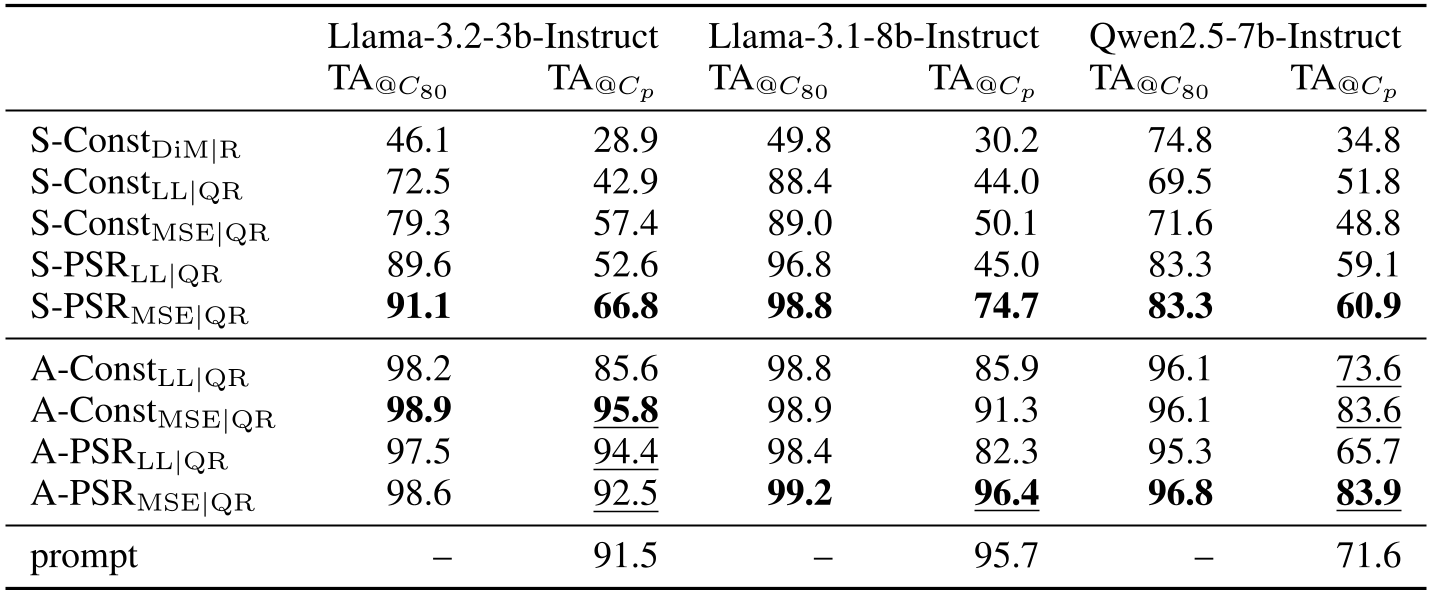 Table: PSR methods (S-PSR and A-PSR) showing superior Trait Alignment at specific coherence levels compared to constant steering.
Critical Insight: Why Does This Work?
Why does knowing "where" to steer matter so much? The authors found that prompt steering effectively targets "branching points"—tokens where the probability distribution is about to shift significantly toward the target trait. By mimicking this selective pressure, PSR avoids "oversteering" (the tendency of activation steering to degrade the model's general coherence by pushing it too hard into an unfaithful regime).
Limitations & Future Work
While PSR is a major step forward, the study notes that for extremely complex, multi-faceted instructions (like those in IFEval requiring specific formatting constraints), a simple rank-1 vector is still not expressive enough. Future research likely needs to combine PSR's dynamic coefficients with higher-rank updates or LoRA-like adapters to capture the full complexity of human instructions.
Conclusion
The discovery that we can "Steer Like the LLM" by simply watching how it reacts to prompts opens a new chapter in model alignment. It suggests that the model already knows how to align itself; our job is simply to find the right "surgical" coefficients to trigger that internal mechanism without the overhead (and vulnerability) of an external prompt.