
Towards Steering without Sacrifice: The Rise of Surgical Prompt-Only Interventions
Towards Steering without Sacrifice: Principled Training of Steering Vectors for Prompt-only Interventions
This paper introduces PrOSV (Prompt-Only Steering Vector) and a principled joint training scheme for steering vectors in Large Language Models. It achieves SOTA performance on the AXBENCH benchmark for concept-based steering by intervening on as few as four prompt tokens during the prefill stage.
Executive Summary
TL;DR: Researchers have developed a way to control Large Language Model (LLM) behavior—like forcing it to talk about the Golden Gate Bridge or use programming terms—by modifying just four tokens in the prompt's internal representation. By moving away from "Full-Sequence" steering to a new method called PrOSV (Prompt-Only Steering Vector) and using a principled training scheme based on scaling theory, they've managed to steer models without the typical "sacrifice" in reasoning ability or speed.
Background Positioning: This work bridges the gap between Mechanistic Interpretability and Controllable Generation. It transitions steering vectors from heuristic-heavy experimental hacks to a theoretically grounded engineering discipline, outperforming current SOTA methods like ReFT on the AXBENCH scale.
The Pain Point: The "Steering Tax"
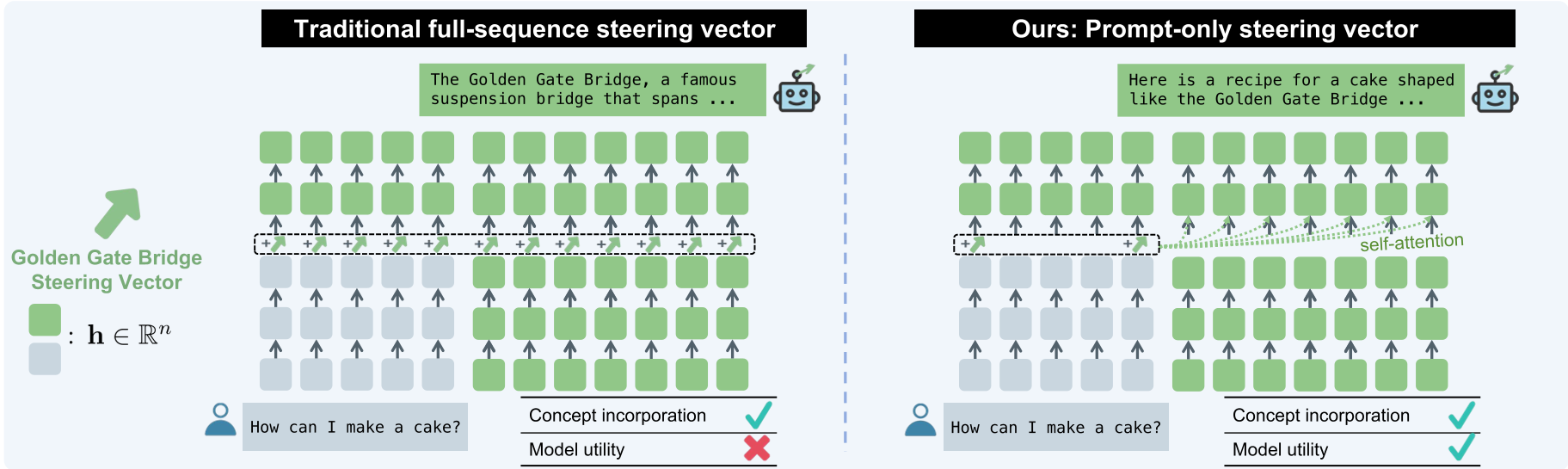
Contemporary representation steering often feels like using a sledgehammer to fix a watch. Existing Full-Sequence Steering Vectors (FSSVs) add a constant vector to model representations at every single step of the generation process. This leads to two major issues:
- Utility Collapse: Intervening on every token often "breaks" the model's brain, causing it to fail at math or logic even if it successfully follows the steering concept.
- The Hyperparameter Nightmare: Users usually have to manually guess a "steering factor" (strength) for every single concept, a process that is brittle and unscalable.
Methodology: Neural scaling and Surgical Precision
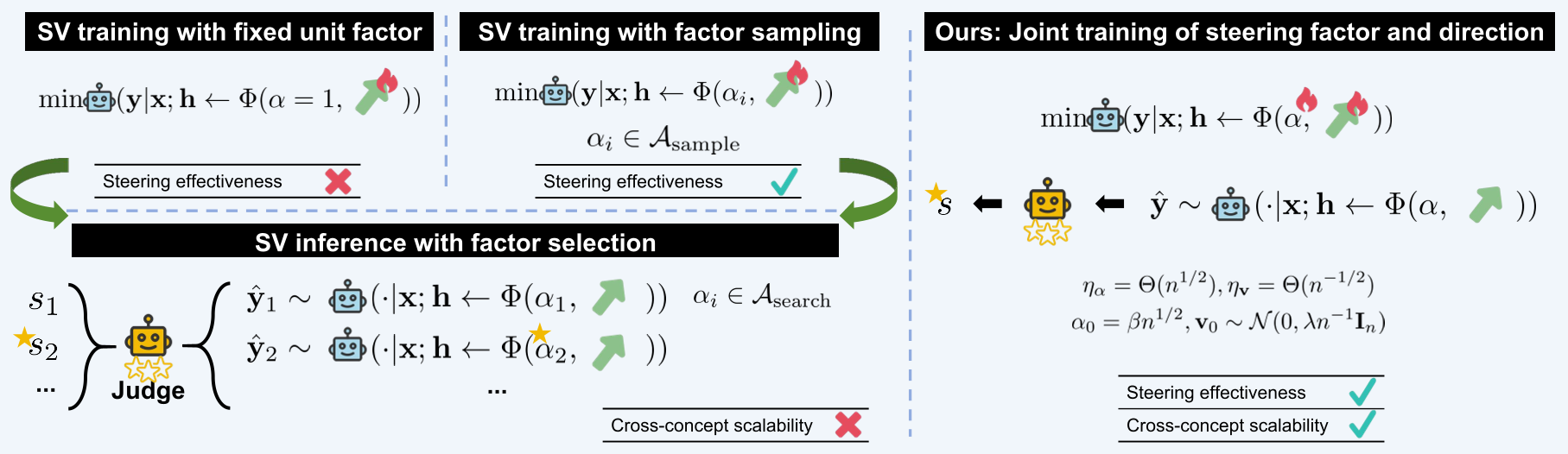
1. Joint Training via Scaling Theory
Instead of picking steering factors by hand at inference time, the authors propose a joint training scheme. They use Neural Network Scaling Theory to derive how the learning rate and initialization should look as the model width grows to infinity.
The core insight is a balance of power: if the steering direction learns faster, the factor must learn proportionally slower ().
2. PrOSV: Steering through the KV Cache
PrOSV's "secret sauce" is its location. It doesn't touch the generated tokens. Instead, it intervenes on a few tokens at the prefill stage (the prompt).
By modifying the prompt's representation, it effectively "bakes" the steering into the KV Cache. When the model starts generating, its attention mechanism naturally picks up the "vibe" from the modified prompt tokens without having its internal logic constantly shifted by an external vector at every step.
Experiments & Results: Efficiency meets Power
The authors tested PrOSV across models like Gemma2 (2B/9B) and Qwen2.5-32B.
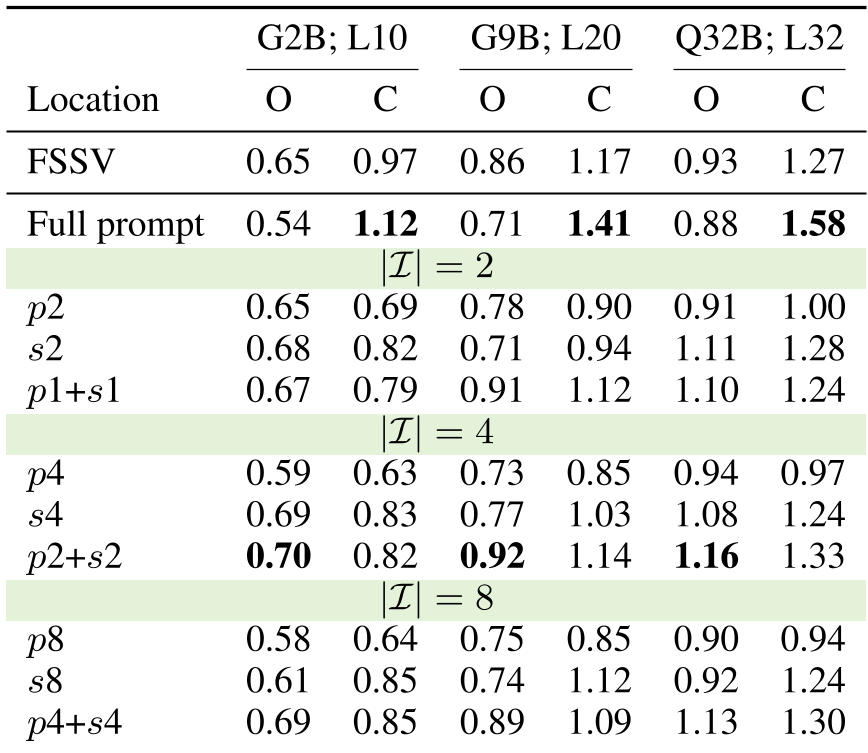
- The Sweet Spot: Surprisingly, intervening on just 4 tokens (2 at the start, 2 at the end of the prompt) was the most effective configuration ().
- Utility Preservation: On the tinyGSM8K arithmetic benchmark, FSSVs caused the model's accuracy to plummet to near zero. PrOSV maintained a much higher accuracy, proving you can steer a model without making it "stupid."
- Speed: Because it only happens once during the prompt prefill, PrOSV is 37x more computationally efficient than sequence-wide steering.
Deep Insight: Why does it work?
The researchers analyzed the Attention Maps. FSSVs tend to destroy the model's attention patterns, forcing it to obsessively attend to the BOS (beginning of sentence) token and ignore the actual context. PrOSV, by contrast, keeps the attention maps clean, which is why the model's reasoning capabilities stay intact.
Conclusion & Takeaways
This paper proves that "less is more" in model steering. By using theoretical scaling laws to stabilize training and focusing interventions on the prompt prefill:
- We can eliminate tedious hyperparameter search.
- We can maintain model intelligence (reasoning) while changing behavior.
- We can achieve massive inference speedups.
Limitations: While PrOSV is excellent for content concepts, it struggles slightly more than FSSV in maintaining steering over extremely long contexts (thousands of tokens) in smaller models. However, in larger models like Qwen-32B, this gap disappears, suggesting that model scale is the final piece of the puzzle for robust, surgical control.